Novel Elastase-Papain Model for Induction of Infrarenal Abdominal Aortic Aneurysm Rupture in Mice
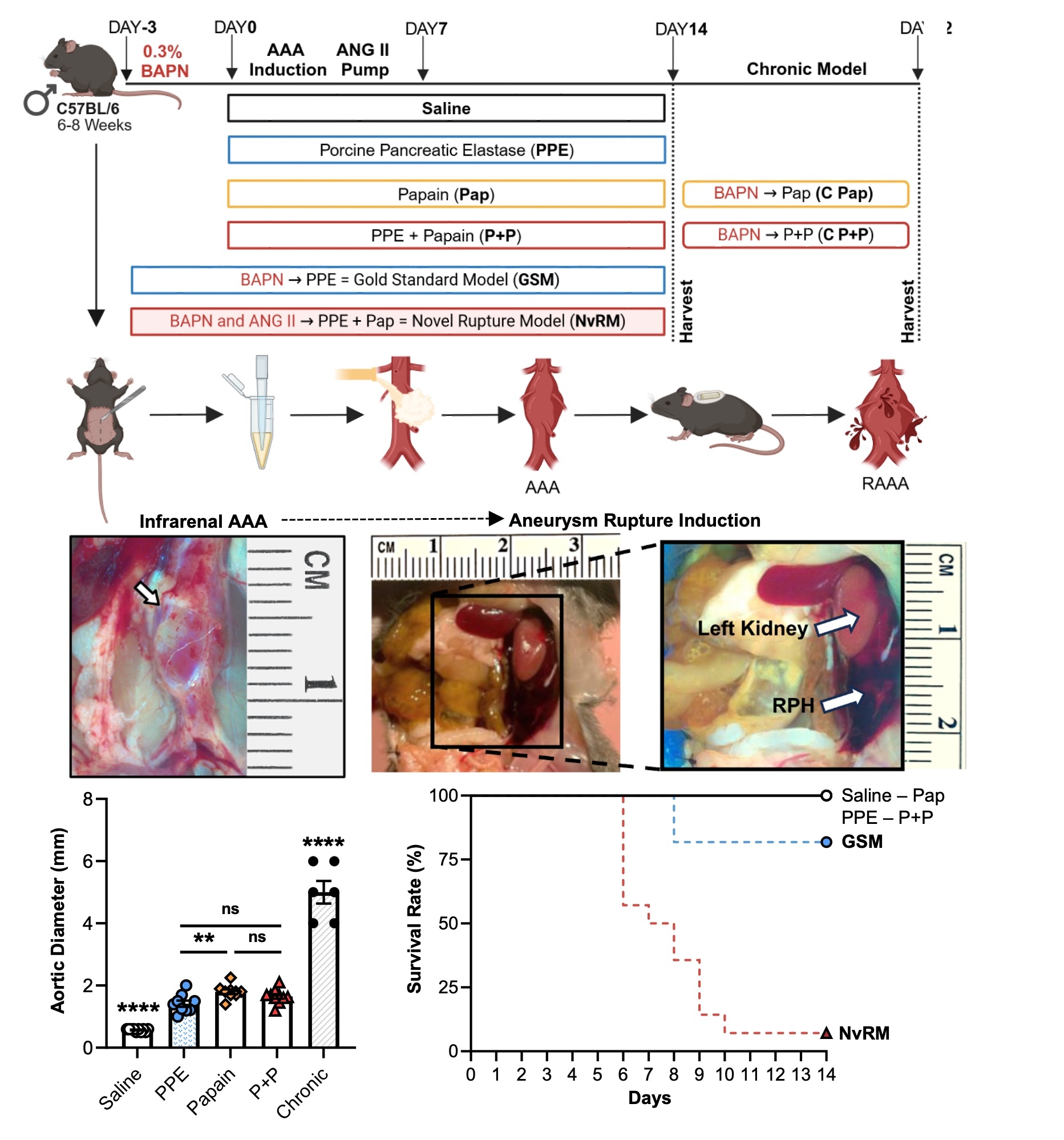
Abstract Body: Intro Abdominal aortic aneurysm (AAA) rupture is associated with high morbidity and mortality. Numerous rodent models attempt to recapitulate AAA pathophysiology to support research efforts for a preventive cure. However, no existing murine model reliably mimics infrarenal AAA rupture in mice. Compounds such as porcine pancreatic elastase (PPE), papain (Pap), β-aminopropionitrile (BAPN), and angiotensin II (ANG II) have been shown to induce AAA formation in rodents. We evaluated whether combining these agents in unique configurations can capitulate AAA rupture that model human disease. Methods 86 male C57BL/6 mice underwent topical periadventitial aortic exposure 50µL of either saline, PPE, Pap, or a combination of PPE+Pap (P+P) for 20 minutes to induce AAA degeneration. Additionally, to assess AAA rupture, a subset of mice received 0.3% BAPN via drinking water and further exposed to either PPE, replicating current gold standard model (GSM) or PPE+Pap and ANG II subcutaneous pump, a novel rupture model (NvRM, Fig.1). Mice that died spontaneously were promptly assessed to confirm AAA rupture. Surviving animals underwent in vivo aortic size measurements, and aortic tissue was harvested at weeks 1, 2, or 6 for analysis. Results At week 2, the Pap and P+P groups exhibited increased aortic diameters compared to the PPE alone and saline groups (Fig.1). Further analysis showed increased elastase and collagen degradation and matrix metalloproteinase (MMP) activity. Co-administration of 0.3% BAPN further augmented AAA diameter in the chronic 6-week model, demonstrating consistent aneurysm dilation and confirming the safety and efficacy of our combination approach (Fig.1). In the NvRM model, mice treated with PPE+Pap+0.3% BAPN and an ANG II subcutaneous pump developed significantly larger infrarenal AAAs, with a 93% rupture rate, substantially higher than the GSM model (Fig.1). Additionally, NvRM AAAs demonstrated increased inflammation, evidenced by upregulation of IL-1β, IL-6, and MCP-1, increased elastin degradation and MMP2 and 9 activation. Conclusions We present a novel murine model that provides a high rate of infrarenal AAA formation and rupture. The model not only combines matrix degradation, but also systemic impulse risk factors known to portend AAA rupture in humans. The feasibility and reliability of the model facilitates its use in future murine genetic and pharmacological studies that seek to better understand AAA pathophysiology and methods of prevention.
Elizondo Benedetto, Santiago
(
, Saint Louis , Missouri , United States )
Zaghloul, Mohamed
(
Washington University in St. Louis
, St louis , Missouri , United States )
Arif, Batool
(
Washington University School of Med
, St. Louis , Missouri , United States )
Zayed, Mohamed
(
WASHINGTON UNIVERSITY SCHOOL M
, Saint Louis , Missouri , United States )
Author Disclosures:
Santiago Elizondo Benedetto:DO NOT have relevant financial relationships
| Mohamed Zaghloul:No Answer
| Batool Arif:No Answer
| Mohamed Zayed:No Answer