
Logo

American Heart Association

  43
  0


Final ID: WP302

Colchicine After Non-Cardioembolic Acute Ischemic Stroke or Transient Ischemic Attack: A Meta-Analysis of Randomized Controlled Trials

Abstract Body: Introduction: Colchicine, an anti-inflammatory medication, has demonstrated significant benefits in reducing inflammation and decreasing subsequent vascular events in patients with acute coronary syndrome and myocardial infarction (MI). This has prompted interest in its potential role in secondary prevention of vascular events in individuals who have experienced a stroke or transient ischemic attack (TIA). This abstract explores the evidence supporting colchicine's efficacy and safety in this context.
Methods: We searched PubMed, Cochrane, and Embase databases for randomized controlled trials investigating the effect of colchicine in patients who experienced stroke or TIA of non-cardioembolic origin. Our primary outcomes were any new vascular event (a composite of stroke, TIA, MI, or vascular death) or ischemic stroke. We also assessed the incidence of relevant side effects. Risk ratios (RR) and hazard ratios (HR) with 95% confidence intervals (CI) were pooled using a random-effects model.
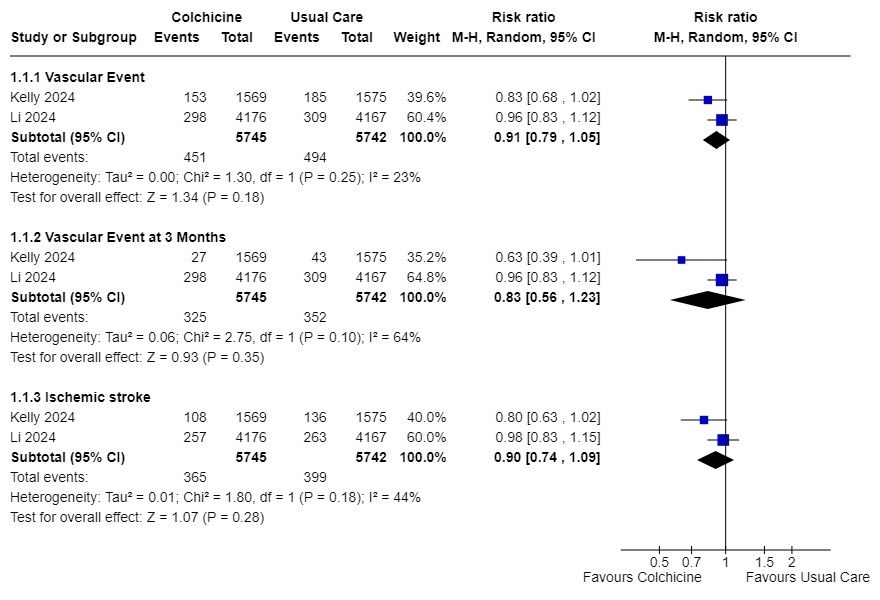
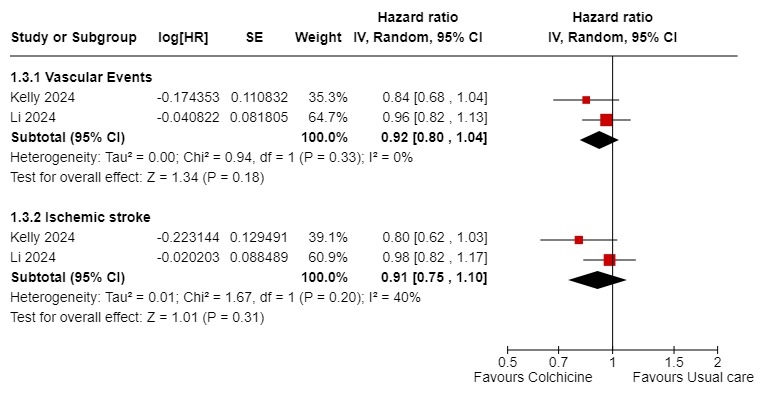
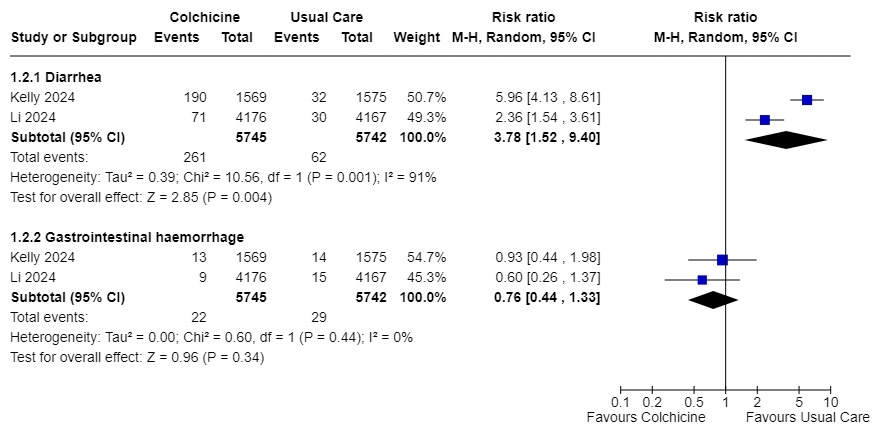
Results: Two studies were included with a total of 11,487 patients. Colchicine did not reduce vascular events after ischemic stroke or TIA both in long term (RR 0.91; 95% CI 0.79 to 1.05; p = 0.18; I2= 23%) (HR 0.92; 95% CI 0.80 to 1.04; p = 0.18; I2= 0%) and short term (RR 0.83; 95% CI 0.56 to 1.23; p = 0.35; I2= 64%) compared with placebo. There was also no significant advantage in the reduction of recurrence of ischemic stroke in the colchicine group (RR 0.90; 95% CI 0.74 to 1.09; p = 0.28; I2= 44%) (HR 0.91; 95% CI 0.75 to 1.10; p = 0.31; I2= 40%). There were no unforeseen side effects in the Colchicine group (RR 3.78; 95% CI 1.52 to 9.40; p= 0.001; I2= 91%).
Conclusion: Colchicine did not prevent recurrent vascular events or ischemic strokes in patients after a non-cardioembolic stroke or TIA in a large sample size of greater than 11,000 patients. Further well-designed randomized controlled trials are needed to conclusively determine its efficacy and safety in this context. Nevertheless, the early data does not seem to indicate that it will provide benefit to this target population.
  • Salha, Issa  ( Trinity College Dublin , Ramallah , Palestine, State of )
  • Rizwan Ahmed, Aisha  ( Jinnah Medical and Dental College , Karachi , Sindh , Pakistan )
  • Koppanatham, Aishwarya  ( Andhra Medical College , Visakhapatnam , India )
  • Punukollu, Anuraag  ( Andhra Medical College , Visakhapatnam , India )
  • Varkey, Thomas  ( University of Arizona School of Medicine Phoenix , Phoenix , Arizona , United States )
  • Author Disclosures:
    Issa Salha: DO NOT have relevant financial relationships | Aisha Rizwan Ahmed: DO NOT have relevant financial relationships | aishwarya koppanatham: DO NOT have relevant financial relationships | Anuraag Punukollu: DO NOT have relevant financial relationships | Thomas Varkey: DO NOT have relevant financial relationships
Meeting Info:
Session Info:

Risk Factors and Prevention Posters I

Wednesday, 02/05/2025 , 07:00PM - 07:30PM

Poster Abstract Session

More abstracts on this topic:
A Novel Imaging Biomarker to Make Precise Outcome Predictions for Patients with Acute Ischemic Stroke

Mallavarapu Monica, Kim Hyun Woo, Iyyangar Ananya, Salazar-marioni Sergio, Yoo Albert, Giancardo Luca, Sheth Sunil, Jeevarajan Jerome

A Retrospective Analysis of the Association of Rehab Time on Discharge Disposition and Length of Stay in Hospitalized Patients with Ischemic Stroke or Intracerebral Hemorrhage

Eperjesi Sarah, Yutrzenka Kayla, Marginean Horia, Crawford Erin, Lesko Alexandra, Clark Diane

More abstracts from these authors:
You have to be authorized to contact abstract author. Please, Login
Not Available

Readers' Comments

We encourage you to enter the discussion by posting your comments and questions below.

Presenters will be notified of your post so that they can respond as appropriate.

This discussion platform is provided to foster engagement, and simulate conversation and knowledge sharing.


You have to be authorized to post a comment. Please, Login or Signup.


   Rate this abstract  (Maximum characters: 500)