Sex differences in longitudinal functional, neurological, cognitive, and quality of life outcomes in the year after first-ever ischemic stroke
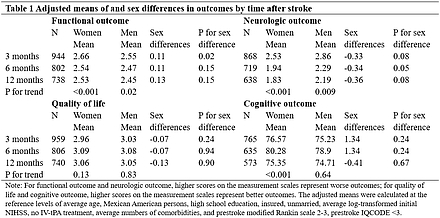
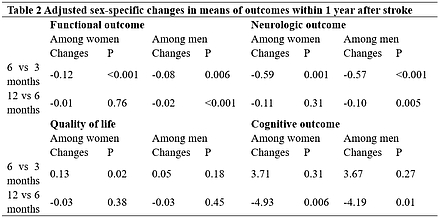
Abstract Body: Background: Given the growing number of stroke survivors in the US, especially among women, understanding contemporary sex-specific trajectories of outcomes after stroke is crucial. Yet, such data are rare. We estimated sex-specific functional, neurological, cognitive, and quality of life outcomes at 3, 6, and 12 months post-stroke in a population-based study. Methods: First-ever ischemic strokes (IS) were ascertained between January 1, 2014 and December 31, 2019 from the Brain Attack Surveillance in Corpus Christi (BASIC) Project in South Texas. Data were collected from medical records and patient or proxy interviews (baseline, 3, 6, and 12 months after stroke). Sex-specific trajectories in functional (activities of daily living/instrumental activities of daily living score, ADL/IADL), neurological (National Institutes of Health Stroke Scale, NIHSS), cognitive (Modified Mini-Mental State Examination), and quality of life (QOL) outcomes (12-domain Stroke-specific Quality of Life scale) were estimated using multivariable-adjusted linear mixed effect models accounting for within-subject correlations. Interactions between sex and time were included to examine sex differences at each time point. Results: Among the 1,440 IS (median age 68, 48.4% women), women had significantly worse functional outcomes (0.11 points higher in ADL/IADL score) but better neurological outcomes (0.33 points lower in NIHSS score) than men at 3 months (Table 1). There were no sex differences in quality of life and cognitive outcomes. Throughout the one year following stroke, functional and neurological outcomes among both sexes improved, primarily driven by the improvement between 3 to 6 months, with small changes in the outcomes on the absolute scale (Table 2). Improvement in quality of life was only seen among women between 3 to 6 months, while worsening of cognitive outcome between 6 to 12 months was seen among both sexes. There were no significant sex differences for all outcomes at 6 or 12 months and no significant interactions between sex and time. Conclusions: Functional and neurological outcomes were at their worst at 3 months after stroke for both sexes and sex differences were small throughout the one-year poststroke, suggesting early assessment and intervention to improve these outcomes in both sex groups. The considerable worsening of cognition after 6 months post-stroke in both sexes suggests that longer-term monitoring of cognitive outcome may be needed.
Chen, Chen
(
University of Michigan
, Ann Arbor , Michigan , United States )
Kwicklis, Madeline
(
University of Michigan
, Ann Arbor , Michigan , United States )
Morgenstern, Lewis
(
UNIV OF MICHIGAN
, Ann Arbor , Michigan , United States )
Lisabeth, Lynda
(
UNIVERSITY MICHIGAN
, Ann Arbor , Michigan , United States )
Author Disclosures:
Chen Chen:DO NOT have relevant financial relationships
| Madeline Kwicklis:DO NOT have relevant financial relationships
| Lewis Morgenstern:DO NOT have relevant financial relationships
| Lynda Lisabeth:DO NOT have relevant financial relationships