Logo

American Heart Association

  54
  0


Final ID: FR460

Association Between Food Insecurity and Hypertension Among Women of Reproductive Age in the SAFE HEART Study

Abstract Body: Background:
Hypertension is a leading contributor to cardiovascular disease among women of reproductive age. Upstream social determinants of health may impact hypertension. Food insecurity, defined as limited or uncertain access to adequate food, may increase the risk of hypertension. Despite this, the relationship between food insecurity and hypertension remains understudied in this population.
Methods:
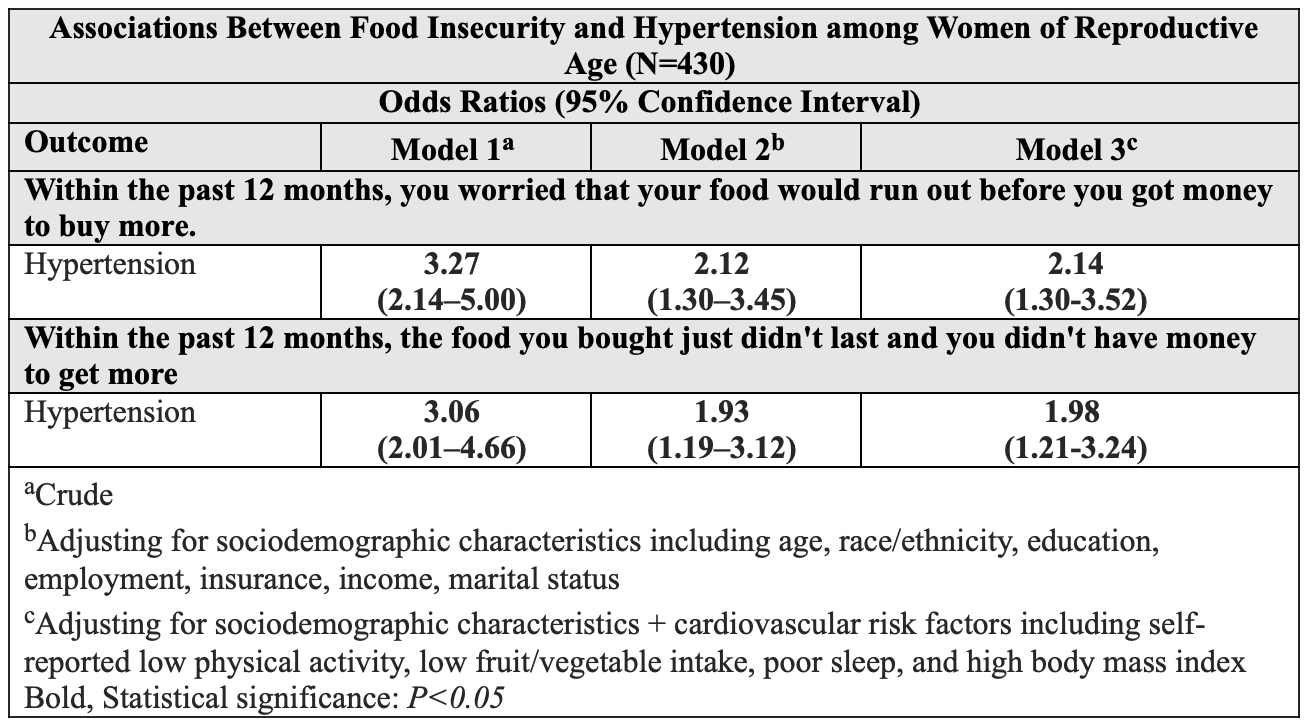
We analyzed cross-sectional data from 430 women aged 18–50 participating in the SAFE HEART Study in Baltimore and Washington, D.C. Food insecurity was assessed using two validated questions reflecting concerns about food running out and food not lasting. Logistic regression models estimated odds ratios (ORs) for hypertension associated with each item across three models: (1) unadjusted, (2) adjusted for sociodemographic factors (age, race/ethnicity, education, employment, insurance, income, marital status), and (3) fully adjusted for cardiovascular risk factors (physical activity, diet, sleep, and BMI).
Results:
Among the 430 participants, the mean age was 30.7 ± 6.8 years; 44.7% identified as Non-Hispanic Black, 28.1% as Hispanic/Other, and 23.0% as Non-Hispanic White. Food insecurity was significantly associated with higher odds of hypertension in crude and adjusted models. Women who worried about food running out had 3.27 times the odds of hypertension (95% CI: 2.14–5.00), which remained significant after sociodemographic adjustment (OR = 2.12; 95% CI: 1.30–3.45), and in fully adjusted models (OR = 2.14; 95% CI: 0.1.30–3.52). Similarly, women who reported food not lasting had higher odds of hypertension (crude OR = 3.06; 95% CI: 2.01–4.66; adjusted OR = 1.93; 95% CI: 1.19–3.12), which remained significant in the fully adjusted model (OR = 1.98; 95% CI: 1.21–3.24).
Conclusion:
Food insecurity was associated with significantly higher odds of hypertension among women of reproductive age, independent of sociodemographic and cardiovascular risk factors. These findings underscore food insecurity as a potential modifiable upstream driver of hypertension risk in this population.
  • Baez Mateo, Ana  ( Johns Hopkins School of Nursing , Baltimore , Maryland , United States )
  • Hladek, Melissa  ( Johns Hopkins University , Ellicott City , Maryland , United States )
  • Sharma, Garima  ( Inova Fairfax Medical Campus , Falls Church , Virginia , United States )
  • Commodore-mensah, Yvonne  ( JOHNS HOPKINS SCHOOL OF NURSIN , Baltimore , Maryland , United States )
  • Metlock, Faith  ( Johns Hopkins University , North Bethesda , Maryland , United States )
  • Hernandez, Lilian  ( Johns Hopkins School of Nursing , Baltimore , Maryland , United States )
  • Ateh Stanislas, Ketum  ( Johns Hopkins School of Nursing , Baltimore , Maryland , United States )
  • Rayani, Asma  ( Johns Hopkins University , Baltimore , Maryland , United States )
  • Dankwa, Kwabena  ( Johns Hopkins University , Baltimore , Maryland , United States )
  • Etelier, Feodora  ( Johns Hopkins University , Baltimore , Maryland , United States )
  • Ezuma, Chioma  ( Howard University , Burtonsville , Maryland , United States )
  • Vaidya, Dhananjay  ( JOHNS HOPKINS UNIVERSITY , Baltimore , Maryland , United States )
  • Ouyang, Pamela  ( JOHNS HOPKINS UNIVERSITY , Towson , Maryland , United States )
  • Author Disclosures:
    Ana Baez Mateo: DO NOT have relevant financial relationships | Melissa Hladek: DO have relevant financial relationships ; Consultant:Fresenius Medical Care:Past (completed) | Garima Sharma: No Answer | Yvonne Commodore-Mensah: No Answer | Faith Metlock: DO NOT have relevant financial relationships | Lilian Hernandez: DO NOT have relevant financial relationships | Ketum Ateh Stanislas: DO NOT have relevant financial relationships | Asma Rayani: DO NOT have relevant financial relationships | Kwabena Dankwa: DO NOT have relevant financial relationships | Feodora Etelier: DO NOT have relevant financial relationships | Chioma Ezuma: DO NOT have relevant financial relationships | Dhananjay Vaidya: DO NOT have relevant financial relationships | Pamela Ouyang: DO NOT have relevant financial relationships
Meeting Info:
Session Info:

Poster Session 2 with Breakfast Reception

Friday, 09/05/2025 , 09:00AM - 10:30AM

Poster Session

More abstracts on this topic:
A Retrospective Analysis of Chronic Kidney Disease and Arrhythmias-Related Mortality Among Adults in the United States (1999-2020): Insights into Disparities by Gender, Race/Ethnicity, and Geography

Waseem Neha, Nouman Zainab, Chaudhry Sohaib Aftab Ahmad, Tariq Waleed, Khan Iftikhar, Shah Mazhar, Farooqi Hanzala Ahmed, Faiz Muneeb

A Measurement Model of Socioeconomic Status and its Association with Cardiovascular Disease in the Hispanic Community Health Study/Study of Latinos

Cordero Christina, Llabre Maria, Romaker Emma, Kobayashi Marissa, Gianola Morgan, Gallo Linda, Isasi Carmen, Perreira Krista, Corsino Leonor, Zhou Laura

More abstracts from these authors:
Joint Associations Between Polysocial and Psychological Risks and Hypertension in Women of Reproductive Age: Findings from the SAFE HEART Study

Metlock Faith, Ouyang Pamela, Hladek Melissa, Sharma Garima, Commodore-mensah Yvonne, Ateh Stanislas Ketum, Rayani Asma, Baez Mateo Ana, Hernandez Lilian, Dankwa Kwabena, Etelier Feodora, Ezuma Chioma, Vaidya Dhananjay

Racial/Ethnic Disparities in Life’s Essential 8 Outcomes Among Women of Reproductive Age in Baltimore and Washington D.C.

Etelier Feodora, Hladek Melissa, Sharma Garima, Commodore-mensah Yvonne, Metlock Faith, Ateh Stanislas Ketum, Rayani Asma, Baez Mateo Ana, Hernandez Lilian, Dankwa Kwabena, Ezuma Chioma, Vaidya Dhananjay, Ouyang Pamela

You have to be authorized to contact abstract author. Please, Login
Not Available