Joint Associations Between Polysocial and Psychological Risks and Hypertension in Women of Reproductive Age: Findings from the SAFE HEART Study
Abstract Body: Background Hypertension is increasingly prevalent among women of reproductive age and contributes significantly to early cardiovascular disease. While social and psychological risks have been independently linked to hypertension, their combined influence remains understudied.
Methods We analyzed cross-sectional data from 430 women aged 18–50 years recruited from a community-based sample as part of the SAFE HEART Study, conducted in Baltimore and Washington, D.C. A three-level risk variable (low, moderate, high) was created using a standardized polysocial risk score and psychological risks (stress, depression, anxiety). The polysocial risk score reflected social disadvantage across domains including socioeconomic stability (education, employment, income, insurance, financial strain), living situation (housing stability, housing quality, marital status, home ownership), food security, transportation, utilities, and interpersonal safety. We used stepwise logistic regression to examine associations with hypertension, adjusting for age, race, sociodemographic, clinical, and behavioral factors. Predictive margins were estimated to examine predicted probabilities of hypertension across risk groups.
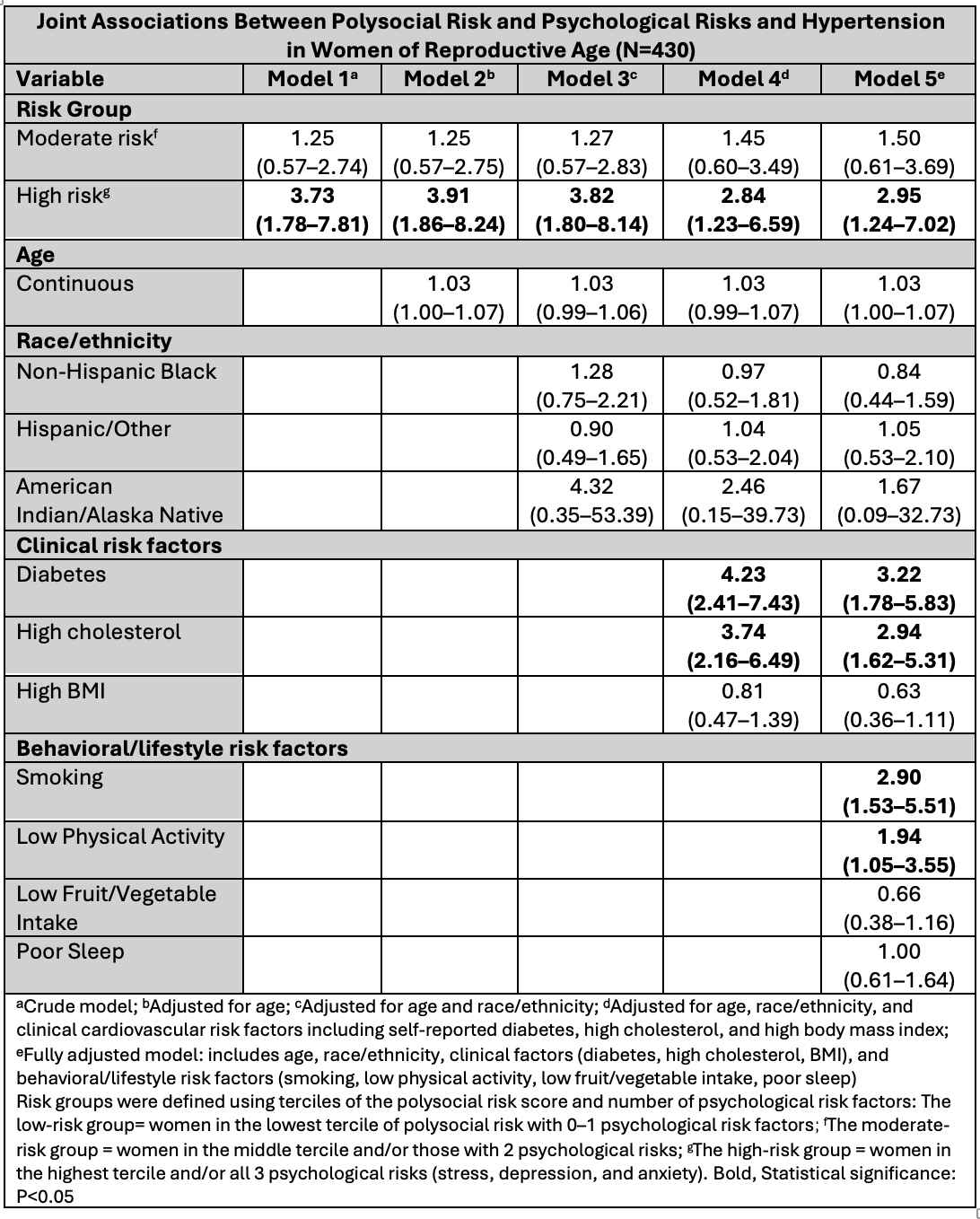
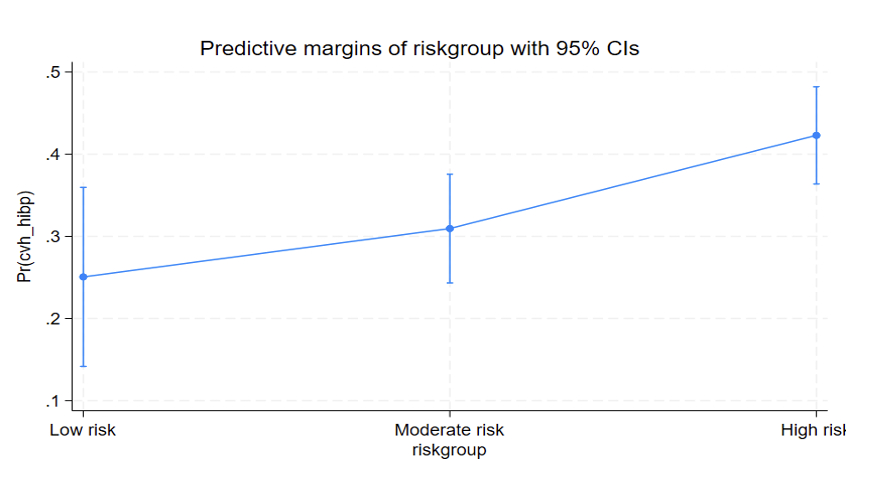
Results The sample had a mean age of 30.7 years and 44.7% were non-Hispanic Black. Over half of participants (51.4%) were classified as high-risk. Hypertension prevalence was highest in the high-risk group (47.1%) compared to moderate (22.9%) and low-risk (19.2%) (p < 0.001). High-risk women had significantly higher odds of hypertension (fully adjusted OR = 2.95, 95% CI: 1.24–7.02). Diabetes (OR = 3.22), high cholesterol (OR = 2.94), smoking (OR = 2.90), and low physical activity (OR = 1.94) were also independently associated with hypertension. Sociodemographic factors such as age, race, income, and BMI were not significant predictors in the final model. Predicted probability of hypertension increased stepwise across risk groups, from 25% in low-risk, to 31% in moderate-risk, and 42% in high-risk women.
Conclusions A high cumulative burden of social and psychological risk was independently associated with greater odds and predicted probability of hypertension. Findings support evaluating whether integrated prevention strategies that address upstream psychosocial determinants alongside traditional cardiovascular risk management in women of reproductive age will improve hypertension control.
Metlock, Faith
(
Johns Hopkins University
, North Bethesda , Maryland , United States )
Ateh Stanislas, Ketum
(
John Hopkins University School of N
, Baltimore , Maryland , United States )
Rayani, Asma
(
Johns Hopkins University
, Baltimore , Maryland , United States )
Baez Mateo, Ana
(
John Hopkins University School of N
, Baltimore , Maryland , United States )
Hernandez, Lilian
(
John Hopkins University School of N
, Baltimore , Maryland , United States )
Dankwa, Kwabena
(
Johns Hopkins University
, Baltimore , Maryland , United States )
Etelier, Feodora
(
Johns Hopkins University
, Baltimore , Maryland , United States )
Ezuma, Chioma
(
Howard University
, Burtonsville , Maryland , United States )
Vaidya, Dhananjay
(
JOHNS HOPKINS UNIVERSITY
, Baltimore , Maryland , United States )
Ouyang, Pamela
(
JOHNS HOPKINS UNIVERSITY
, Towson , Maryland , United States )
Hladek, Melissa
(
Johns Hopkins University
, Ellicott City , Maryland , United States )
Sharma, Garima
(
Inova Fairfax Medical Campus
, Falls Church , Virginia , United States )
Commodore-mensah, Yvonne
(
JOHNS HOPKINS SCHOOL OF NURSIN
, Baltimore , Maryland , United States )
Author Disclosures:
Faith Metlock:DO NOT have relevant financial relationships
| Pamela Ouyang:DO NOT have relevant financial relationships
| Melissa Hladek:DO have relevant financial relationships
;
Consultant:Fresenius Medical Care:Past (completed)
| Garima Sharma:No Answer
| Yvonne Commodore-Mensah:No Answer
| Ketum Ateh Stanislas:DO NOT have relevant financial relationships
| Asma Rayani:DO NOT have relevant financial relationships
| Ana Baez Mateo:DO NOT have relevant financial relationships
| Lilian Hernandez:DO NOT have relevant financial relationships
| Kwabena Dankwa:DO NOT have relevant financial relationships
| Feodora Etelier:DO NOT have relevant financial relationships
| Chioma Ezuma:DO NOT have relevant financial relationships
| Dhananjay Vaidya:DO NOT have relevant financial relationships