Healthcare Access and Hypertension Cascade in Reproductive-Aged Women: Findings from the SAFE HEART Study
Abstract Body: Background Hypertension in reproductive-aged women is often underrecognized and undertreated. Understanding how healthcare access influences cascade performance (awareness, treatment, and control) can inform early interventions in this population.
Methods We conducted a cross-sectional descriptive analysis of women with hypertension (N=73) amongst 231 enrolled in the SAFEHeart study. Hypertension was defined as self-reported diagnosis, or average systolic blood pressure (SBP) ≥130 mmHg or diastolic blood pressure (DBP) ≥80 mmHg, based on the average of the 2nd and 3rd readings. Among hypertensive participants, we assessed awareness, treatment, and control (average SBP <130 and DBP <80 mmHg). Insurance status, primary care provider (PCP) presence, and transportation barriers were examined at each stage.
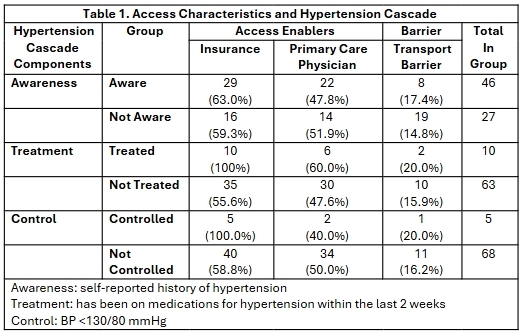
Results The mean age was 35.0 years (95% CI: 32.9–37.0). Of the 73 participants with hypertension, 46 (63.0%) were aware of their diagnosis. Of those aware, 10 (21.7%) were on treatment, and among those treated, 5 (50.0%) had controlled blood pressure. Among the 46 aware individuals, 63.0% were insured, 47.8% had a PCP, and 17.4% reported transportation barriers. Among the 27 not aware, 59.3% were insured, 51.9% had a PCP, and 14.8% had transportation barriers. Among the 10 treated individuals, 100.0% were insured, 60.0% had a PCP, and 20.0% had transportation barriers. Among the 63 not treated, 55.6% were insured, 47.6% had a PCP, and 15.9% had transportation barriers. Among the 5 with controlled blood pressure, 100.0% were insured, 40.0% had a PCP, and 20.0% reported transportation barriers. Among the 68 not controlled, 58.8% were insured, 50.0% had a PCP, and 16.2% reported transportation barriers.
Conclusion While a majority of hypertensive women were aware of their diagnosis, treatment and control rates remained low. Insurance coverage was highest among those treated and controlled. However, gaps in primary care access and transportation barriers were observed at each stage. These findings underscore the need for tailored strategies to address logistical barriers and enhance continuity of care in this population.
Dankwa, Kwabena
(
Johns Hopkins University
, Baltimore , Maryland , United States )
Ateh Stanislas, Ketum
(
Johns Hopkins University
, Baltimore , Maryland , United States )
Rayani, Asma
(
Johns Hopkins University
, Baltimore , Maryland , United States )
Mateo, Ana
(
Johns Hopkins School of Nursing
, Baltimore , Maryland , United States )
Hernandez, Lilian
(
Johns Hopkins School of Nursing
, Baltimore , Maryland , United States )
Etelier, Feodora
(
Johns Hopkins University
, Baltimore , Maryland , United States )
Ezuma, Chioma
(
Howard University
, Burtonsville , Maryland , United States )
Vaidya, Dhananjay
(
JOHNS HOPKINS UNIVERSITY
, Baltimore , Maryland , United States )
Ouyang, Pamela
(
JOHNS HOPKINS UNIVERSITY
, Towson , Maryland , United States )
Hladek, Melissa
(
Johns Hopkins University
, Ellicott City , Maryland , United States )
Sharma, Garima
(
Johns Hopkins University
, Baltimore , Maryland , United States )
Commodore-mensah, Yvonne
(
JOHNS HOPKINS SCHOOL OF NURSIN
, Baltimore , Maryland , United States )
Metlock, Faith
(
Johns Hopkins School of Nursing
, Baltimore , Maryland , United States )
Author Disclosures:
Kwabena Dankwa:DO NOT have relevant financial relationships
| Melissa Hladek:DO have relevant financial relationships
;
Consultant:Fresenius Medical Care:Past (completed)
| Garima Sharma:No Answer
| Yvonne Commodore-Mensah:No Answer
| Faith Metlock:No Answer
| Ketum Ateh Stanislas:DO NOT have relevant financial relationships
| Asma Rayani:DO NOT have relevant financial relationships
| Ana Mateo:No Answer
| Lilian Hernandez:DO NOT have relevant financial relationships
| Feodora Etelier:DO NOT have relevant financial relationships
| Chioma Ezuma:DO NOT have relevant financial relationships
| Dhananjay Vaidya:DO NOT have relevant financial relationships
| Pamela Ouyang:DO NOT have relevant financial relationships