Perceived Interpersonal Safety and Hypertension Diagnosis Among Women of Reproductive Age: Insights from the SAFE HEART Study
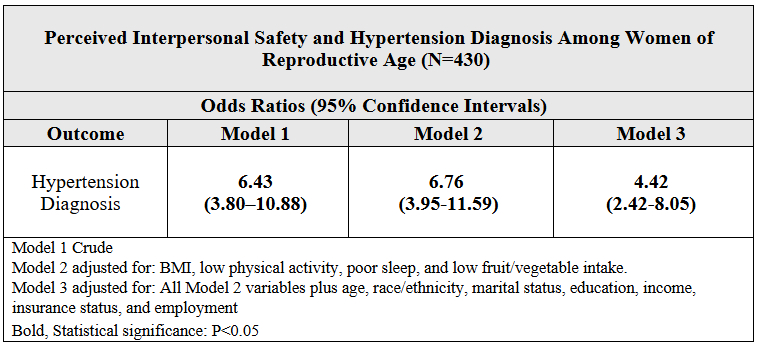
Abstract Body: Background: Perceived interpersonal safety, including emotional and physical abuse, can act as a sustained stressor, particularly for women of reproductive age, and contribute to hypertension and cardiovascular health (CVH) risk. This study examined associations between perceived interpersonal safety and self-reported hypertension in a community sample, controlling for CVH risk factors, and sociodemographic characteristics. Methods: A cross-sectional analysis was conducted among women of reproductive age (18–50 years). Perceived interpersonal safety was assessed using a four-item scale measuring physical harm, threats, insults, and verbal aggression. Responses ranged from “Never” to “Frequently” and were summed; scores ≥11 indicated high safety concern. Logistic regression models estimated odds of self-reported hypertension: Model 1 (unadjusted), Model 2 adjusted for CVH risk factors (BMI, low physical activity, poor sleep, and low fruit/vegetable intake), and Model 3 further adjusted for sociodemographic (age, race/ethnicity, education, income, insurance, marital status, and employment). Results: Among 430 women (mean age = 30.7 ± 6.8 years), 19% reported high interpersonal safety concern. Compared to women with low safety concern, those with high concern were more likely to identify as Non-Hispanic Black or Hispanic, be unmarried, unemployed, low-income, and uninsured (all p < 0.01). In unadjusted models (Model 1), women with high interpersonal safety concern had over six times the odds of reporting hypertension (OR = 6.43; 95% CI: 3.80–10.88). After adjusting for CVH risk factors (Model 2), the association remained significant (aOR = 6.76; 95% CI: 3.95–11.59). In the fully adjusted model (Model 3), which included sociodemographic characteristics, the association remained statistically significant but attenuated (aOR = 4.42; 95% CI: 2.42–8.05). Conclusion: High interpersonal safety concern was an independent predictor of hypertension among women of reproductive age, even after accounting for CVH risk factors and sociodemographic characteristics. These findings underscore the need for trauma-informed, equity-focused approaches to hypertension prevention and management, particularly in reproductive-age women exposed to chronic stress and interpersonal harm.
Ezuma, Chioma
(
Howard University
, Washington , District of Columbia , United States )
Ateh Stanislas, Ketum
(
JOHNS HOPKINS SCHOOL OF NURSING
, Baltimore , Maryland , United States )
Rayani, Asma
(
JOHNS HOPKINS SCHOOL OF NURSING
, Baltimore , Maryland , United States )
Baez Mateo, Ana
(
JOHNS HOPKINS SCHOOL OF NURSING
, Baltimore , Maryland , United States )
Hernandez, Lilian
(
JOHNS HOPKINS SCHOOL OF NURSING
, Baltimore , Maryland , United States )
Dankwa, Kwabena
(
JOHNS HOPKINS SCHOOL OF NURSING
, Baltimore , Maryland , United States )
Etelier, Feodora
(
Johns Hopkins University
, Baltimore , Maryland , United States )
Vaidya, Dhananjay
(
JOHNS HOPKINS UNIVERSITY
, Baltimore , Maryland , United States )
Ouyang, Pamela
(
JOHNS HOPKINS UNIVERSITY
, Baltimore , Maryland , United States )
Hladek, Melissa
(
JOHNS HOPKINS UNIVERSITY
, Baltimore , Maryland , United States )
Sharma, Garima
(
Inova Fairfax Medical Campus
, Falls Church , Virginia , United States )
Commodore-mensah, Yvonne
(
JOHNS HOPKINS SCHOOL OF NURSING
, Baltimore , Maryland , United States )
Metlock, Faith
(
JOHNS HOPKINS SCHOOL OF NURSING
, Baltimore , Maryland , United States )
Author Disclosures:
Chioma Ezuma:DO NOT have relevant financial relationships
| Melissa Hladek:DO have relevant financial relationships
;
Consultant:Fresenius Medical Care:Past (completed)
| Garima Sharma:No Answer
| Yvonne Commodore-Mensah:No Answer
| Faith Metlock:No Answer
| Ketum Ateh Stanislas:DO NOT have relevant financial relationships
| Asma Rayani:DO NOT have relevant financial relationships
| Ana Baez Mateo:DO NOT have relevant financial relationships
| Lilian Hernandez:DO NOT have relevant financial relationships
| Kwabena Dankwa:DO NOT have relevant financial relationships
| Feodora Etelier:DO NOT have relevant financial relationships
| Dhananjay Vaidya:DO NOT have relevant financial relationships
| Pamela Ouyang:DO NOT have relevant financial relationships