
Logo

American Heart Association

  54
  0


Final ID: FR433

Estimating Inner-arm Length using Common Anthropometric Measures for Appropriate Blood Pressure Cuff Size Selection

Abstract Body: Background: Validation guidelines require the width of auscultatory blood pressure (BP) cuffs to cover 37.5%-50% of the mid-arm circumference but this can be problematic for short and wide arms, which are common among obese adults. Till date, there has not been a way to quantify the extent of implausible cuff requirements for obese adults due to the absence of inner-arm length measurements in large cohorts. Equations estimating inner-arm length based on standard anthropometric measures are critical to quantify the extent of this cuff mismatch and inform scientific priorities around cuff dimensions for adults with obesity.
Objective: To estimate inner arm length from common body measurements using screening data from two community trials to inform best practices in BP cuff selection.
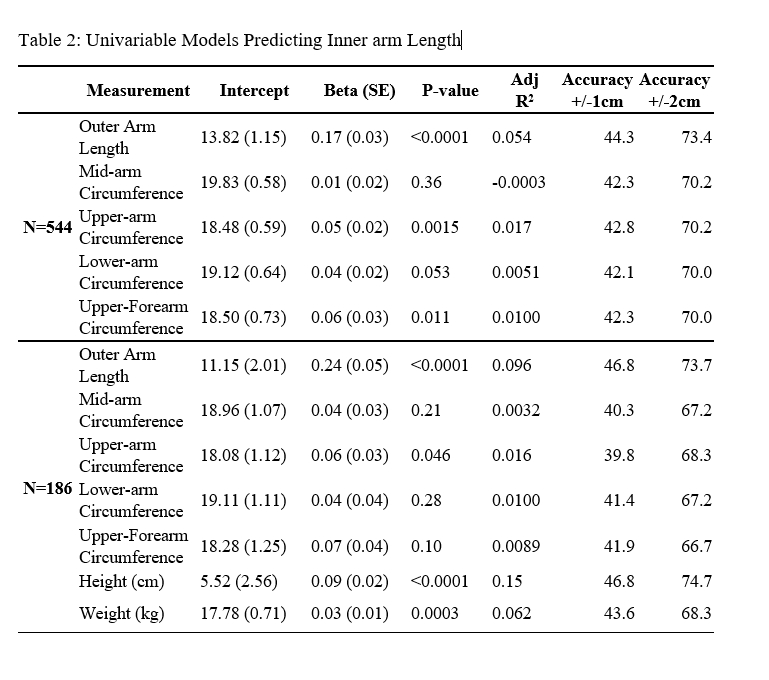
Methods: During screening visits for GoFresh and GoFreshRx, we obtained the following measurements from 544 participants: outer arm length (acromion to elbow), inner arm length (anterior axillary fold to antecubital fossa), upper arm circumference (around arm directly under the axillary fold), mid arm circumference, lower arm circumference (above the antecubital fossa), and upper forearm circumference (below the antecubital fossa). Height and weight was obtained from a subset of 186 participants. We used univariable and multivariable linear regression models of these arm measures, height, and weight to estimate inner-arm length. Model performance was assessed using the adjusted R-squared and compared via likelihood ratio tests. We determined accuracy within ±1 cm and ±2 cm of the actual inner-arm length.
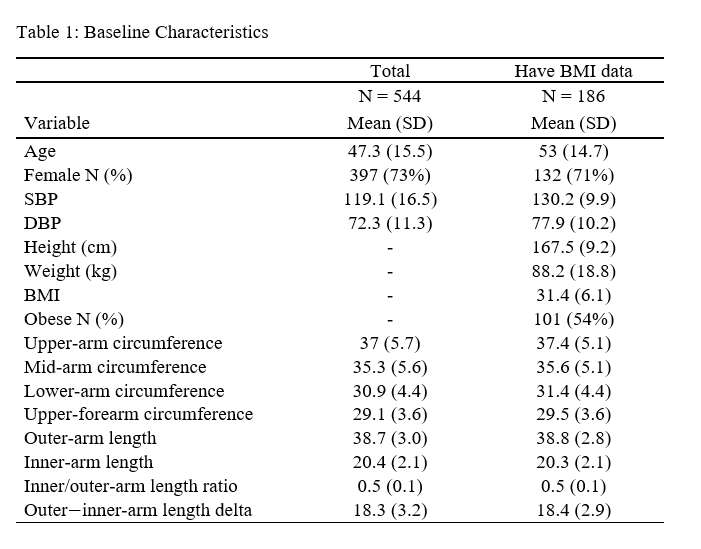
Results: Mean age was 47 years among the 544 participants and 53 years in the subset of 186; most were female (73% vs 71%) (Table 1). Outer arm length and height showed strongest association with inner arm length (Table 2). Likelihood ratio tests indicated that the addition of height and weight significantly improved model fit (P < 0.05) (Table 3). In the subset, height and weight, in combination with outer arm length and all arm circumference measures, produced the best overall performance; although it was still low (adjusted R2 = 0.18).
Conclusion: Outer arm length and height are most strongly associated with inner arm length and could be used to estimate inner arm length in large population databases. However, despite their associations, model performance was poor and likely should not be a substitute for direct measurement of inner arm length among adults with obesity.
  • Aidoo, Emily  ( BIDMC , Boston , Massachusetts , United States )
  • Col, Hannah  ( BIDMC , Boston , Massachusetts , United States )
  • Khan, Md Marufuzzaman  ( Beth Israel Deaconess Medical Cente , Brookline , Massachusetts , United States )
  • Budu, Marian  ( Beth Israel Deaconess Medical Ctr. , Boston , Massachusetts , United States )
  • Turkson-ocran, Ruth-alma  ( Beth Israel Deaconess Medical Ctr , Boston , Massachusetts , United States )
  • Zhang, Mingyu  ( Harvard Medical School , Boston , Massachusetts , United States )
  • Cluett, Jennifer  ( BIDMC-Harvard Medical School , Boston , Massachusetts , United States )
  • Ngo, Long  ( Harvard Medical School , Boston , Massachusetts , United States )
  • Juraschek, Stephen  ( BIDMC-Harvard Medical School , Boston , Massachusetts , United States )
  • Author Disclosures:
    Emily Aidoo: DO NOT have relevant financial relationships | Hannah Col: No Answer | Md Marufuzzaman Khan: DO NOT have relevant financial relationships | Marian Budu: No Answer | Ruth-Alma Turkson-Ocran: DO NOT have relevant financial relationships | Mingyu Zhang: DO NOT have relevant financial relationships | Jennifer Cluett: DO NOT have relevant financial relationships | Long Ngo: No Answer | Stephen Juraschek: DO NOT have relevant financial relationships
Meeting Info:
Session Info:

Poster Session 2 with Breakfast Reception

Friday, 09/05/2025 , 09:00AM - 10:30AM

Poster Session

More abstracts on this topic:
A cerebrovascular longitudinal atlas: different rates of morphological change in aneurysm patients associated with hypertension and diabetes

Chien Aichi, Salamon Noriko, Vinuela Fernando, Szeder Viktor, Colby Geoffrey, Jahan Reza, Boyle Noel, Villablanca Juan, Duckwiler Gary


A Longitudinal 20-year Analysis Indicates Acceleration of Cardiometabolic Comorbidities on Dementia Risk

Lihua Huang, Danish Muhammad, Auyeung Tw, Jenny Lee, Kwok Timothy, Abrigo Jill, Wei Yingying, Lo Cecilia, Fung Erik

More abstracts from these authors:
Characteristics and Temporal Usage Patterns of Omron Home Blood Pressure Device Users in the United States

Khan Md Marufuzzaman, Col Hannah, Larbi Fredrick, Zhang Mingyu, Turkson-ocran Ruth-alma, Ngo Long, Juraschek Stephen

Social Determinants of Health and Biologic Measures Differ by Hypertension Treatment Status Between Participants in Two Similar Clinical Trials

Totwani Mansi, Cao Jingyi, Col Hannah, Turkson-ocran Ruth-alma, Zhang Mingyu, Aidoo Emily, Budu Marian, Nartey Sarah, Juraschek Stephen

You have to be authorized to contact abstract author. Please, Login
Not Available