Comparative Associations of High-sensitivity Troponins T and I with Neurocognitive Outcomes in SPRINT
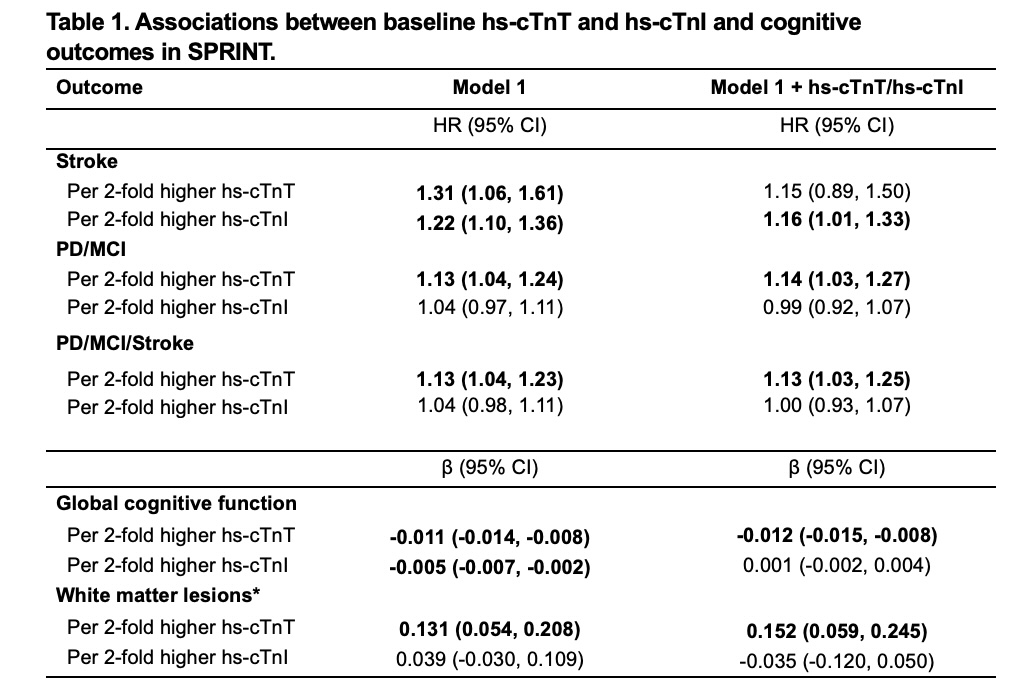
Abstract Body: Introduction: Subclinical elevations in high sensitivity cardiac troponins reflect pathophysiological processes affecting both the heart and the brain. Cardiac troponin T (hs-cTnT) and I (hs-cTnI) provide complementary prognostic information about cardiovascular outcomes, but it is unknown whether this pattern is similar for neurocognitive outcomes. Hypothesis: We hypothesized that higher baseline levels of hs-cTnT and hs-cTnI would each be associated with higher risk for adverse neurocognitive outcomes independent of demographics, clinical characteristics, and the other troponin. Methods: In the Systolic Blood Pressure Intervention Trial (SPRINT), multivariable Cox models were used to evaluate the individual and joint associations of hs-cTnT and hs-cTnI levels at baseline with the following outcomes: incident stroke in SPRINT (n=8820); incident probable dementia or mild cognitive impairment (PD/MCI) in SPRINT MIND (n=8103); and change in global cognitive function (n=2731) and progression of white matter lesions (WMLs) assessed by MRI (n=636) in SPRINT MIND substudies. Results: Baseline characteristics were similar across the SPRINT, SPRINT MIND, and SPRINT MIND substudy participants who had available baseline hs-cTnT and hs-cTnI. In multivariable adjusted models, higher baseline levels of hs-cTnT were significantly associated with stroke risk (HR: 1.31, 95% CI: 1.06, 1.61), risk of PD/MCI (HR: 1.13, 95% CI: 1.04, 1.24), faster decline in global cognitive function (β: -0.011, 95% CI: -0.014, -0.008), and faster progression of WMLs (β: 0.131, 95% CI: 0.054, 0.208). Higher baseline levels of hs-cTnI were also associated with risk of stroke (HR: 1.22, 95% CI: 1.10, 1.36) and faster decline in global cognitive function (β: -0.005, 95% CI: -0.007, -0.002). After further adjustment for the other troponin, hs-cTnT remained significantly associated with all outcomes, except stroke, whereas hs-cTnI remained associated with stroke but none of the other outcomes (Table 1). Conclusion: In SPRINT, hs-cTnT and hs-cTnI have differential associations with cognitive outcomes. Compared with hs-cTnI, hs-cTnT may be a more informative biomarker for prognosticating brain health.
Lwin, Yee May
(
University of California, Davis
, Sacramento , California , United States )
Zhang, Wenxin
(
Harvard T.H. Chan School of Public Health
, Boston , Massachusetts , United States )
Berry, Jarett
(
UT Tyler School of Medicine
, Tyler , Texas , United States )
De Lemos, James
(
UT SOUTHWESTERN MEDICAL CTR
, Dallas , Texas , United States )
Ma, Yuan
(
Harvard T.H. Chan School of Public Health
, Boston , Massachusetts , United States )
Ascher, Simon
(
University of California, Davis
, Sacramento , California , United States )
Author Disclosures:
Yee May Lwin:DO NOT have relevant financial relationships
| Wenxin Zhang:No Answer
| Jarett Berry:No Answer
| James de Lemos:DO have relevant financial relationships
;
Research Funding (PI or named investigator):Abbott Diagnostics:Past (completed)
; Research Funding (PI or named investigator):Roche Diagnostics:Past (completed)
| Yuan Ma:DO NOT have relevant financial relationships
| Simon Ascher:DO NOT have relevant financial relationships