Logo

American Heart Association

  52
  0


Final ID: FR502

Cerebral Perfusion in the Heart-Brain Axis: Cardiovascular Determinants and Association with Subclinical Brain Injury

Abstract Body: Background: Cerebral perfusion is a key component of cerebrovascular integrity, and its impairment with aging may contribute to both cerebrovascular and neurodegenerative disease. However, the interplay between cardiovascular morphology, cerebral hemodynamics, and subclinical brain injury is not well understood.
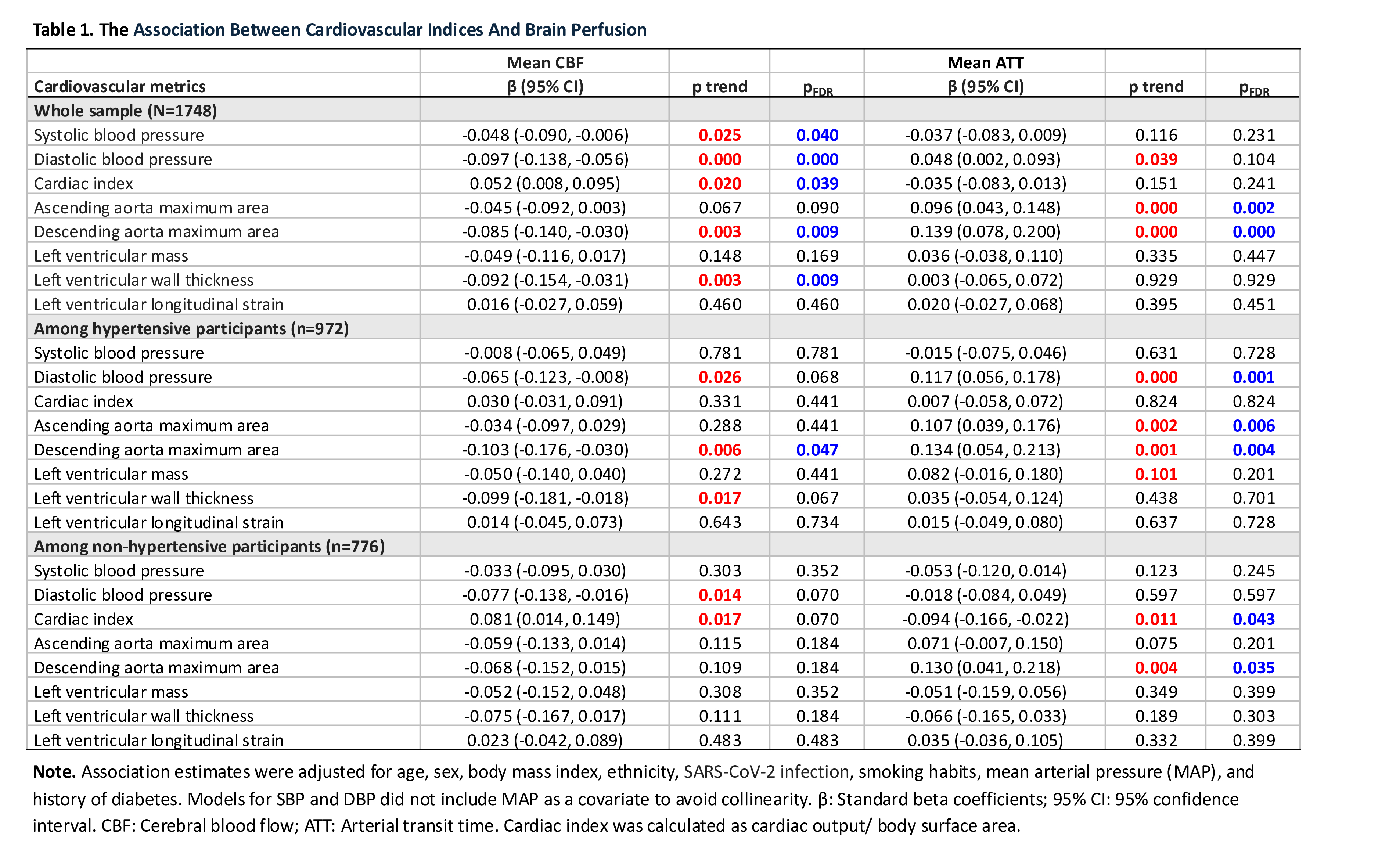
Objective and Methods: We investigated the relationship between cardiovascular indices (measured in 2015), cerebral perfusion metrics, and subclinical brain injury (both measured in 2019) in 1,748 healthy older adults (56.1% women; mean age: 59.8 years) with 1.5T cardiac MRI and multi-modal 3T brain MRI measurements from the UK Biobank study. We assessed eight cardiovascular measures (Table 1). Cerebral perfusion metrics included cerebral blood flow (CBF) and arterial transit time (ATT) and were measured using Arterial Spin Labeling with a multi-post labeling delay protocol. Subclinical brain injury was measured by white matter hyperintensity (WMH) volume from T2 FLAIR images. We examined the association between cardiovascular morphology and brain perfusion and between brain perfusion measures and WMH using multivariable linear models. We further assessed the effect modification by brain perfusion on the relationship between cardiovascular morphology and WMH.
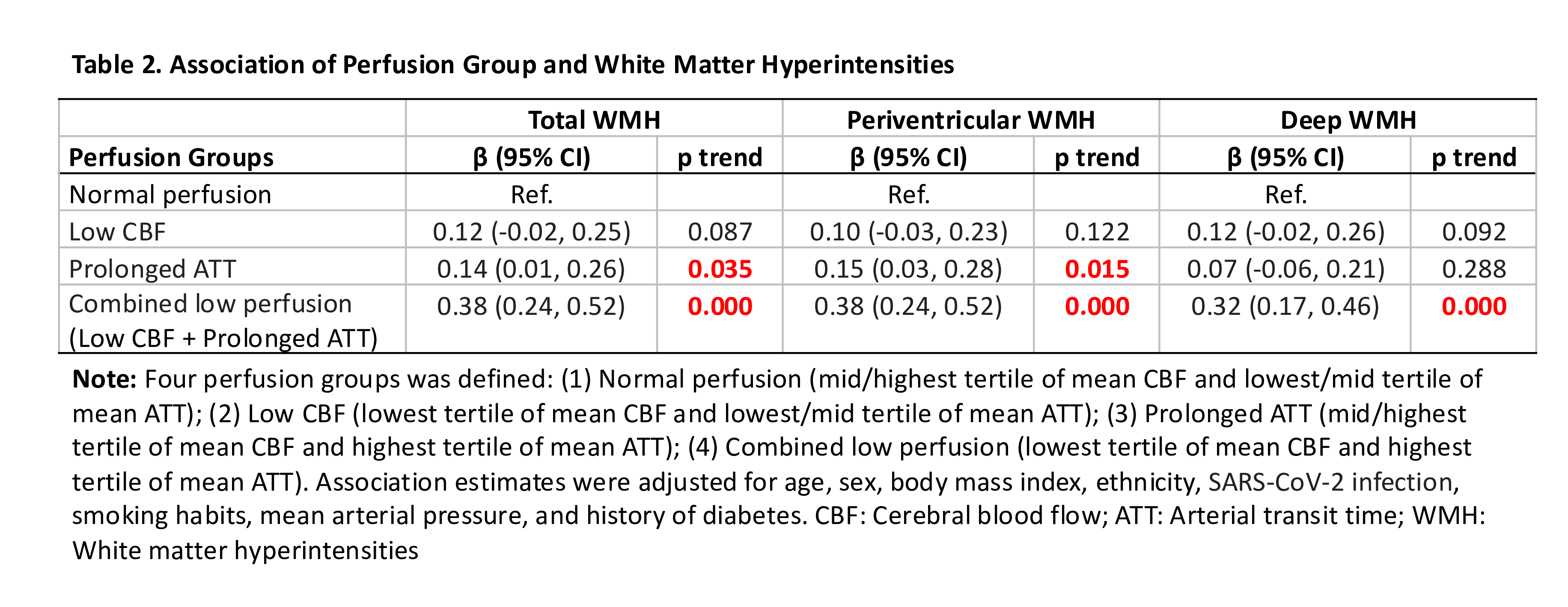
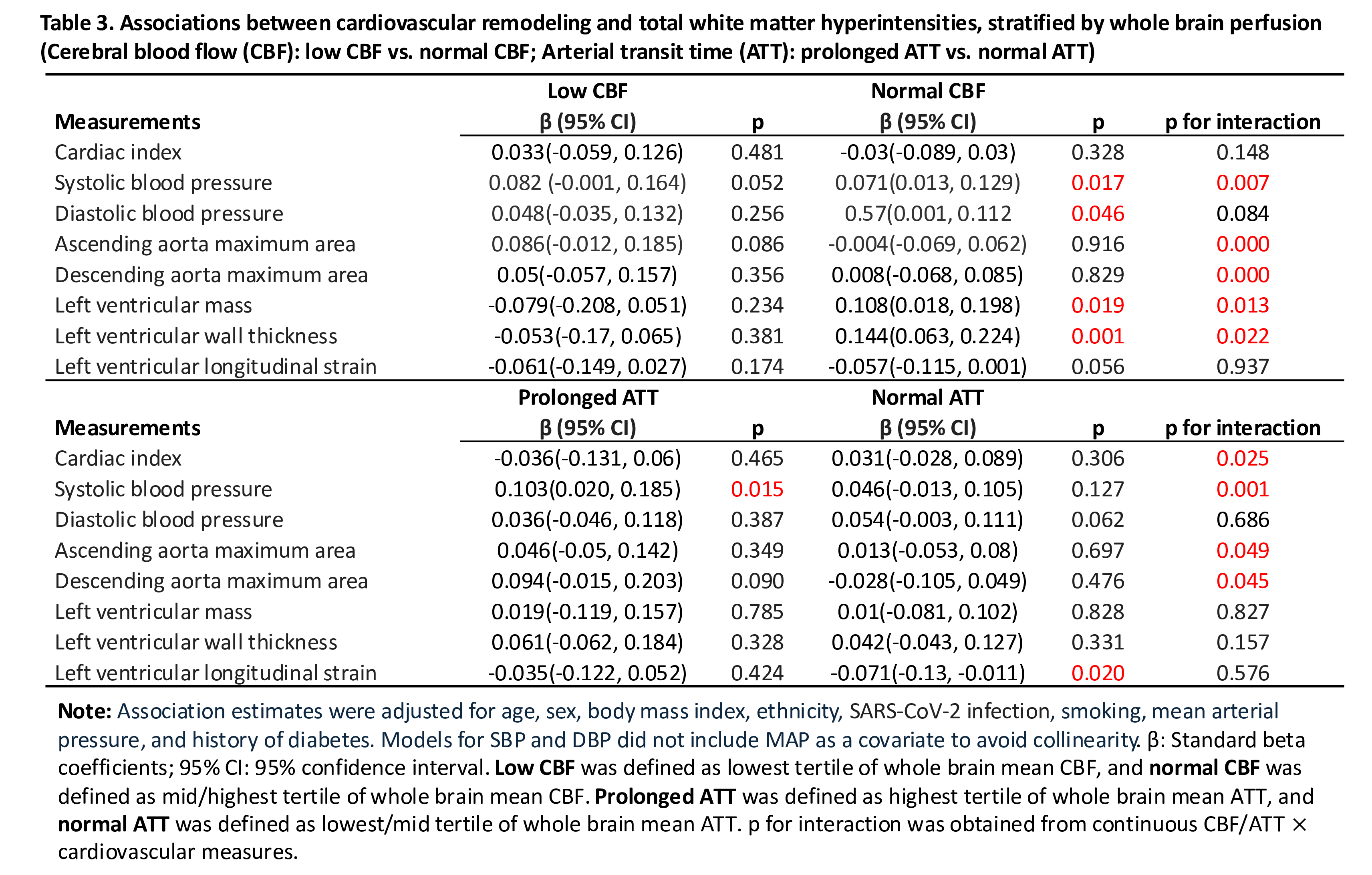
Results: Five cardiovascular measures were significantly associated with lower CBF, both globally and across four cortical regions. Specifically, per standard deviation (SD) decrease in cardiac index was associated with lower CBF (0.052 ml/100g/min; 95% CI: 0.008 to 0.095), while increase in ascending aortic area, LV wall thickness, SBP, and DBP was associated with lower CBF. In contrast, impaired aortic compliance was linked to prolonged ATT (Table 1). Furthermore, lower CBF and longer ATT independently predicted higher WMH burden, with the highest WMH observed in participants with low CBF and prolonged ATT, who showed a 0.37 SD greater burden compared to those with normal perfusion (Table 2). Finally, brain perfusion modified the relationship between cardiovascular morphology and WMH, with a pronounced association observed in those with low CBF or prolonged ATT (p for interaction < 0.05) (Table 3).
Conclusions: Impaired cerebral perfusion may represent a mechanistic pathway linking cardiovascular morphology to white matter injury. Jointly considering CBF and ATT may improve the detection of high-risk individuals with abnormal cerebral perfusion and cerebrovascular vulnerability to brain aging.
  • Zhang, Ye  ( Harvard University , Boston , Massachusetts , United States )
  • Hughes, Timothy  ( Wake Forest University School of Medicine , Winston Salem , North Carolina , United States )
  • Zhang, Wenxin  ( Harvard University , Boston , Massachusetts , United States )
  • Glodzik, Lidia  ( Weill Cornell Medicine , New York , New York , United States )
  • Dolui, Sudipto  ( Hospital of the University of Pennsylvania , Philadelphia , Pennsylvania , United States )
  • Goulart, Thiago  ( Harvard University , Boston , Massachusetts , United States )
  • Norling, Amani M.  ( The Hinda and Arthur Marcus Institute for Aging Research , Boston , Massachusetts , United States )
  • Lipsitz, Lewis  ( The Hinda and Arthur Marcus Institute for Aging Research , Boston , Massachusetts , United States )
  • Ma, Yuan  ( Harvard University , Boston , Massachusetts , United States )
  • Author Disclosures:
    Ye Zhang: DO NOT have relevant financial relationships | Timothy Hughes: No Answer | Wenxin Zhang: No Answer | Lidia Glodzik: No Answer | Sudipto Dolui: No Answer | Thiago Goulart: No Answer | Amani M. Norling: DO NOT have relevant financial relationships | Lewis Lipsitz: DO NOT have relevant financial relationships | Yuan Ma: DO NOT have relevant financial relationships
Meeting Info:
Session Info:

Poster Session 2 with Breakfast Reception

Friday, 09/05/2025 , 09:00AM - 10:30AM

Poster Session

More abstracts on this topic:
A Nationwide Italian Network for the Clinical and Genetic Diagnosis of Familial Dyslipidemias: The LIPIGEN registry

Casula Manuela, Galimberti Federica, Olmastroni Elena, Arca Marcello, Averna Maurizio, Catapano Alberico

A 10-year longitudinal cohort study of lipid variability, cognitive decline, and dementia in 9846 community-dwelling older adults

Zhou Zhen, Moran Chris, Murray Anne, Zoungas Sophia, Nelson Mark, Talic Stella, Wolfe Rory, Ryan Joanne

More abstracts from these authors:
Associations between 24-hour Blood Pressure Variability Measures and Orthostatic Blood Pressure Changes

Patil Dhrumil, Cluett Jennifer, Mukamal Kenneth, Coresh Joe, Selvin Elizabeth, Wagenknecht Lynne, Hughes Timothy, Windham B Gwen, Mosley Thomas, Lutsey Pamela, Ring Kimberly, Xue Catherine, Lipsitz Lewis, Ma Yuan, Valint Arielle, Juraschek Stephen, Khan Md Marufuzzaman, Col Hannah, Larbi Fredrick, Zhang Wenxin, Zhang Mingyu, Turkson-ocran Ruth-alma, Ngo Long

Comparative Associations of High-sensitivity Troponins T and I with Neurocognitive Outcomes in SPRINT

Lwin Yee May, Zhang Wenxin, Berry Jarett, De Lemos James, Ma Yuan, Ascher Simon

You have to be authorized to contact abstract author. Please, Login
Not Available