Effects of Antihypertensive Class on Orthostatic Changes Differ by Body Position, Initial Blood Pressure, and Treatment Duration: Secondary Analysis of the Treatment of Mild Hypertension Study (TOMHS)
Abstract Body: Background Orthostatic hypotension (OH) is common among adults with hypertension and often complicates treatment. Antihypertensive treatment is frequently avoided in these patients due to concerns that medications have consistent effects on BP. However, effects may differ by body position, initial BP, and treatment duration. These insights are critical for class selection to avoid hypotensive complications.
Objective To determine how the orthostatic effects of 5 common antihypertensives (acebutolol, amlodipine, chlorthalidone, doxazosin, enalapril) differ by baseline systolic BP (SBP) and treatment duration.
Methods We performed a post-hoc analysis of TOMHS data. Adults aged 45-69 with a diastolic BP of 90-99 mmHg were randomly assigned to 1 of 5 antihypertensives or placebo. BP was measured with a Hawksley random-0 sphygmomanometer twice after 5 minutes of seated rest (separated by 30 seconds) and 2 minutes of standing. Measurements were at randomization, 1 month post-randomization, and every 3 months up to 54 months. We used generalized estimating equations to determine the effect of drugs on: (1) seated or standing SBP (in strata of 110 to ≤130, 130 to ≤140, 140 to ≤150, >150 mmHg), (2) orthostatic change in SBP (≥20, 10 to <20, >-10 to <10, -10 to >-20, ≤-20 mmHg), and (3) over time (at 1, 1-6, 6-12, 12-24, 24-36, >36 months). Orthostatic change was continuous (standing - seated SBP) and dichotomous (change ≤-20 mmHg).
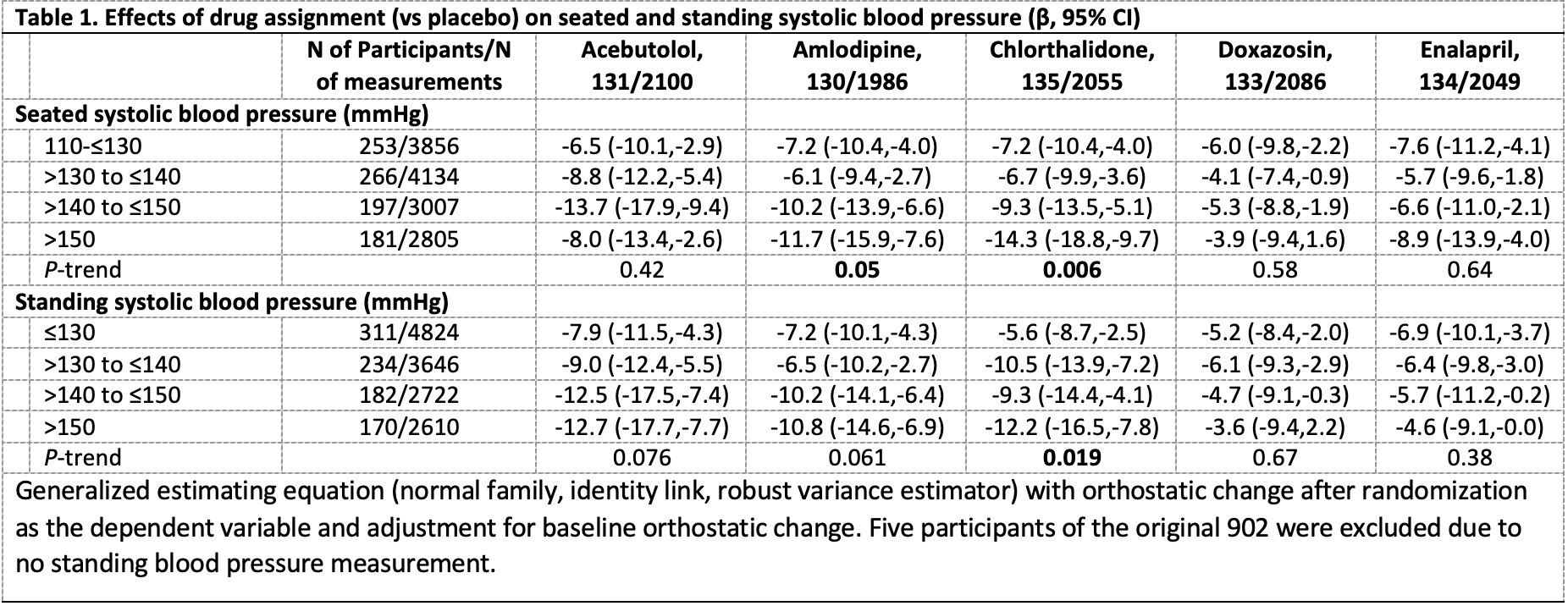
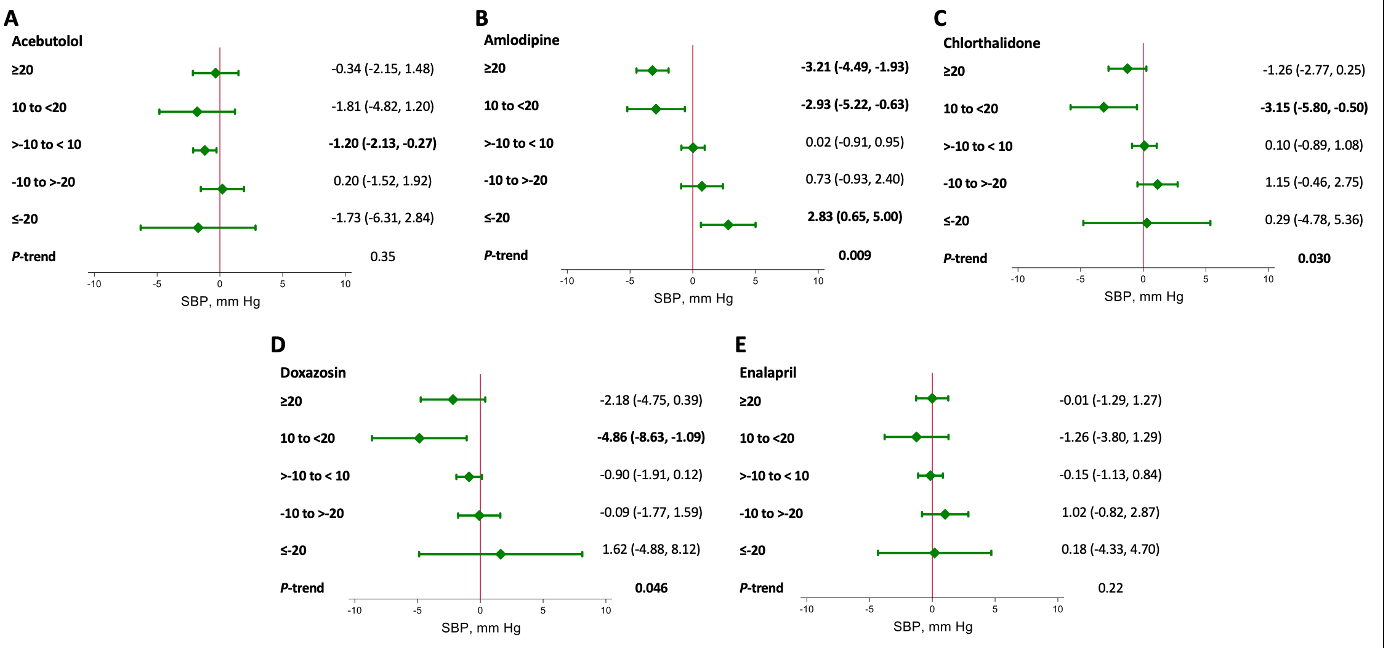
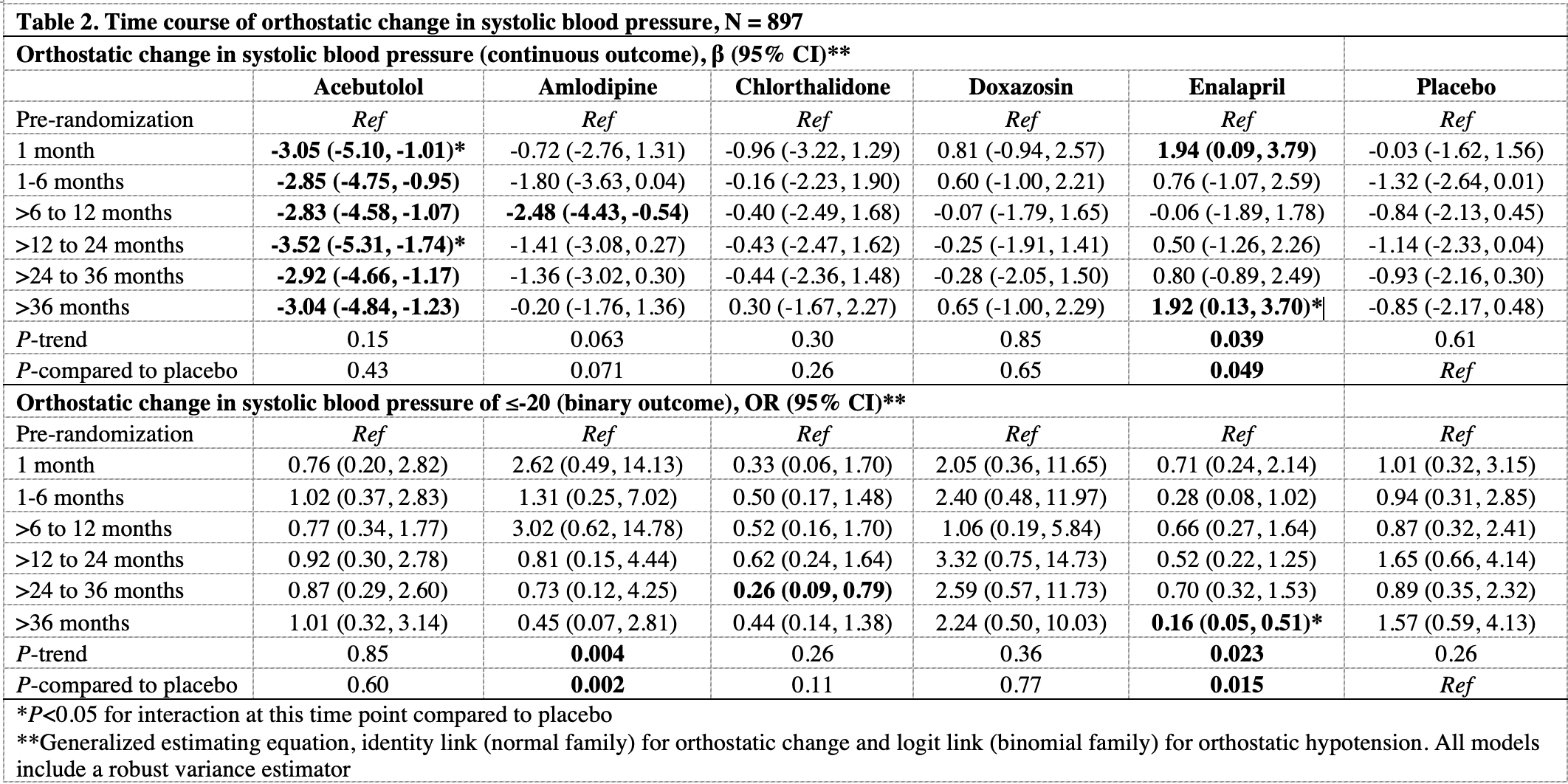
Results Of 902 randomized participants, 897 had orthostatic BP measures (mean age 54.8, SD 6.4 yr; 38.5% female, 19.6% Black). Compared to placebo, chlorthalidone was associated with greater reductions in SBP at higher baseline values for seated and standing (P-trends 0.006 and 0.019, respectively) (Table 1). Amlodipine had the greatest effect on orthostatic change, mitigating orthostatic increases and decreases in SBP (P-trend = 0.009) (Figure 1). At 1 month, acebutolol had a greater magnitude negative orthostatic change in SBP (-3.05 mmHg; 95% CI: -5.10, -1.01), while enalapril increased orthostatic change (1.94 mmHg; 0.09, 3.79; Table 2). Over time, amlodipine and enalapril decreased the odds of orthostatic change ≤-20 mmHg (P-trends 0.002 and 0.015).
Conclusions Antihypertensive agents had different effects on SBP based on body position, initial resting value, and treatment duration. These effects are applicable for treating hypertension in patients with OH and should be evaluated with respect to hypotensive events such as falls and syncope.
Liu, Esther
(
BIDMC
, Boston , Massachusetts , United States )
Petriceks, Aldis
(
BIDMC
, Boston , Massachusetts , United States )
Lee, Grace
(
Harvard Medical School
, Boston , Massachusetts , United States )
Khan, Md Marufuzzaman
(
Beth Israel Deaconess Medical Cente
, Brookline , Massachusetts , United States )
Col, Hannah
(
BIDMC
, Boston , Massachusetts , United States )
Zhang, Mingyu
(
Harvard Medical School
, Boston , Massachusetts , United States )
Ngo, Long
(
Harvard Medical School
, Boston , Massachusetts , United States )
Lipsitz, Lewis
(
BIDMC
, Boston , Massachusetts , United States )
Juraschek, Stephen
(
BIDMC-Harvard Medical School
, Boston , Massachusetts , United States )
Author Disclosures:
Esther Liu:DO NOT have relevant financial relationships
| Aldis Petriceks:No Answer
| Grace Lee:DO NOT have relevant financial relationships
| Md Marufuzzaman Khan:DO NOT have relevant financial relationships
| Hannah Col:No Answer
| Mingyu Zhang:DO NOT have relevant financial relationships
| Long Ngo:No Answer
| Lewis Lipsitz:DO NOT have relevant financial relationships
| Stephen Juraschek:DO NOT have relevant financial relationships
Wang Yunfeng, Xu Wei, Song Lijuan, Wang Chunqi, Wu Yi, Krumholz Harlan, Li Xi, Hu Shengshou, Guo Weihong, Hao Yang, Zheng Xin, Zhang Haibo, Yang Yang, Chen Bowang, Zhang Xiaoyan, Cui Jianlan