
Logo

American Heart Association

  19
  0


Final ID: 4365166

Computational Simulations of Coronary Artery Bifurcation Stenting Using Realistic Plaque Distribution and Materials

Abstract Body (Do not enter title and authors here): Background:
Percutaneous coronary intervention (PCI) of bifurcated coronary lesions is associated with higher complication and restenosis rates due to complex vessel geometry and plaque heterogeneity. Accurate preprocedural planning is essential, and computational simulations have emerged as valuable tools. Finite element analysis (FEA) allows detailed simulation of stent deployment and vessel biomechanics during PCI. Among FEA approaches, full-plaque (FP) models, which incorporate the lumen, vessel wall, and heterogeneous plaque components, are the most comprehensive. This study presents development and validation of a high-fidelity FP model using nine patient-specific coronary bifurcation cases.
Methods:
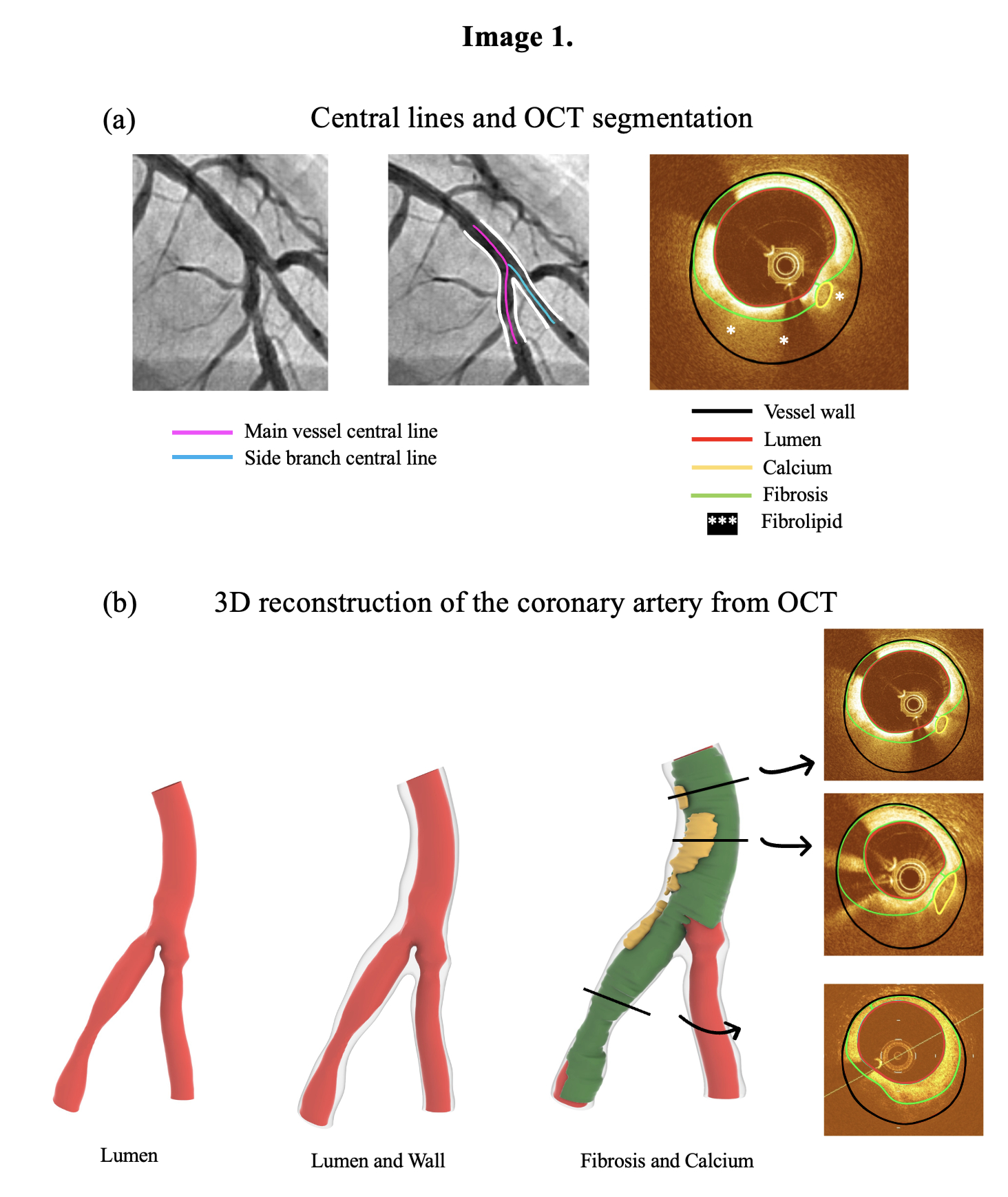
Pre-stenting OCT and angiographic data from nine patients with LAD bifurcation lesions were used to reconstruct 3D vessel geometries, including fibrotic, calcified, and fibrolipid plaques (Image 1). The FP model was meshed with tetrahedral elements. Plaques were assigned literature-based nonlinear elasto-plastic properties; vessel walls were modeled as hyperelastic. Stepwise PCI procedures were simulated using the Abaqus/Explicit solver. Simulated lumen geometries were validated using post-stenting OCT, and Bland-Altman analysis was used to assess agreement.
Results:
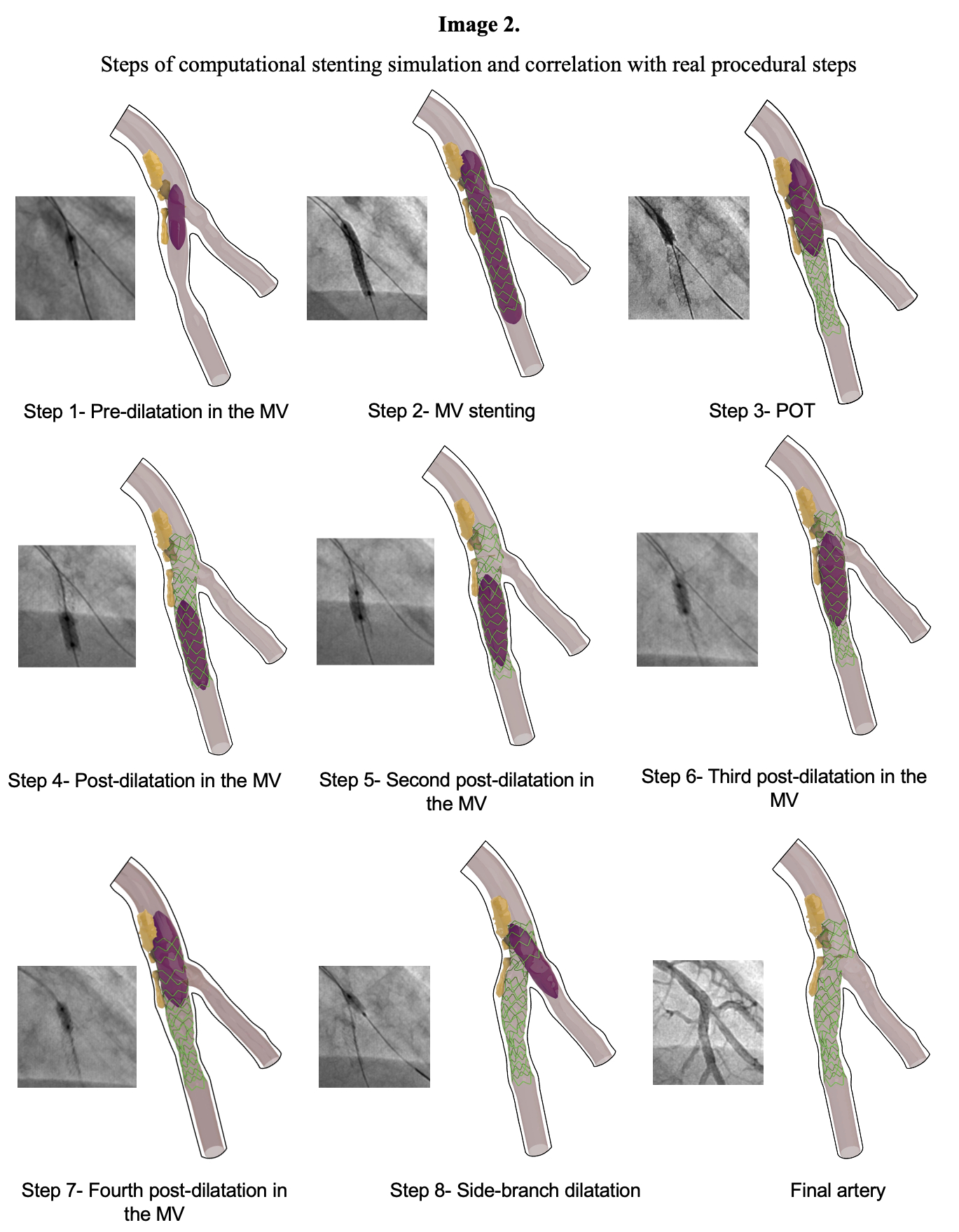
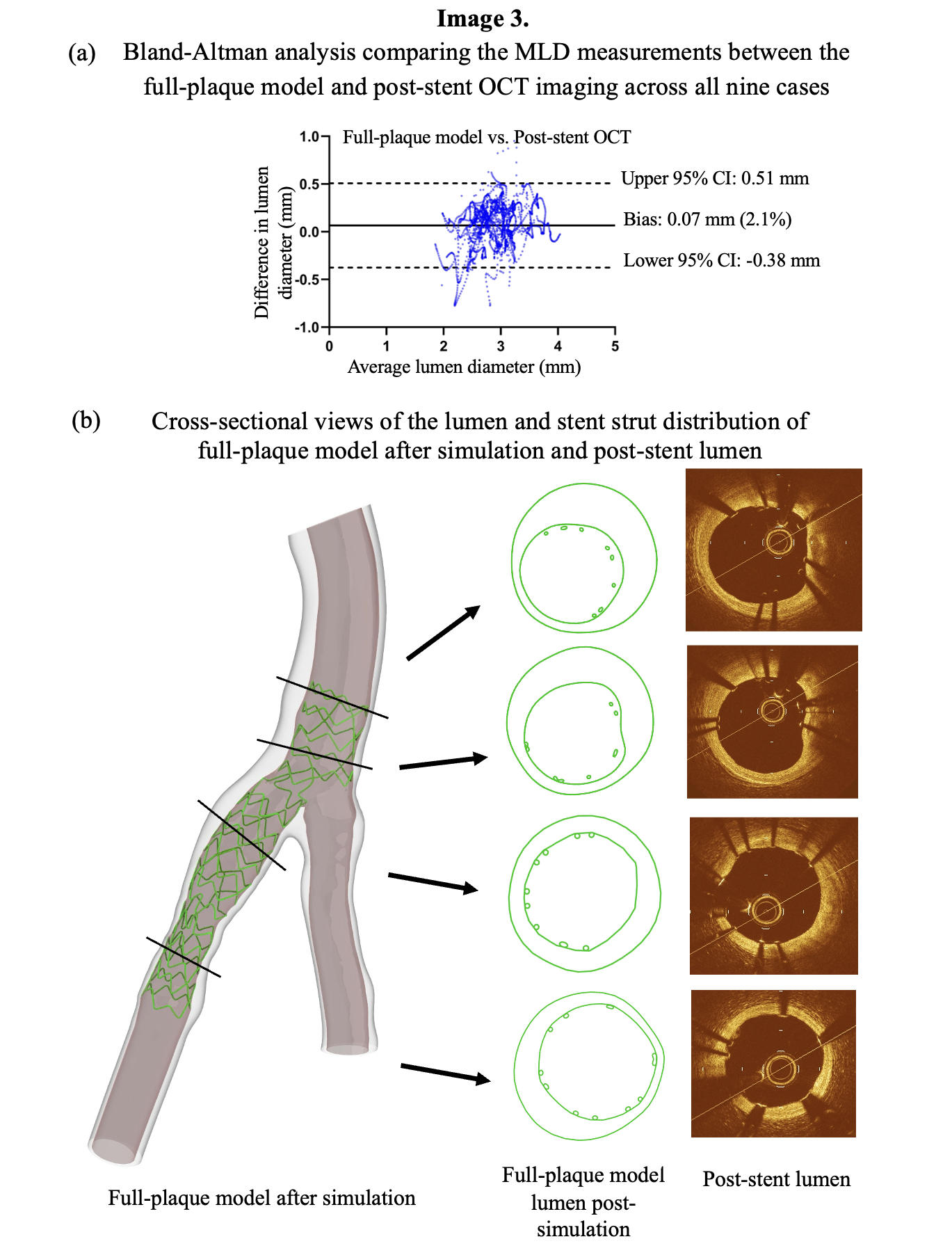
The FP model closely reproduced all procedural steps and biomechanical changes, including balloon and stent deformation, plaque displacement, and vessel remodeling (Image 2). Mean lumen diameters from the FP model showed strong agreement with post-stenting OCT (mean bias 0.07 mm; 95% limits of agreement: -0.38 to 0.51 mm) (Image 3a). It also replicated cross-sectional lumen shape and stent strut distribution, including regions of malapposition (Image 3b), key for identifying potential mechanical issues such as high stress areas or incomplete stent apposition that could impact long-term outcomes.
Conclusion:
This study presents the development and validation of a high-fidelity FP model for simulating coronary bifurcation stenting. Built from OCT-based segmentation and literature-derived material properties, the model accurately captures anatomical detail and biomechanical behavior. Its strong agreement with post-stenting OCT supports its use as a reference standard for evaluating simplified models. Future efforts will focus on automating the workflow to enable real-time clinical application.
  • Wu, Wei  ( Miller School of Medicine , Miami , Florida , United States )
  • Arora, Komal  ( Miller School of Medicine , Miami , Florida , United States )
  • Lee, Changkye  ( Miller School of Medicine , Miami , Florida , United States )
  • Chatzizisis, Yiannis  ( Miller School of Medicine , Miami , Florida , United States )
  • Zhao, Shijia  ( Miller School of Medicine , Miami , Florida , United States )
  • Bhat, Rakshita Ramesh  ( Miller School of Medicine , Miami , Florida , United States )
  • Munjal, Parth  ( Miller School of Medicine , Miami , Florida , United States )
  • Trivedi, Yash Vardhan  ( Miller School of Medicine , Miami , Florida , United States )
  • Chikatimalla, Rahul  ( Miller School of Medicine , Miami , Florida , United States )
  • Tapia-orihuela, Ruben  ( Miller School of Medicine , Miami , Florida , United States )
  • Zafar, Hammad  ( Miller School of Medicine , Miami , Florida , United States )
  • Darapaneni, Haritha  ( Miller School of Medicine , Miami , Florida , United States )
  • Author Disclosures:
    Wei Wu: DO NOT have relevant financial relationships | Komal Arora: DO NOT have relevant financial relationships | Changkye Lee: DO NOT have relevant financial relationships | Yiannis Chatzizisis: DO have relevant financial relationships ; Speaker:Boston Scientific Inc.:Active (exists now) ; Research Funding (PI or named investigator):Medtronic Inc. :Active (exists now) ; Advisor:Medtronic Inc. :Active (exists now) ; Research Funding (PI or named investigator):Boston Scientific Inc.:Active (exists now) ; Advisor:Boston Scientific Inc.:Active (exists now) | Shijia Zhao: DO NOT have relevant financial relationships | Rakshita Ramesh Bhat: DO NOT have relevant financial relationships | Parth Munjal: DO NOT have relevant financial relationships | Yash Vardhan Trivedi: DO NOT have relevant financial relationships | Rahul Chikatimalla: DO NOT have relevant financial relationships | Ruben Tapia-Orihuela: DO NOT have relevant financial relationships | Hammad Zafar: DO NOT have relevant financial relationships | HARITHA DARAPANENI: No Answer
Meeting Info:

Scientific Sessions 2025

2025

New Orleans, Louisiana

Session Info:

State-of-the-Art Coronary Imaging & Hemodynamic Physiology

Sunday, 11/09/2025 , 08:00AM - 09:15AM

Abstract Oral Session

More abstracts on this topic:
Computational Fluid Dynamics is Key Predictors of Adverse Events in Single Ventricle Patients After the Fontan

Wei Zhenglun, Salargarna Fatemeh, Murawsky Jessica, Si Biao, Frechette Joshua, Carter Allen, Zou Jian, Yoganathan Ajit, Fogel Mark

A Rare Case of Mycotic Pseudoaneurysm in a Pediatric Patient with a History of Disseminated MRSA

Amilhamja Anissa, Shaikh Adam, Porisch Mary

More abstracts from these authors:
Demographic and Socioeconomic Disparities in the Co-Occurrence of Hypertension and Depression – A Population-Based Study

Arora Komal, Shah Anand, Bhat Rakshita Ramesh, Trivedi Yash Vardhan, Cheriyath Pramil

Invasive Versus Conservative Management Strategy in NSTE-MI in ≥70-Year-Old Patients: A Meta-Analysis.

Banga Akshat, Talaei Fahimeh, Munjal Parth, Trivedi Yash Vardhan, Rathore Sawai Singh, Gurav Jaiprakash, Sah Biki, Mautong Hans, Bansal Vikas

You have to be authorized to contact abstract author. Please, Login
Not Available