Trends in Prevalence, Treatment, and Control of Cardiometabolic Risk Factors among Patients with Hypertension in the US, 1999-2023
Abstract Body: Introduction: Hypertension-related deaths in the US have sharply increased over the past decade, suggesting that patients with hypertension are now experiencing greater comorbidity and disease complexity.
Methods: Using the National Health and Nutrition Examination Survey (NHANES), we examined changes in prevalence, treatment, and control of cardiometabolic risk factors among patients with hypertension in the US from 1999 through 2023. All estimates were age-standardized to the weighted population of adults aged ≥20 years with hypertension in the 2021-2023 NHANES cycle.
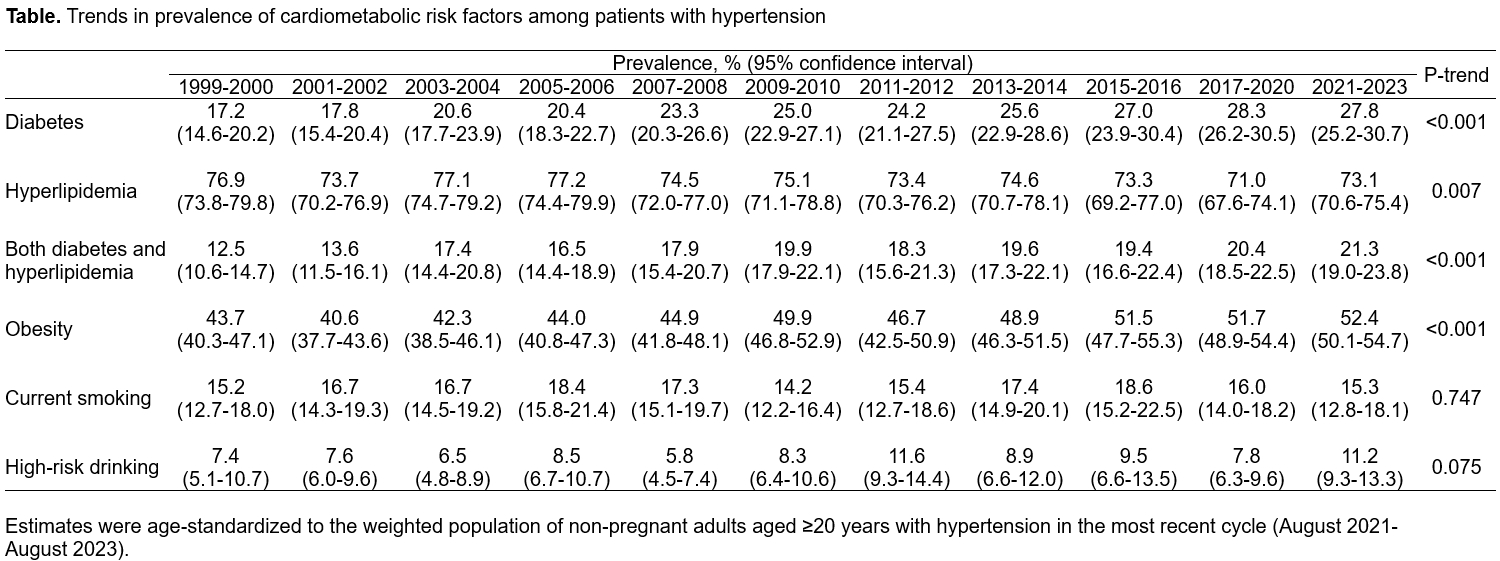
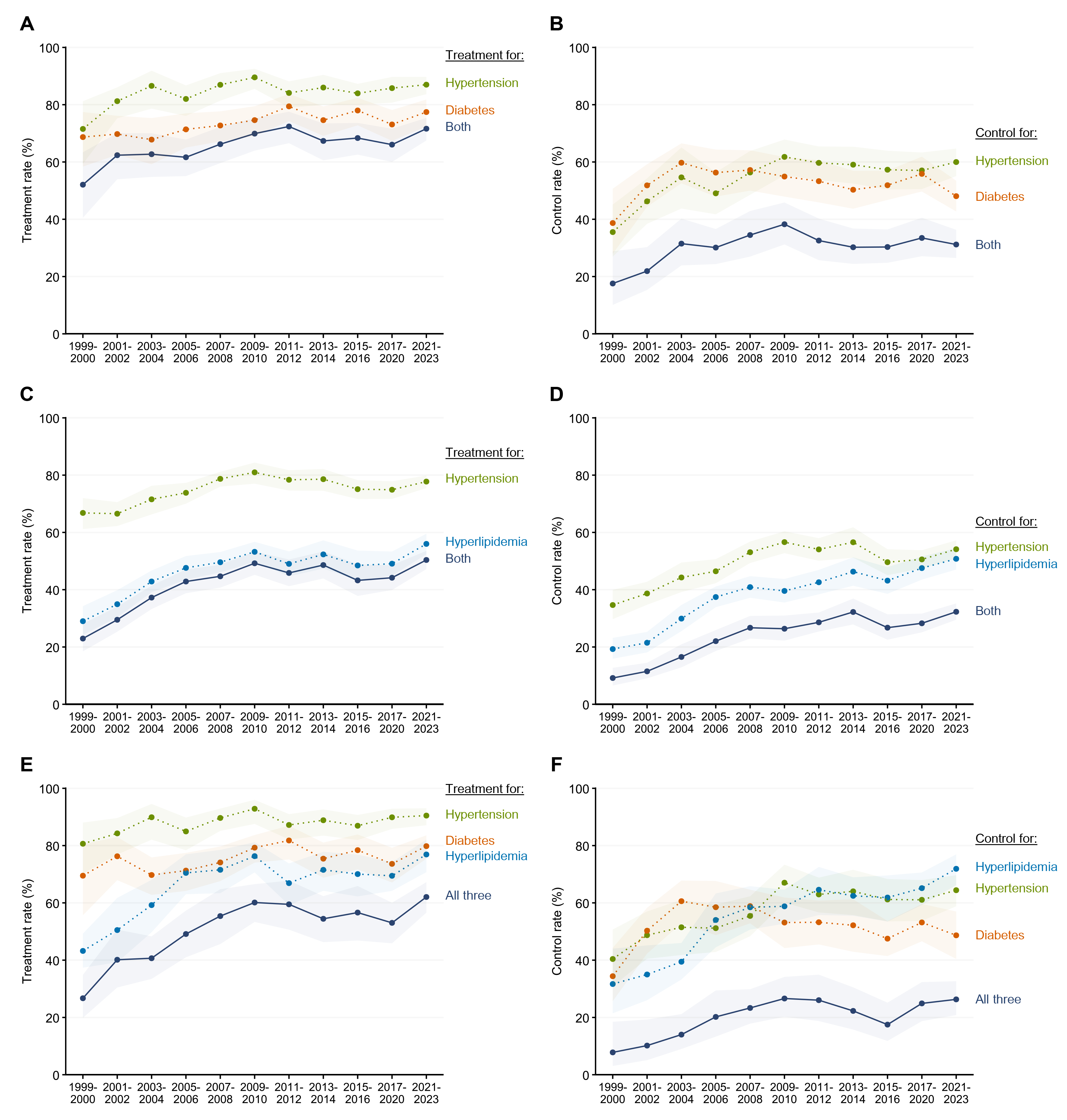
Results: During the study period, the prevalence of diabetes in patients with hypertension steadily increased (Table). Among patients with hypertension and diabetes, the treatment rate for both conditions rose until 2009-2010 (69.9%; 95% CI, 64.0-75.2) but subsequently leveled off (71.6% in 2021-2023; 95% CI, 67.5-75.4) (Fig. A). The control rate for both conditions showed a similar trend, with no improvement between 2007-2008 (34.5%; 95% CI, 27.0-42.9) and 2021-2023 (31.2%; 95% CI, 26.5-36.3) (Fig. B).
The prevalence of hyperlipidemia in patients with hypertension decreased over the study period (Table). Among patients with hypertension and hyperlipidemia, the treatment rate for both conditions increased until 2005-2006 (42.9%; 95% CI, 38.8-47.0) but then plateaued (50.4% in 2021-2023; 95% CI, 47.2-53.6) (Fig. C). Similarly, the control rate for both conditions improved only until 2007-2008 (26.7%; 95% CI, 23.0-30.8), without significant increase thereafter (32.3% in 2021-2023; 95% CI, 29.5-35.2) (Fig. D).
The prevalence of concurrent diabetes and hyperlipidemia in patients with hypertension nearly doubled during the study period (Table). Among patients with hypertension, diabetes, and hyperlipidemia, the treatment rate for all 3 conditions increased until 2007-2008 (55.4%; 95% CI, 45.6-64.8) but plateaued afterward (62.1% in 2021-2023; 95% CI, 56.6-67.2) (Fig. E). The control rate for all 3 conditions followed a similar trend, with the rate improving to 23.3% (95% CI, 17.8-29.8) in 2007-2008 but subsequently leveling off and remaining at 26.3% (95% CI, 20.8-32.6) in 2021-2023 (Fig. F).
Conclusion: Since 1999, the prevalence of concurrent diabetes and hyperlipidemia in adults with hypertension has nearly doubled in the US—largely driven by an increase in diabetes. Combined management of hypertension, diabetes, and hyperlipidemia has overall remained stagnant for over 15 years.
Lee, Hyeok-hee
(
BIDMC
, Boston , Massachusetts , United States )
Cho, So Mi
(
Broad Institute of MIT and Harvard
, Cambridge , Massachusetts , United States )
Krawisz, Anna
(
Beth Israel Deaconness
, Boston , Massachusetts , United States )
Secemsky, Eric
(
BIDMC
, Boston , Massachusetts , United States )
Author Disclosures:
Hyeok-Hee Lee:DO NOT have relevant financial relationships
| So Mi Cho:No Answer
| Anna Krawisz:DO have relevant financial relationships
;
Consultant:Medtronic:Past (completed)
| Eric Secemsky:DO have relevant financial relationships
;
Consultant:Abbott, Asahi, BD, Boston Scientific, Conavi, Cook, Cordis, Endovascular Engineering, Evident Vascular, Gore, InfraRedx, Medtronic, Penumbra, Philips, RapidAI, Rampart IC , R3, Regeneron, Shockwave , Siemens, Son i Vie, Teleflex, Terumo, Thrombolex, VentureMed , Zoll:Active (exists now)