Logo

American Heart Association

  113
  0


Final ID: MDP748

National Estimates of Patient Eligibility for Renal Denervation Therapy Post-FDA Approval

Abstract Body (Do not enter title and authors here): Background
Renal denervation (RDN) has been shown in randomized trials to improve blood pressure compared with a sham procedure. Currently, there are two FDA-approved RDN devices in the United States (US). While nearly half of the US population has hypertension (HTN), the number of patients who may benefit from RDN therapy remains uncertain. In this study, we used a nationally representative dataset to approximate the proportion of patients with HTN who may be eligible for consideration of RDN based on selective criteria.

Methods
All adult patients with HTN who participated in the National Health and Nutrition Examination Survey (NHANES) between the years 2009-2020 were identified. We characterized the proportion of these participants that met eligibility criteria based on 1) the FDA indication, 2) the SCAI 2023 RDN position statement, and 3) enrollment criteria from the RDN on-medication randomized trials. National estimates were obtained utilizing survey weighting from the NHANES multistage probability survey design.

Results
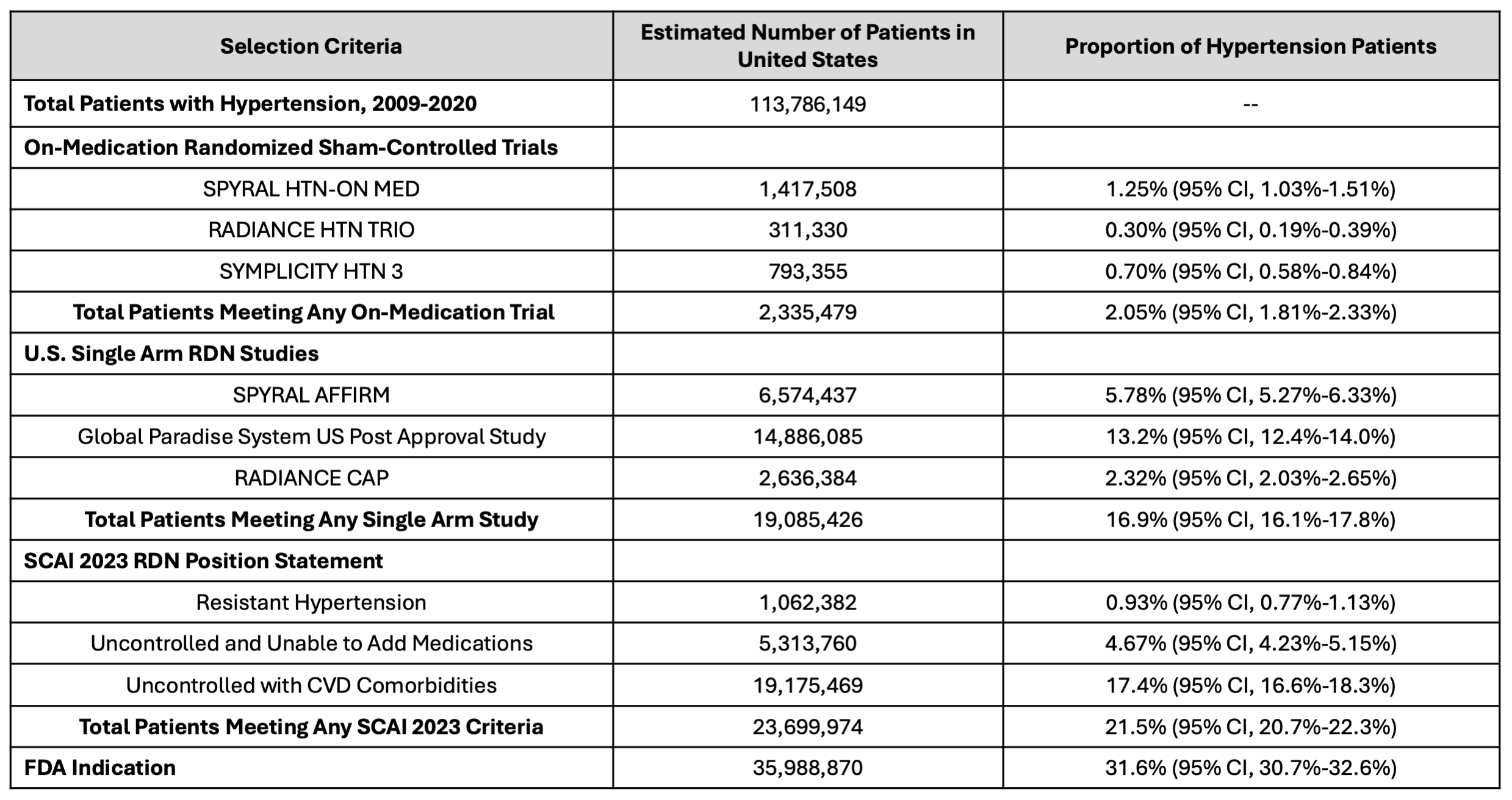
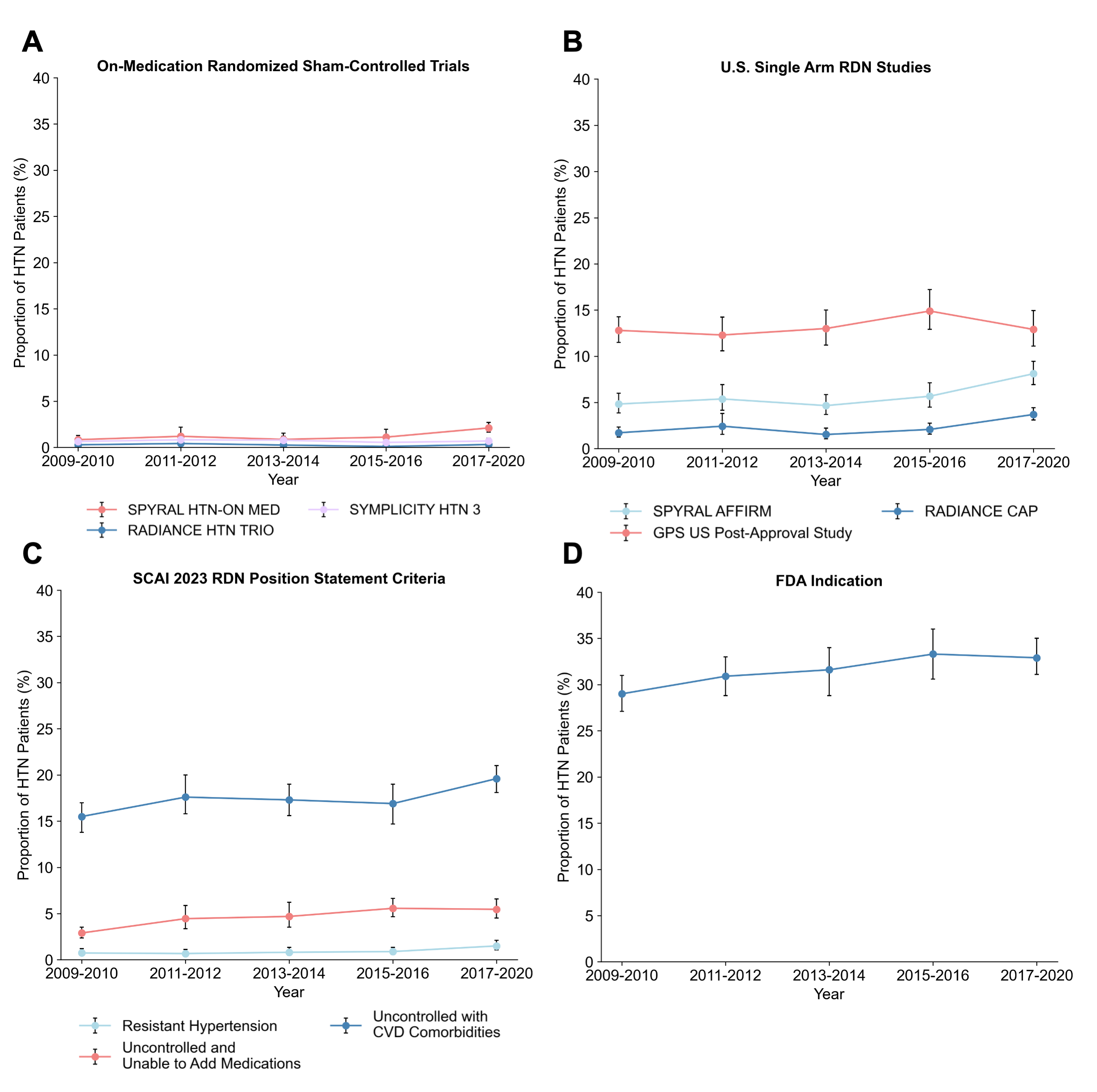
In total, we identified 16,677 patients with HTN in the US, representing a weighted total of 113,786,149 patients (Table). Using the FDA indication, 31.6% (95% CI, 30.7%-32.6%) of patients meet eligibility criteria for RDN, corresponding to 35,988,870 US adults. By the SCAI 2023 position statement selection criteria, 21.5% (95% CI, 20.7%-22.3%) of patients are eligible for consideration of RDN. Based on enrollment criteria from the RDN on-medication randomized trials, 2.05% (95% CI, 1.81%-2.33%) of US adults meet eligibility for consideration of RDN (Figure).

Conclusions
Our findings indicate that nearly one third of US adults with HTN are eligible for consideration of RDN based on the FDA indication; however, a smaller proportion of patients would be eligible based upon society recommendations and randomized trial inclusion criteria. Future studies are needed to further inform which patients will best benefit from this intervention.
  • Watson, Nathan  ( Harvard Medical School , Boston , Washington , United States )
  • Earle, William  ( BIDMC-Harvard Medical School , Boston , Massachusetts , United States )
  • Kandzari, David  ( PIEDMONT HEART INST , Atlanta , Georgia , United States )
  • Kirtane, Ajay  ( Columbia University Medical Center , New York , New York , United States )
  • Mahfoud, Felix  ( SAARLAND UNIVERSITY HOSPITAL , Homburg , Germany )
  • Cluett, Jennifer  ( BIDMC-Harvard Medical School , Boston , Massachusetts , United States )
  • Krawisz, Anna  ( BIDMC-Harvard Medical School , Boston , Massachusetts , United States )
  • Juraschek, Stephen  ( BIDMC-Harvard Medical School , Boston , Massachusetts , United States )
  • Secemsky, Eric  ( BIDMC-Harvard Medical School , Boston , Massachusetts , United States )
  • Author Disclosures:
    Nathan Watson: DO NOT have relevant financial relationships | William Earle: DO NOT have relevant financial relationships | David Kandzari: DO have relevant financial relationships ; Consultant:Medtronic:Active (exists now) ; Researcher:Ablative Solutions:Active (exists now) ; Researcher:Medtronic:Active (exists now) ; Consultant:DeepQure:Active (exists now) ; Consultant:Ablative Solutions:Active (exists now) | Ajay Kirtane: DO have relevant financial relationships ; Other (please indicate in the box next to the company name):Dr. Kirtane reports Institutional funding to Columbia University and/or Cardiovascular Research Foundation from Medtronic, Boston Scientific, Abbott Vascular, Amgen, CathWorks, CSI, Philips, ReCor Medical, Neurotronic, Biotronik, Chiesi, Bolt Medical, Magenta Medical, Canon, SoniVie, and Shockwave Medical. In addition to research grants, institutional funding includes fees paid to Columbia University and/or Cardiovascular Research Foundation for consulting and/or speaking engagements in which Dr. Kirtane controlled the content. Personal: Travel Expenses/Meals from Amgen, Medtronic, Biotronik, Boston Scientific, Abbott Vascular, CathWorks, Concept Medical, Edwards, CSI, Novartis, Philips, Abiomed, ReCor Medical, Chiesi, Zoll, Shockwave, and Regeneron.:Active (exists now) | Felix Mahfoud: DO have relevant financial relationships ; Consultant:Ablative Solutions, Amgen, Astra-Zeneca, Bayer, Boehringer Ingelheim, Inari, Medtronic, Merck, ReCor Medical, Servier, and Terumo.:Past (completed) | Jennifer Cluett: DO NOT have relevant financial relationships | Anna Krawisz: DO have relevant financial relationships ; Consultant:Medtronic:Active (exists now) | Stephen Juraschek: DO NOT have relevant financial relationships | Eric Secemsky: DO have relevant financial relationships ; Consultant:Abbott/CSI, BD, BMS, Boston Scientific, Cagent, Conavi, Cook, Cordis, Endovascular Engineering, Gore, InfraRedx, Medtronic, Philips, RapidAI, Rampart, Shockwave, Terumo, Thrombolex, VentureMed, Zoll:Active (exists now)
Meeting Info:

Scientific Sessions 2024

2024

Chicago, Illinois

Session Info:

Hypertension Gets Exciting! New Drugs! New Technologies! What Should I Choose?

Sunday, 11/17/2024 , 03:15PM - 04:30PM

Moderated Digital Poster Session

More abstracts on this topic:
Association of renal function with mortality and heart failure hospitalization rates after Transcatheter Mitral Valve Edge to Edge Repair

Abuzeid Wael, Shuvy Mony, Cantor Warren, Mehta Shamir, Fam Neil, Abdel-qadir Husam, Sacoransky Ethan, Czarnecki Andrew, Ke Danny Yu Jia, Teng Carolyn, Dave Prasham, Osten Mark, Zile Brigita, Wang Xuesong

Early renal denervation reduces ventricular arrhythmogenesis by improving Angiotensin II-disrupted expression of connexin 43 after acute myocardial infarction

Du Suiyong, Hu Wenfeng, Zhang Dongze

More abstracts from these authors:
You have to be authorized to contact abstract author. Please, Login
Not Available