Logo

American Heart Association

  46
  0


Final ID: 038

Racial and Ethnic Disparities in Shared Decision-Making Around Hypertension Among Women of Reproductive Age: Insights from the SAFE HEART Study

Abstract Body: Background:
Shared decision-making (SDM) enhances hypertension (HTN) management by promoting patient engagement and personalized care. Disparities in SDM may contribute to outcome inequities, especially among women of reproductive age, a high-risk but understudied group.
Objective:
To assess racial and ethnic differences in SDM among women of reproductive age and evaluate whether HTN status modifies these associations.
Methods:
We analyzed cross-sectional data from the AHA-funded SAFE HEART Study, which conducted primary data collection among women aged 18–49 years from Baltimore City and Washington County (August–November 2024). We enrolled 231 participants of whom 46 were excluded due to missing SDM or race/ethnicity data or small overall race/ethnicity group size, yielding n= 185 for analysis. SDM was assessed using the validated 3-item collaboRATE tool scored 0-4 per item and converted to a 0-100 scale using the top score method. Higher scores indicating greater shared decision-making. Race/ethnicity was self-reported as White, Black, Hispanic, or Asian. HTN status was defined through self-report and clinical documentation. Covariates included age, education, employment, insurance, and marital status. ANOVA with Bonferroni correction and stepwise linear regression models, including a race × HTN interaction term, were used.
Results:
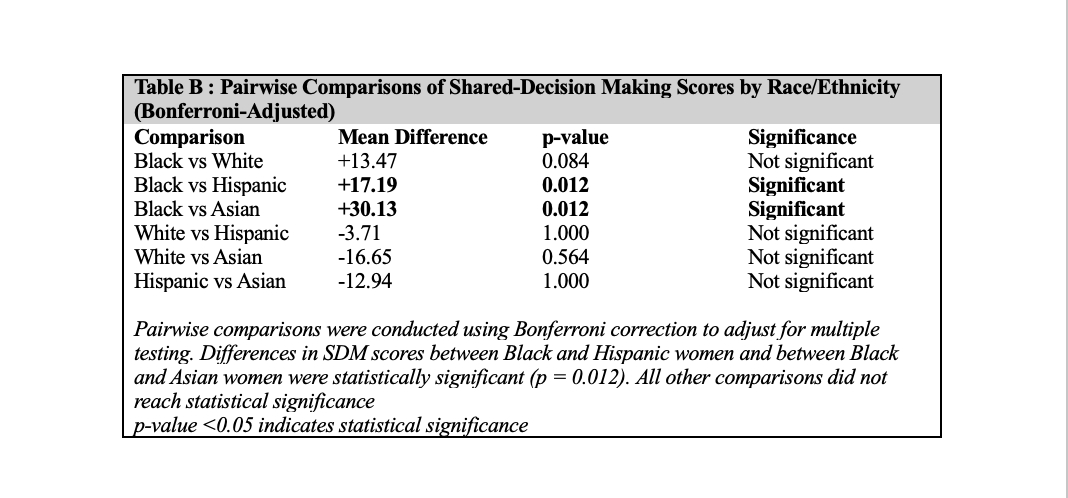
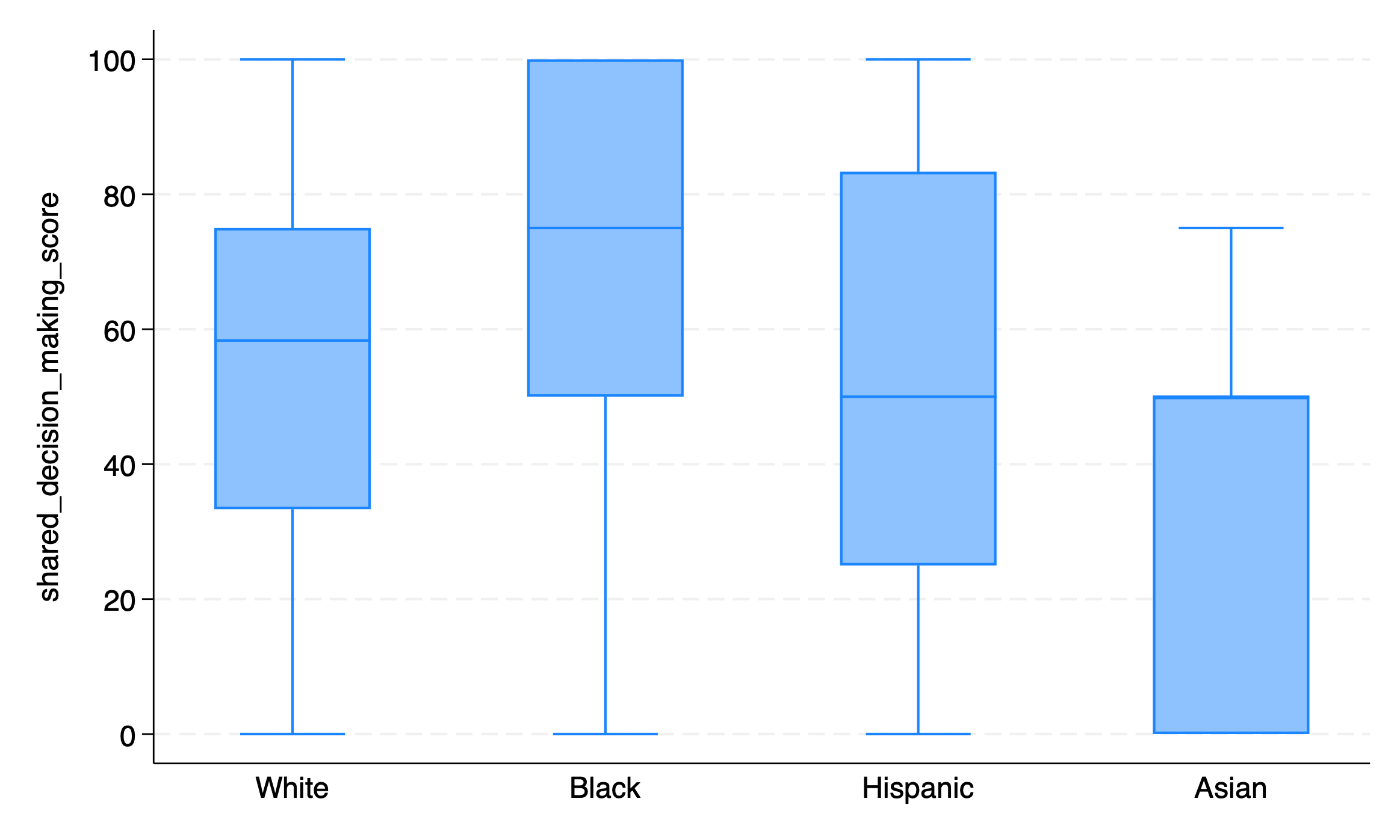
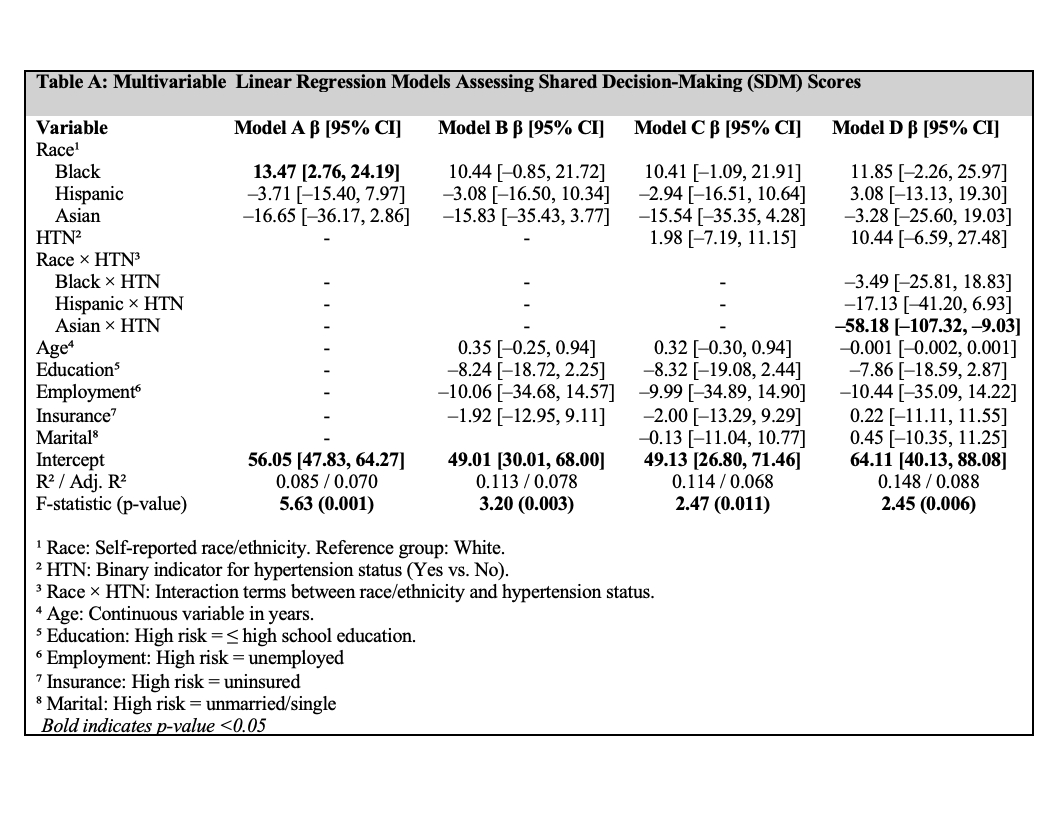
Mean age was 31.9 ± 8.0 years and varied significantly by race (p < 0.001): Hispanic (35.1±7.4), Black (33.4±7.9), White(28.2±6.9), and Asian (25.0±5.4). Educational attainment and insurance coverage also differed by race (p <0.001). HTN prevalence was highest among Black (46.6%) and Hispanic (40.0%) women. SDM scores also differed significantly (p = 0.001): Black (69.5 ± 27.3), White (56.0 ± 30.1), Hispanic (52.3 ± 33.1), and Asian (39.4 ± 27.7). Black women had higher SDM scores than White women in unadjusted models (β = 13.47, p = 0.014), though the difference attenuated after adjustment. Bonferroni-adjusted comparisons showed higher SDM scores among Black vs. Hispanic and Black vs. Asian women (both p = 0.012). A significant race × HTN interaction (β = –58.18, p = 0.021) suggested lower SDM among hypertensive Asian women; however, this finding should be interpreted cautiously due to the small subgroup size.
Conclusion:
Racial/ethnic disparities in SDM highlight gaps in care for women of reproductive age, emphasizing need for larger studies to evaluate these patterns to inform SDM practices around hypertension care.
  • Rayani, Asma  ( Johns Hopkins University School of Nursing , Baltimore , Maryland , United States )
  • Commodore-mensah, Yvonne  ( JOHNS HOPKINS SCHOOL OF NURSIN , Baltimore , Maryland , United States )
  • Ateh Stanislas, Ketum  ( Johns Hopkins University School of Nursing , Baltimore , Maryland , United States )
  • Metlock, Faith  ( Johns Hopkins University School of Nursing , Baltimore , Maryland , United States )
  • Vaidya, Dhananjay  ( JOHNS HOPKINS UNIVERSITY , Baltimore , Maryland , United States )
  • Baez Mateo, Ana  ( John Hopkins University School of N , Baltimore , Maryland , United States )
  • Hernandez, Lilian  ( Johns Hopkins University School of Nursing , Baltimore , Maryland , United States )
  • Dankwa, Kwabena  ( Johns Hopkins University School of Nursing , Baltimore , Maryland , United States )
  • Ouyang, Pamela  ( JOHNS HOPKINS UNIVERSITY , Towson , Maryland , United States )
  • Sharma, Garima  ( Inova Fairfax Medical Campus , Falls Church , Virginia , United States )
  • Author Disclosures:
    Asma Rayani: DO NOT have relevant financial relationships | Yvonne Commodore-Mensah: No Answer | Ketum Ateh Stanislas: DO NOT have relevant financial relationships | Faith Metlock: No Answer | Dhananjay Vaidya: DO NOT have relevant financial relationships | Ana Baez Mateo: DO NOT have relevant financial relationships | Lilian Hernandez: DO NOT have relevant financial relationships | Kwabena Dankwa: DO NOT have relevant financial relationships | Pamela Ouyang: DO NOT have relevant financial relationships | Garima Sharma: No Answer
Meeting Info:
Session Info:
More abstracts from these authors:
Perceived versus Actual Cardiovascular Health Risk among Women of Reproductive Age: SAFE HEART Women Study

Ateh Stanislas Ketum, Sharma Garima, Commodore-mensah Yvonne, Metlock Faith, Rayani Asma, Ezuma Chioma, Hladek Melissa, Baez Mateo Ana, Hernandez Lilian, Ouyang Pamela, Vaidya Dhananjay

Perceived Interpersonal Safety and Hypertension Diagnosis Among Women of Reproductive Age: Insights from the SAFE HEART Study

Ezuma Chioma, Hladek Melissa, Sharma Garima, Commodore-mensah Yvonne, Metlock Faith, Ateh Stanislas Ketum, Rayani Asma, Baez Mateo Ana, Hernandez Lilian, Dankwa Kwabena, Etelier Feodora, Vaidya Dhananjay, Ouyang Pamela

You have to be authorized to contact abstract author. Please, Login
Not Available