
Logo

American Heart Association

  48
  0


Final ID: 077

Semaglutide Attenuates High-Fat Diet-Induced Hypertension in Dahl Salt-Sensitive Rats

Abstract Body: Background:
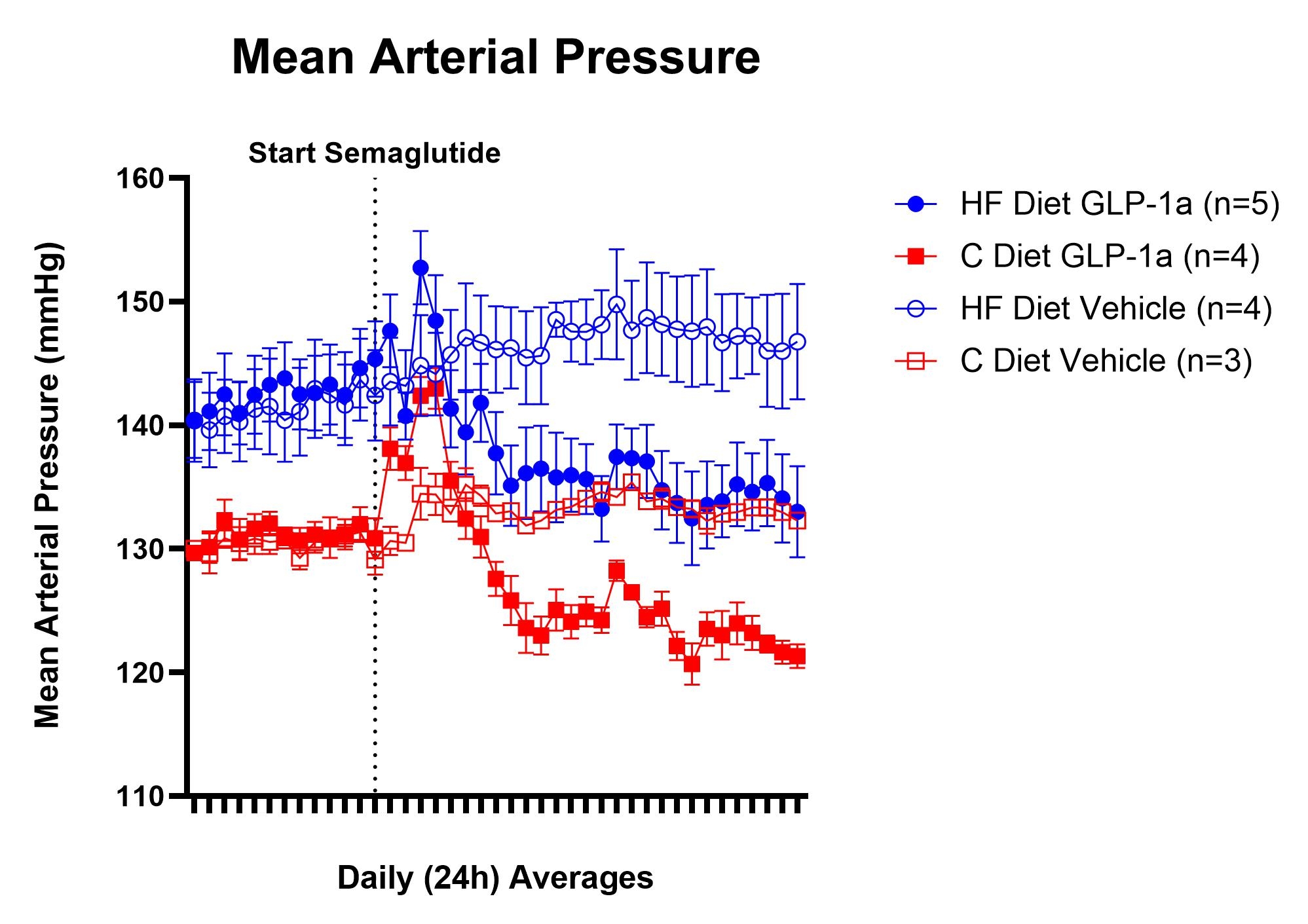
Glucagon-like peptide-1 receptor agonists (GLP-1RAs) are widely used for metabolic disease, but their effects on hypertension remain incompletely understood. This study tested the hypothesis that semaglutide, a long-acting GLP-1RA, attenuates blood pressure elevation and cardiometabolic abnormalities in a preclinical model of diet-induced hypertension.

Methods:
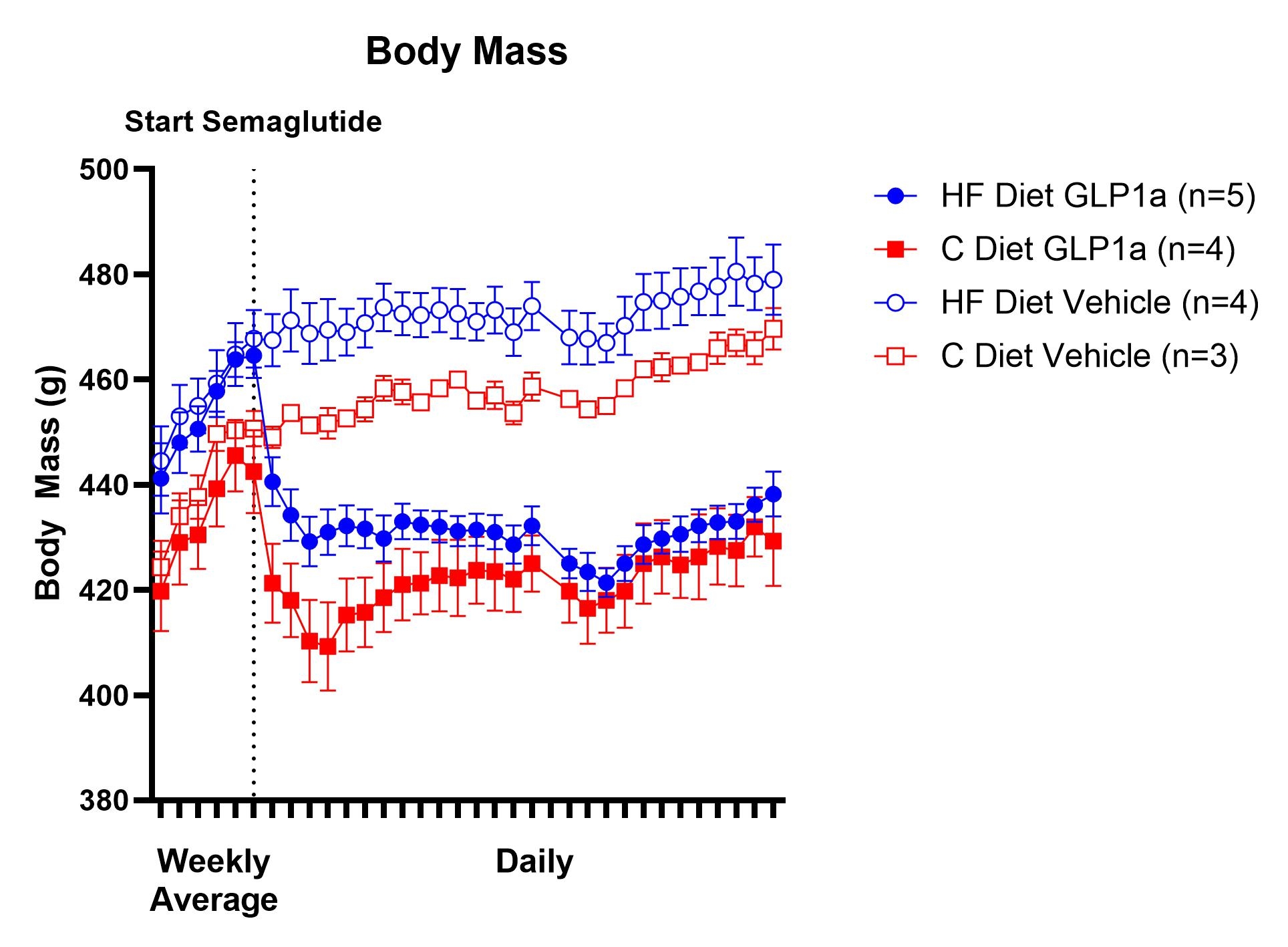
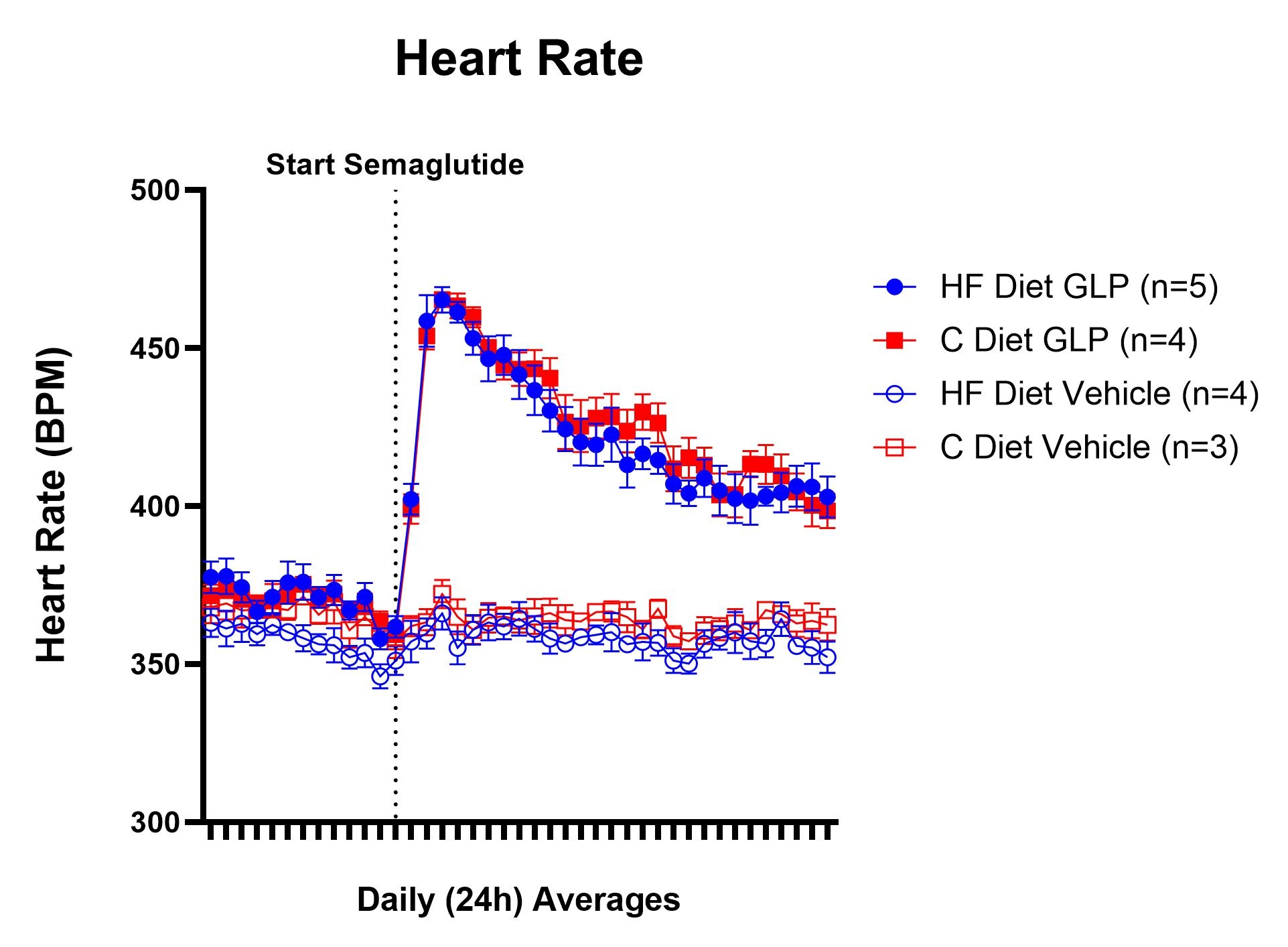
Male Dahl Salt-Sensitive rats (n=17) were fed a control diet (CD; 10% kcal from fat) or a high-fat diet (HFD; 60% kcal from fat) beginning at 4 weeks of age. After 21 weeks, rats received daily subcutaneous semaglutide (0.1 mg/kg) or vehicle for 28 days. Radiotelemetry enabled continuous monitoring of mean arterial pressure (MAP), heart rate, activity, and core temperature. Metabolic endpoints included body weight, food intake, fasting glucose, blood chemistry (renal, hepatic, lipid panels), and micro-CT imaging of adiposity.

Results:
HFD-fed rats exhibited significantly higher body weight (CD: 446.0 ± 4.7 g vs. HFD: 466 ± 3.2 g; p<0.05) and MAP (CD: 131.4 ± 0.7 mmHg vs. HFD: 142.5 ± 2.3 mmHg; p<0.05) than CD-fed controls. Semaglutide significantly reduced body weight in HFD rats (-11.2 ± 5.2 g from baseline; p<0.05) and decreased MAP in both CD and HFD groups (-8.4 ± 1.1 mmHg and -8.4 ± 0.9 mmHg, respectively; p<0.05). Treatment elicited a sustained heart rate increase (peak: +97.4 BPM in CD; +87.8 BPM in HFD; p<0.05), along with transient reductions in food/fluid intake and core body temperature. Locomotor activity declined temporarily, consistent with treatment-related malaise. Micro-CT imaging revealed substantial reductions in both visceral and subcutaneous fat depots with semaglutide. Markers of renal and hepatic function remained within normal ranges, though changes in biliary markers warrant further study. Correlation analysis linked reductions in adiposity and body weight to the antihypertensive effect of semaglutide.

Conclusions:
Semaglutide reduces blood pressure and body weight in a model of diet-induced hypertension. These findings support a role for GLP-1RAs in mitigating obesity-related hypertension via mechanisms beyond glucose lowering.

Grant Support: NHLBI P01HL152951.
  • Lauver, Adam  ( Michigan State University , East Lansing , Michigan , United States )
  • Garver, Hannah  ( Michigan State University , East Lansing , Michigan , United States )
  • Mckenzie, Mckenzie  ( Michigan State University , East Lansing , Michigan , United States )
  • Kram, Rachel  ( Michigan State University , East Lansing , Michigan , United States )
  • Hix, Jeremy  ( Michigan State University , East Lansing , Michigan , United States )
  • Watts, Stephanie  ( Michigan State University , East Lansing , Michigan , United States )
  • Fink, Gregory  ( Michigan State University , East Lansing , Michigan , United States )
  • Author Disclosures:
    Adam Lauver: DO NOT have relevant financial relationships | Hannah Garver: No Answer | McKenzie McKenzie: No Answer | Rachel Kram: DO NOT have relevant financial relationships | Jeremy Hix: No Answer | Stephanie Watts: DO NOT have relevant financial relationships | Gregory Fink: DO NOT have relevant financial relationships
Meeting Info:
Session Info:

Concurrent A: Genetics, Proteomics, and Metabolomics

Saturday, 09/06/2025 , 01:30PM - 03:00PM

Oral Abstract Session

More abstracts from these authors:
Adverse Maternal and Offspring Outcomes in Dahl Salt-Sensitive Rat Pregnancies: Impact of a Maternal Hypertensive High-Fat Diet

Gomes Viviane, Watts Stephanie, Fink Gregory, Kim Lauren, Lopez Krystal, Gilbert Bryce, Bailey Victoria, Marques Bruno, Garver Hannah, Mckenzie Mckenzie, Lauver Adam

A Murine Model of Mid-Thoracic Aortic Coarctation

Lauver Adam, Garver Hannah, Rendon Javier, Fink Gregory, Krieger-burke Teresa, Contreras Andres, Watts Stephanie

You have to be authorized to contact abstract author. Please, Login
Not Available