Hypertensive Emergency Hospitalizations and Mortality Trends Among Hispanic and Black Populations in the U.S. (2005–2022): An Integrated Analysis of CDC WONDER and National Inpatient Data
Abstract Body: Background Hypertensive crises are becoming more common, and they disproportionately affect racial and ethnic minorities in the United States. While national databases insights into mortality and hospitalization trends on their own, few studies have combined population-level and clinical data to provide a complete assessment of this growing disaster. This research combines CDC WONDER mortality data with hospitalization outcomes from the National Inpatient Sample (NIS) to look at temporal patterns and disparities among Hispanic and Black individuals from 2005 to 2022.
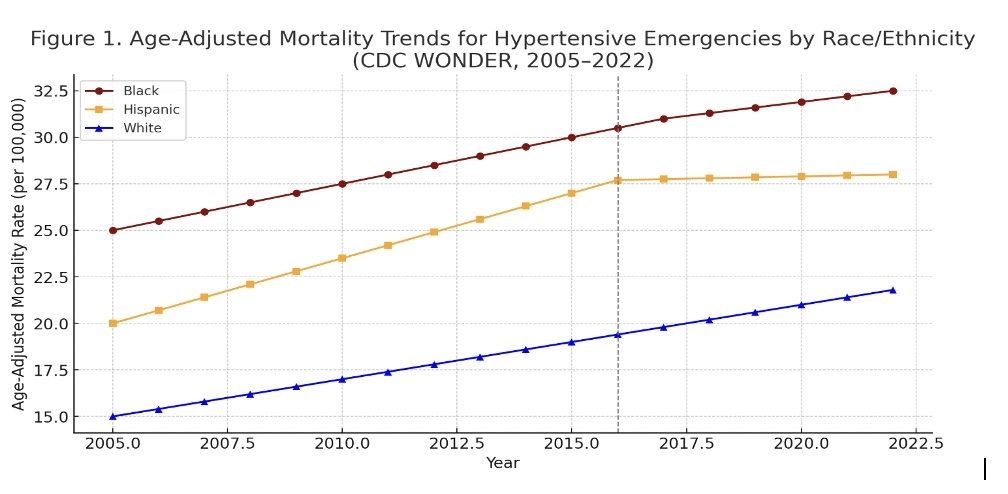
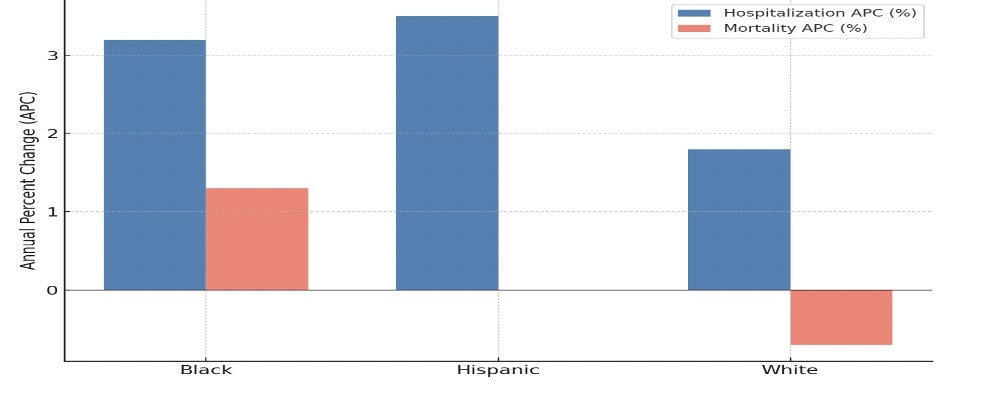
Methods Mortality data were obtained from the CDC WONDER Multiple Cause of Death database (ICD-10 codes I10-I16), and hospitalization data from the NIS (2005-2021), with hypertensive emergency admissions identified using ICD-9-CM code 401.0 and ICD-10-CM codes I16.0-I16.9. We calculated age-adjusted mortality rates (AAMRs) per 100,000 people and hospitalization rates by race/ethnicity (Black, Hispanic, and White). In-hospital mortality, extended stay (>4 days), and comorbidity load were among the NIS outcomes. Joinpoint regression identified major inflection points and annual percentage increases (APC). Results From 2005 to 2022, the CDC reported a 64% increase in hypertensive emergency-related mortality, with the largest increases among Hispanic (+91%) and Black (+78%) groups. AAMRs plateaued for Hispanics after 2016 but increased for Black patients from 2018 to 2022 (APC +1.3%, p = 0.04). A parallel analysis of 1.7 million NIS hospitalizations revealed similar trends: Black individuals were hospitalized at the highest incidence (42.7 per 100,000), followed by Hispanics (33.1) and whites (21.4). Although total in-hospital mortality has decreased, it remains disproportionately high among minority groups, particularly those with chronic renal disease in low-income ZIP locations.
Conclusion This dual-dataset analysis indicates an increasing and unequal incidence of hypertensive crises in the United States, particularly among Hispanic and Black populations. While clinical results have modestly improved, persistent mortality disparities need for community-based, culturally appropriate hypertension management and upstream public health interventions. Addressing socioeconomic causes, increasing access to treatment, and improving early detection in high-risk groups are critical for reversing these trends.
Kumar, Harendra
(
Dow University of Health Sciences
, Hyderabad , Pakistan )
Tiwari, Angad
(
Maharani Laxmibai Medical College
, Jhansi , India )
Sharma, Ashish
(
University of Connecticut
, Hartford , Connecticut , United States )
Jailani, Mohamed
(
University of Connecticut
, Hartford , Connecticut , United States )
Abi Rached, Emilio
(
University of Connecticut
, Hartford , Connecticut , United States )
Albeyoumi Mohammed, Hossam
(
University of Connecticut
, Hartford , Connecticut , United States )
Jain, Nidhi
(
University of Connecticut
, Hartford , Connecticut , United States )
Author Disclosures:
Harendra Kumar:DO NOT have relevant financial relationships
| Angad Tiwari:DO NOT have relevant financial relationships
| Ashish Sharma:DO NOT have relevant financial relationships
| Mohamed Jailani:No Answer
| Emilio Abi Rached:No Answer
| Hossam Albeyoumi Mohammed:DO NOT have relevant financial relationships
| Nidhi Jain:DO NOT have relevant financial relationships