
Logo

American Heart Association

  53
  0


Final ID: TH289

"Efficacy of Low-Dose Versus High-Dose Aprocitentan in Resistant Hypertension Management: A Meta-Analysis of Randomized Controlled Trials"

Abstract Body: Introduction:
Resistant hypertension is a growing clinical challenge, often inadequately controlled with standard therapies such as ACE inhibitors, ARBs, calcium channel blockers, and diuretics. Aprocitentan, a dual endothelin receptor antagonist recently approved by the FDA, represents a novel approach by targeting the endothelin pathway involved in vascular tone and blood pressure regulation. This meta-analysis evaluates the efficacy of low-dose (12.5 mg) versus high-dose (25 mg) aprocitentan compared to placebo in reducing sitting systolic (SiSBP) and diastolic blood pressure (SiDBP) in patients with resistant hypertension.

Hypothesis:
High-dose aprocitentan (25 mg) will provide greater BP reduction than low-dose (12.5 mg) and placebo.

Methods:
We searched PubMed, Cochrane, and clinicaltrials.gov for randomized controlled trials comparing changes in SiSBP and SiDBP with low- and high-dose aprocitentan versus placebo. Pooled mean differences were calculated using a random-effects model. Significance was set at p<0.05.

Results:
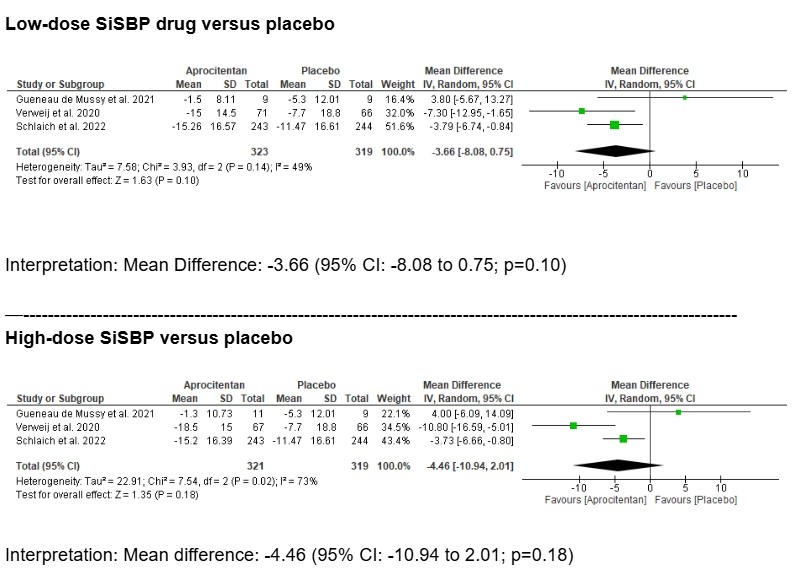
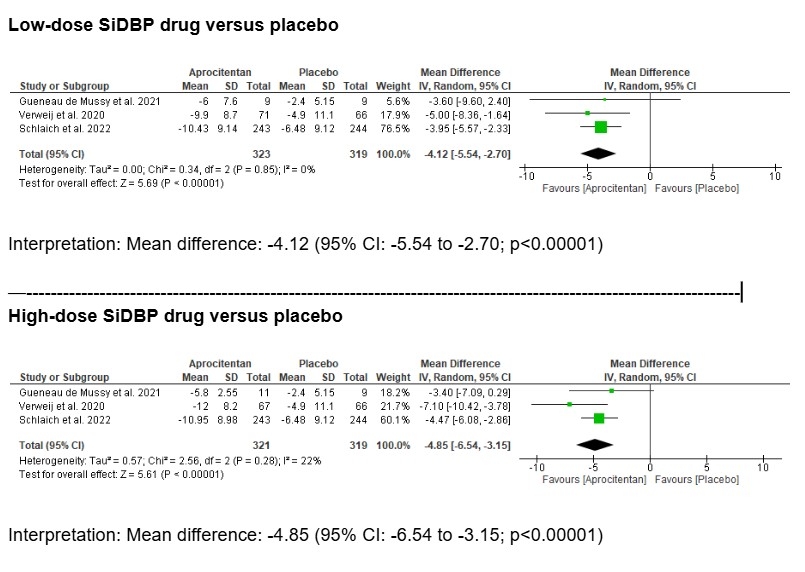
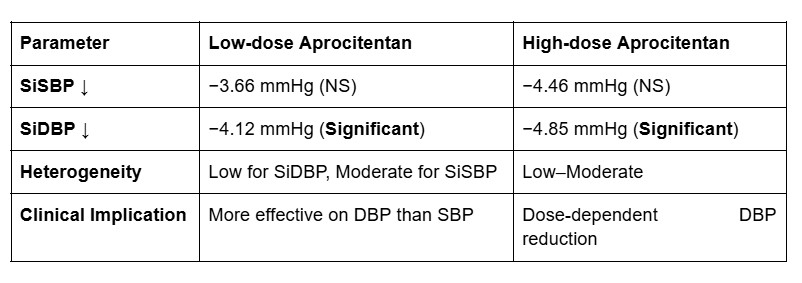
Three RCTs were included. For SiSBP, both low-dose (mean difference: -3.66 mmHg; 95% CI: -8.08 to 0.75; p=0.10) and high-dose (mean difference: -4.46 mmHg; 95% CI: -10.94 to 2.01; p=0.18) showed reductions vs placebo, though not statistically significant. In contrast, SiDBP was significantly reduced with both doses: low-dose (mean difference: -4.12 mmHg; 95% CI: -5.54 to -2.70; p<0.00001) and high-dose (mean difference: -4.85 mmHg; 95% CI: -6.54 to -3.15; p<0.00001). Heterogeneity was low for SiDBP comparisons (I2 = 0–22%) and moderate for SiSBP (I2 = 49–73%).

Conclusion:
Aprocitentan significantly reduces diastolic BP, with a dose-dependent trend favoring high-dose therapy. Systolic BP reductions were observed but did not reach statistical significance. These findings support the role of aprocitentan as an effective diastolic BP-lowering agent in resistant hypertension.

Clinical Implication:
Aprocitentan is effective in lowering diastolic BP, with dose-dependent improvement.
Effect on systolic BP remains inconclusive.
  • Adrejiya, Parth  ( Wellstar Health System , Griffin , Georgia , United States )
  • Panchal, Viraj  ( LSU Health , Shreveport , Louisiana , United States )
  • Shah, Vedant  ( NYMC- St. Mary's & St. Clare's , Denville , New Jersey , United States )
  • Abubaker, Mohammad  ( Wellstar Health System , Griffin , Georgia , United States )
  • Author Disclosures:
    Parth Adrejiya: DO NOT have relevant financial relationships | Viraj Panchal: No Answer | Vedant Shah: No Answer | Mohammad Abubaker: No Answer
Meeting Info:
Session Info:

Poster Session 1 and Reception (includes TAC Poster Competition)

Thursday, 09/04/2025 , 05:30PM - 07:00PM

Poster Session

More abstracts on this topic:
Comprehensive Resistant Hypertension Clinic Improves Access to Care and Blood Pressure Control

Vardanyan Lilit, Atreja Surabhi, Yoon Karis, Martinez-puente Brenda, Zeb Suhail, Acosta Milan, Ta Brian, Lwin Yee May, Lee Vivian, Sobol Tim

Effect of the endothelin receptor antagonist aprocitentan on plasma endothelin, renin and aldosterone concentrations in patients with resistant hypertension. A biomarker analysis of the PRECISION study.

Iglarz Marc, Blattmann Peter, Dreier Roland, Danaietash Parisa, Sassi-sayadi Mouna, Clozel Martine

More abstracts from these authors:

Evaluating the Performance of AI-Driven photoplethysmography(PPG) Models for Cuffless Blood Pressure Monitoring: A Meta-Analysis

Adrejiya Parth, Shah Vedant, Panchal Viraj, Abubaker Mohammad, Patel Kaushal, Irshad Sana, Singh Sonu

Evaluating Lipid-Lowering Efficacy Of Obicetrapib: An Updated Meta-Analysis of Clinical Trials

Adrejiya Parth, Panchal Viraj, Abubaker Mohammad, Guntuku Sandeep, Shah Vedant, Joshi Divya, Thandra Abhishek

You have to be authorized to contact abstract author. Please, Login
Not Available