
T cells activated by IsoLG-adducts display variable organ distribution depending on sex in Hypertension
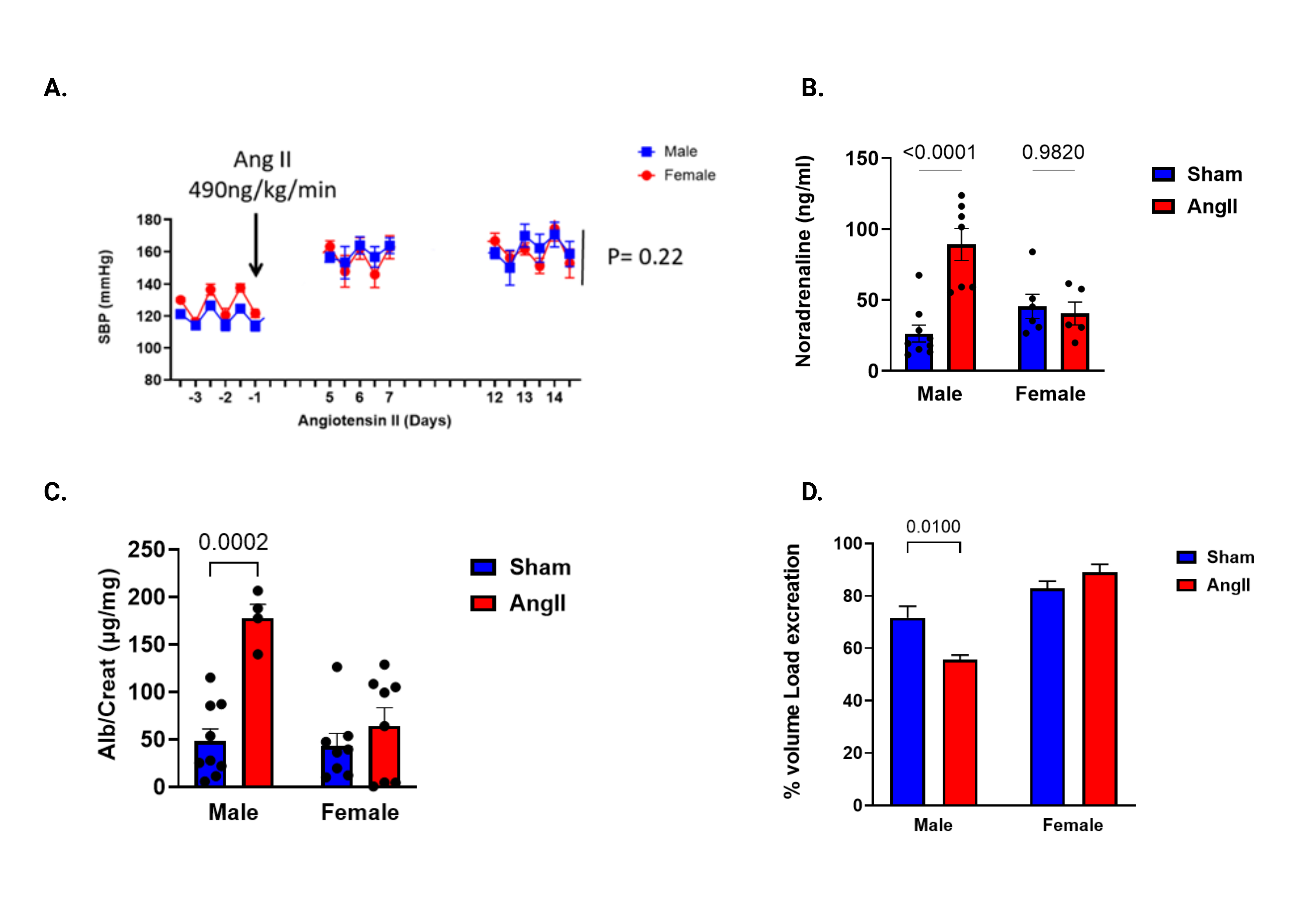
Abstract Body: BACKGROUND: Hypertensive stimuli increase reactive oxygen species (ROS) production and the formation of Isolevuglandins (IsoLGs) that modify self-proteins, forming IsoLG-adducts that are immunogenic. Dendritic cells (DCs) with these adducts migrate to spleen and secondary lymphoid organs and activate T cells that recognize the IsoLG adduct-MHC-I complex. Activated T cells then infiltrate target tissues, including the kidney and vasculature, release cytokines, and cause organ damage. We have identified four isoLG-adducted peptides presented by murine class-I major histocompatibility complex (H2-Db), triggering CD8+ T cell activation and promoting hypertension in male mice. HYPOTHESIS: Sex influences the immunogenicity of IsoLG-adducts and the accumulation of T cells specific for these adducts in hypertension. METHODS AND RESULTS: Ang II infusion (490 ng/kg/min X 2 weeks) induced identical blood pressure elevations in 12-week-old male and female C57Bl/6 mice (Figure Panel A). Despite this similar degree of hypertension, we observed a markedly different degree of renal but not vascular inflammation. Male mice exhibited a marked increase in CD8+ T cells detected by isoLG-adducted SGLT2 and CDH-16 peptide/H2-Db/IgG probes in the kidney, while female mice did not. We also employed Nur77-GFP mice to monitor acutely activated T cell receptors and observed that these predominantly exist in the TCR-specific T cells in male but not female mice. These changes in renal T cell accumulation were associated with striking differences in renal function. Albuminuria, serum creatinine, and urinary NGAL levels were elevated in hypertensive male but not female mice, and the ability to secrete a volume challenge was reduced in male but not female mice (Panel C-D). We have previously shown that catecholamines induce IsoLG formation. In keeping with this, we found that male mice exhibited a striking increase in urinary norepinephrine, while female mice did not (Panel B). Heart rate variability was similar between male and female mice during Ang II infusion. CONCLUSION: While the hypertensive response to Ang II is similar between male and female mice, female mice show protection against renal T cell activation and renal dysfunction. The similar levels of hypertension may indicate vascular inflammation, which is comparable between male and female mice and can contribute to increased systemic vascular resistance and vascular remodeling.
Abd-eldayem, Marwa
( Vanderbilt Medical Center
, Franklin
, Tennessee
, United States
)
Chen, Wei
( Vanderbilt Medical Center
, Franklin
, Tennessee
, United States
)
Hunter, Kuniko
( Vanderbilt Medical Center
, Franklin
, Tennessee
, United States
)
Rivera-medina, Luis Miguel
( Vanderbilt Medical Center
, Franklin
, Tennessee
, United States
)
Hennen, Elizabeth
( Vanderbilt University
, Nashville
, Tennessee
, United States
)
Bloodworth, Nathaniel
( Vander belt University
, Nashville
, Tennessee
, United States
)
Harrison, David
( VANDERBILT
, Nashville
, Tennessee
, United States
)
Author Disclosures:
Marwa Abd-Eldayem:DO NOT have relevant financial relationships
| Wei Chen:DO NOT have relevant financial relationships
| Kuniko Hunter:DO NOT have relevant financial relationships
| Luis Miguel Rivera-Medina:No Answer
| Elizabeth Hennen:No Answer
| Nathaniel Bloodworth:No Answer
| David Harrison:DO NOT have relevant financial relationships