
Logo

American Heart Association

  53
  0


Final ID: TAC228

Trends in Salt Substitute Use Among US Adults, 2003–2020

Abstract Body: Excessive sodium (Na) and inadequate potassium (K) intake are recognized as important risk factors for hypertension (HTN). Salt substitutes (SS) offer a potential strategy to reduce Na intake, yet trends in SS use in the U.S. population have not been explored. This study examined SS use among U.S. adults and HTN subgroups from 2003 to 2020 using data from the National Health and Nutrition Examination Survey (NHANES).
Adults aged ≥18 years were categorized into 4 subgroups based on presence of HTN (BP ≥130/80 mmHg) and antihypertensive medication use: 1) treated/controlled HTN, 2) treated/uncontrolled HTN, 3) untreated HTN, and 4) normotensive. Salt types were classified as ordinary salt (e.g., iodized salt, sea salt, etc.), SS (e.g., K-enriched or other SS), and no salt use. Additional analysis was performed in SS-eligible subjects with estimated glomerular filtration rate ≥ 60 ml/min/1.73m2 and not taking concomitant medications that reduce K excretion or K supplement. We also evaluated frequency of eating out to assess its influence on SS use. All analyses incorporated NHANES sampling weights and complex survey design.
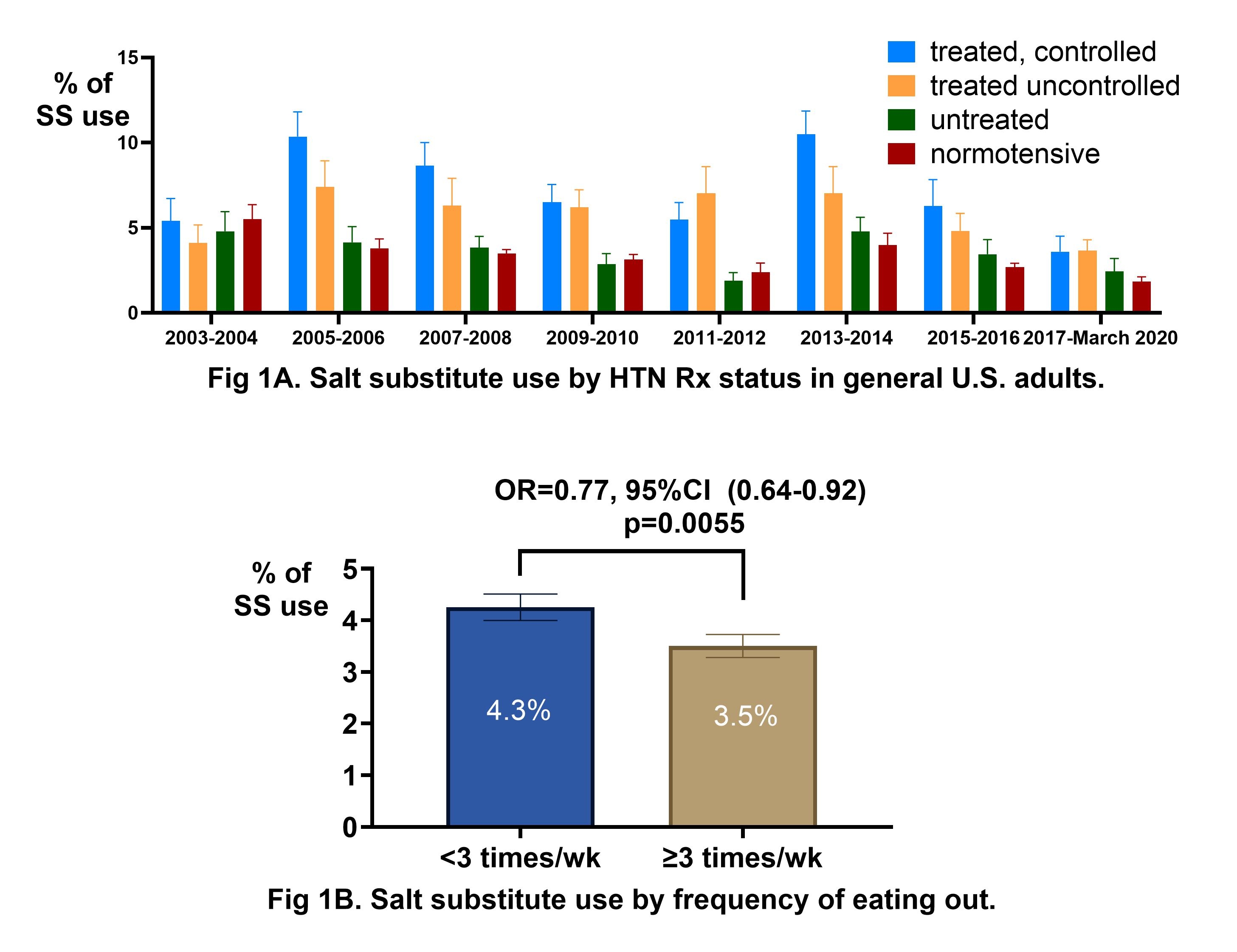
SS use among all U.S. adults remained low, peaking at 5.4% in 2013–2014 and falling to 2.5% by 2017–March 2020. Among eligible adults, use ranged from 2.3% to 5.1%. Usage was highest in individuals with treated and controlled hypertension (3.6–10.5%), followed by those with treated but uncontrolled hypertension (3.7–7.4%), while use remained consistently <5.6% among untreated and normotensive individuals (Figure 1A). Adults eating out ≥3 times/week had 23% lower odds of using SS compared to those who ate out less frequently (OR: 0.77, 95% CI: 0.64–0.92, p=0.0055; Figure 1B).
In a nationally representative sample of U.S. adults, SS use remained uncommon over two decades, including among those with HTN. Even among individuals with treated/ uncontrolled or untreated HTN, fewer than 8% reported using SS, while the majority continued to use ordinary salt. Low SS use may be related to higher frequency of eating out where individuals have limited control over the salt type. Greater efforts are needed to promote SS as part of dietary strategies to support HTN control, particularly among individuals with persistent or poorly controlled HTN.
  • Wei, Yinying  ( UT Southwestern Medical Center , Dallas , Texas , United States )
  • Abraham, Jesslin  ( UT Southwestern Medical Center , Dallas , Texas , United States )
  • Wang, Jijia  ( UT Southwestern Medical Center , Dallas , Texas , United States )
  • Sandon, Lona  ( UT Southwestern Medical Center , Dallas , Texas , United States )
  • Price, Angela  ( UT Southwestern , Dallas , Texas , United States )
  • Giacona, John  ( UT Southwestern Medical Center , Dallas , Texas , United States )
  • Vongpatanasin, Wanpen  ( UT Southwestern Medical Center , Dallas , Texas , United States )
  • Author Disclosures:
    YINYING WEI: DO NOT have relevant financial relationships | Jesslin Abraham: No Answer | Jijia Wang: DO NOT have relevant financial relationships | Lona Sandon: DO NOT have relevant financial relationships | Angela Price: DO NOT have relevant financial relationships | John Giacona: DO NOT have relevant financial relationships | Wanpen Vongpatanasin: DO NOT have relevant financial relationships
Meeting Info:
Session Info:

Poster Session 1 and Reception (includes TAC Poster Competition)

Thursday, 09/04/2025 , 05:30PM - 07:00PM

Poster Session

More abstracts on this topic:
Diet quality, pathway-specific polygenic risk scores, and risk of type 2 diabetes among US men and women

Mei Zhendong, Liang Liming, Hu Frank, Li Jun, Wang Xingyan, Yun Huan, Sevilla-gonzalez Magdalena, Hu Jie, Bhupathiraju Shilpa, Sun Qi, Stampfer Meir, Willett Walter

Adoptive Transfer of Lupus Patient PBMCs Promotes Salt-Sensitive Hypertension and Kidney Injury in Immunodeficient Mice

Saleem Mohammad, Ormseth Michelle, Kirabo Annet, Ahmad Taseer, Haynes Alexandria, Albritton Claude, Arshad Suha, Kulapatana Phicharmon, Posey Olivia, Major Amy, Stein Charles

More abstracts from these authors:
Accuracy of Visually Estimated Mean Home Blood Pressure: Estimating Yield of Eyeballed BP Study

Abraham Jesslin, Vongpatanasin Wanpen, Giacona John, Tran Bau, Brinker Stephanie, Price Angela, Jetpuri Zaiba, Kazi Salahuddin, Wei Yinying

Associations between High-density Lipoprotein Cholesterol Efflux and Brain Health

Giacona John, Rohatgi Anand, Vongpatanasin Wanpen, Wang Jijia, Zhang Rong, Kelley Brendan, Hajjar Ihab, Thomas Binu, Lacritz Laura, Yu Fang, De Lemos James

You have to be authorized to contact abstract author. Please, Login
Not Available