
Logo

American Heart Association

  46
  0


Final ID: 052

Innate Immunity-Mediated Mechanisms of Hypertensive Kidney Damage and Dysfunction

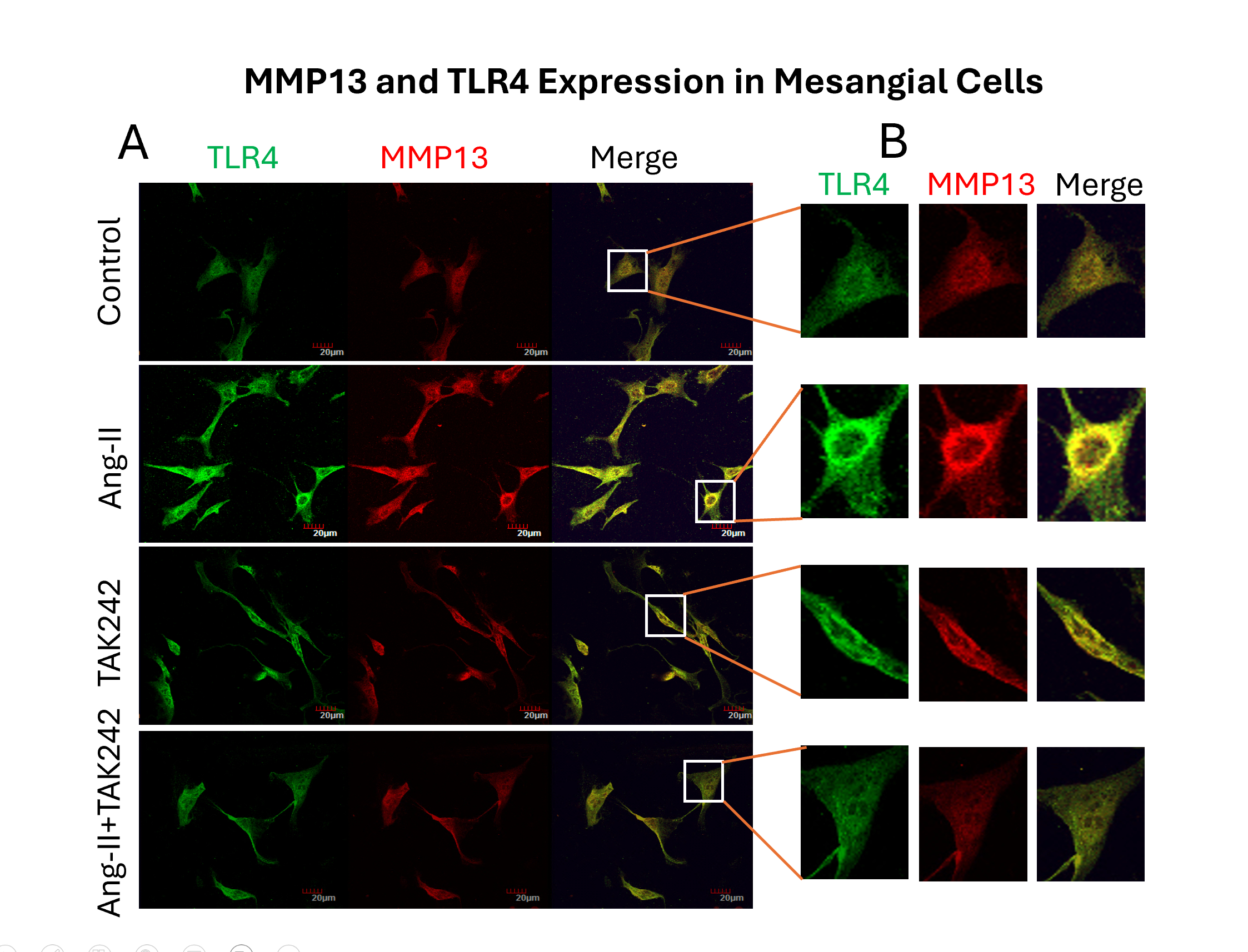
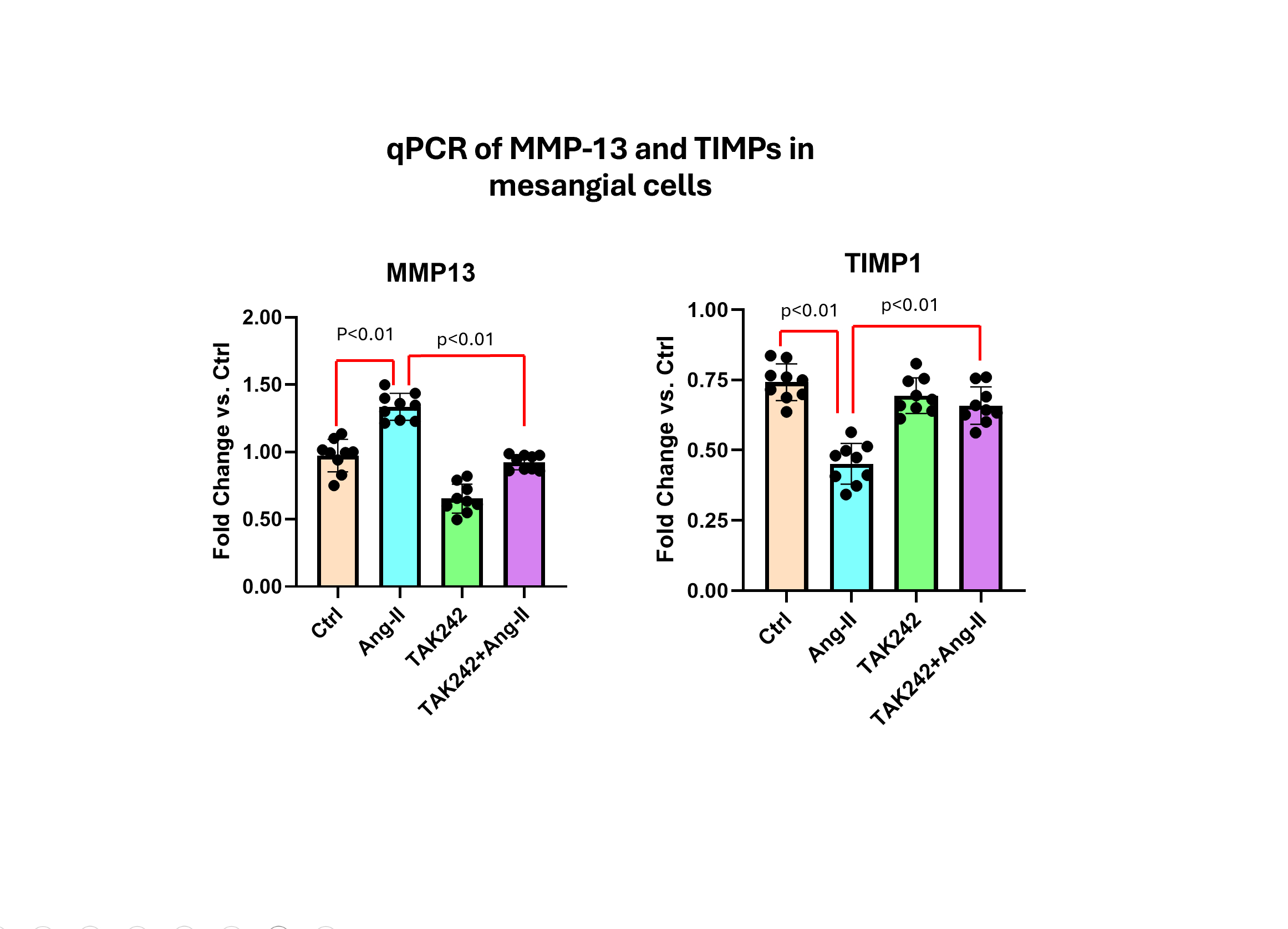
Abstract Body: Hypertension is a major cause of chronic kidney disease. It triggers an innate immune response that leads to further damage to the kidney's vasculature, resulting in dysfunction. We, along with others, have reported that toll-like receptors (TLRs) are key activators of this immune response in hypertension; however, the specific mechanisms are not fully understood. We hypothesized that hypertension activates TLR4, leading to kidney dysfunction through remodeling involving the NF-kB pathway. To test this hypothesis, we created a hypertensive animal model by infusing Angiotensin II (Ang-II) in TLR4 normal (TLR4N; C3H/Heouj) and TLR4 mutant (TLR4M; C3H/Hej) mice for four weeks. In vitro studies were conducted using mesangial cells treated with Ang-II and TAK-242 a TLR4 inhibitor. In vivo blood pressure was measured using radiotelemetry, while kidney function was assessed with the FITC-sinistrin method. Protein expression was quantified by Western blot analysis and immunostaining. Results are expressed as mean ± standard deviation (SD). Comparisons between groups were performed using one-way ANOVA, followed by a post-hoc Tukey test. The Mann–Whitney U test was used for nonparametric data. A difference with a p-value < 0.05 was considered significant. Our results indicated that Ang-II-induced hypertension led to diminished kidney function in both male and female TLR4N mice, effects that were less pronounced in TLR4M mice. Immunoblotting and immunostaining revealed increased expression of TLR4, an imbalance of matrix metalloproteinases (MMPs) and tissue inhibitors of metalloproteinases (TIMPs), pyroptosis marker GSDMD, and apoptotic marker caspase 9 in the kidneys of hypertensive male and female TLR4N mice, without sex-specific differences. These effects were mitigated in TLR4M mice, partly through the NF-kB pathway. In in vitro mesangial studies, Ang-II was found to increase TLR4 expression and MMP-13 levels while decreasing TIMP-1 and TIMP-3. These changes were ameliorated by TAK-242. In conclusion, our study revealed that TLR4 plays a critical role in hypertensive kidney damage and dysfunction through the NF-kB pathway. The mutation or inhibition of TLR4 limits kidney damage and dysfunction in hypertension.
  • Almarshood, Hebah  ( University of Louisville , Louisville , Kentucky , United States )
  • Sen, Utpal  ( UNIVERSITY OF LOUISVILLE , Louisville , Kentucky , United States )
  • Author Disclosures:
    Hebah Almarshood: DO NOT have relevant financial relationships | Utpal Sen: No Answer
Meeting Info:
Session Info:

KCVD Early Career Session

Saturday, 09/06/2025 , 08:00AM - 09:00AM

Oral Abstract Session

More abstracts on this topic:
Angiotensin II-induced vascular response is enhanced by Extracellular Vesicles

Wei Jin, Wu Jing, Musante Luca, Liu Ruisheng, Liu Jing, Greig Morgan, Harding Michael, Le Thu, Erdbruegger Uta

Cardioactive molecules identified by functional in vivo screening prevent anthracycline cardiotoxicity

Bortolotti Francesca, Mura Antonio, Riccio Matteo Maria, Dal Ferro Matteo, Zentilin Lorena, Giacca Mauro

You have to be authorized to contact abstract author. Please, Login
Not Available