
Logo

American Heart Association

  28
  0


Final ID: FR559

Risks of hyperkalaemia with potassium-enriched salt substitute among patients using concomitant blockade of the renin-angiotensin-aldosterone system in the Salt Substitute and Stroke Study

Abstract Body: Background
Potassium-enriched salt substitutes have been shown to reduce stroke, cardiovascular events, and all-cause mortality regardless of background use of antihypertensive drug therapy. However, concerns have been raised about the potential for causing hyperkalemia in patients with concomitant use of renin-angiotensin-aldosterone system (RAAS) blockers.
Methods
This post hoc analysis of the Salt Substitute and Stroke Study evaluated hyperkalemia risk, among participant subgroups that were and were not using RAAS blockade. Effects were compared between these subgroups for those assigned to potassium-enriched salt (75% sodium chloride, 25% potassium chloride) versus regular salt by estimating rate ratios and testing for heterogeneity.
Results
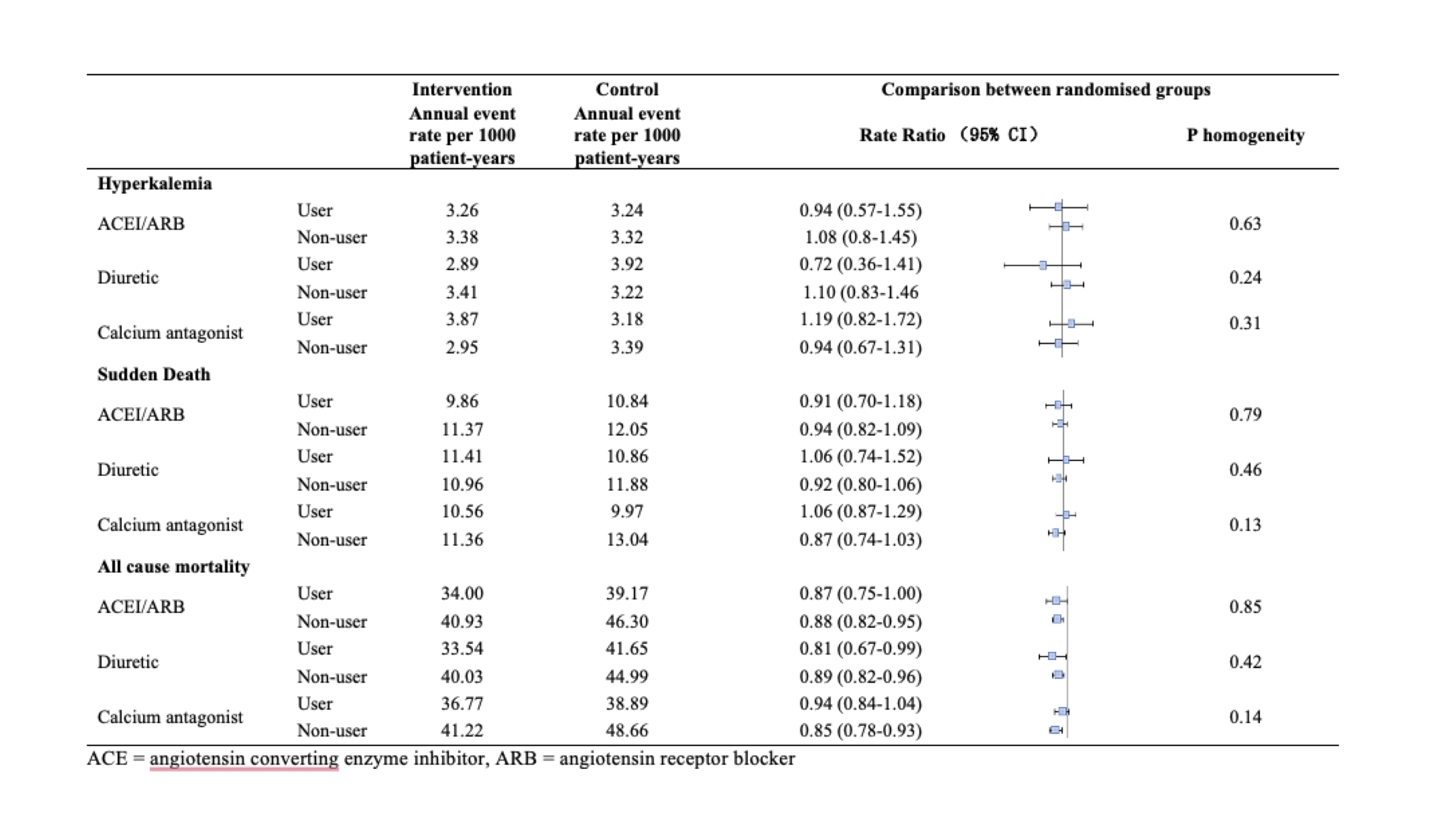
Among the 20,995 participants, 4,828 were using a RAAS blocker at baseline and 16,167 were not. There were 315 possible hyperkalemia events recorded during a median follow-up of 4.7 years. No overall increased risk was observed among those assigned to potassium-enriched salt substitute versus regular salt (rate ratio 1.04, 95% confidence interval 0.80 to 1.37). The rate ratio was 0.94 (0.57 to 1.55) for those with baseline use of RAAS blockade and 1.08 (0.80 to 1.45) for those not using RAAS blockade (p homogeneity=0.63). There were likewise no differences between these participant subgroups for risks of sudden death (1,133 events) or total mortality (4,172 events) (both p homogeneity>0.79).
Conclusions
There was no evidence that potassium-enriched salt use increased the risk of hyperkalaemia, sudden death or total mortality in patients with concomitant use of RAAS blockade. The use of RAAS blockade should not be a contra-indication to using a potassium-enriched salt substitute.
Clinical Trial Registration
ClinicalTrials.gov number NCT02092090 (https://clinicaltrials.gov/study/NCT02092090)
  • Yin, Xuejun  ( Nanchang University , Nanchang , China )
  • Wu, Yangfeng  ( PEKING UNIVERSITY , Beijing , China )
  • Trieu, Kathy  ( The George Institute , Newtown , New South Wales , Australia )
  • Neal, Bruce  ( GEORGE INSTITUTE GLOBAL HEALTH , Missenden Rd , New South Wales , Australia )
  • Huang, Liping  ( The George Institute for Global Health , New Delhi , India )
  • Tian, Maoyi  ( Harbin Medical University , Harbin , China )
  • Song, Hongyi  ( The George Institute for Global Health , Beijing , --- Select One --- , China )
  • Jha, Vivekanand  ( The George Institute for Global Health , New Delhi , India )
  • Kotwal, Sradha  ( UNIVERSITY OF SYDNEY , Sydney , New South Wales , Australia )
  • Marklund, Matti  ( The George Institute for Global Health , New Delhi , India )
  • Liu, Yishu  ( Nanjing Medical University , Nanjing , China )
  • Zhang, Xinyi  ( Harbin Medical University , Harbin , China )
  • Author Disclosures:
    Xuejun Yin: DO NOT have relevant financial relationships | Yangfeng Wu: No Answer | Kathy Trieu: No Answer | Bruce Neal: DO NOT have relevant financial relationships | Liping Huang: No Answer | Maoyi Tian: No Answer | Hongyi Song: No Answer | Vivekanand Jha: No Answer | Sradha Kotwal: DO have relevant financial relationships ; Consultant:Novartis:Active (exists now) ; Speaker:Amgen:Past (completed) ; Other (please indicate in the box next to the company name):Bayer:Active (exists now) ; Consultant:Dimerix:Past (completed) ; Speaker:Novo Nordisk:Active (exists now) | Matti Marklund: No Answer | Yishu Liu: No Answer | Xinyi Zhang: No Answer
Meeting Info:
Session Info:

Poster Session 2 with Breakfast Reception

Friday, 09/05/2025 , 09:00AM - 10:30AM

Poster Session

More abstracts on this topic:
Hacking the ubiquitin code to distinctively modulate ion channel functional expression

Shanmugam Sri Karthika, Kanner Scott, Zou Xinle, Choudhury Papiya, Soni Rajesh, Kass Robert, Colecraft Henry

Macrophage PPARα is essential to increased immune function induced by angiotensin converting enzyme (ACE).

Bernstein Kenneth, Saito Suguru, Cao Duo-yao, Bernstein Ellen, Nishi Erika, Shibata Tomohiro, Khan Zakir

More abstracts from these authors:
Estimated health impact, cost, and cost-effectiveness of mandating sodium benchmarks in Australia’s packaged foods

Marklund Matti, Trieu Kathy, Aminde Leopold, Cobiac Linda, Coyle Daisy, Huang Liping, Neal Bruce, Veerman J. Lennert, Wu Jason

Discussant: SSTT (See Sodium To Treat)

Neal Bruce, Gupta Deepak, Flack John

You have to be authorized to contact abstract author. Please, Login
Not Available