Mineralocorticoid Receptor Signaling in Chronic Kidney Disease-Driven Aortic Stenosis: Role of the Innate Immune Toll-Like Receptor Pathway
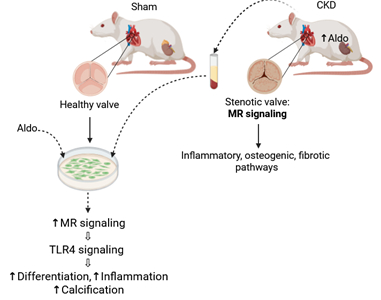
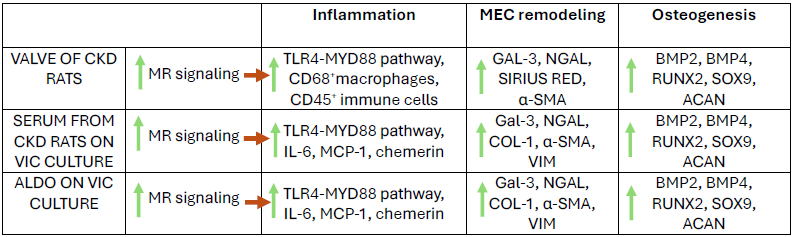
Abstract Body: INTRODUCTION: Chronic kidney disease (CKD) is a progressive condition marked by declining kidney function. It is a known cardiovascular disease risk factor, driven by hypertension, chronic inflammation, uremic toxins, phosphate-calcium imbalance, and RAAS dysregulation. These factors contribute to cardiac hypertrophy and vascular/valvular dysfunction. Elevated aldosterone (aldo) levels, common in CKD, promote vascular and valvular disease via mechanisms including mineralocorticoid receptor (MR) and Neutrophil Gelatinase-Associated Lipocalin (NGAL). Thus, aldo may accelerate aortic valve (AV) remodeling by promoting inflammation, fibrosis, and mineralization during aortic stenosis (AS). OBJECTIVE: To elucidate the specific role of aldosterone/MR signaling in CKD-associated aortic stenosis and uncover novel MR-driven pathogenic pathways. METHODS: CKD was induced in rats via 5/6 subtotal nephrectomy. Three groups were studied: (i) Sham-operated rats, (ii) CKD rats on a high-phosphate (HP) diet post-surgery, and (iii) CKD+EPLE rats treated with the MRA eplerenone (100 mg/kg/day). Human AV samples from AS patients with CKD were analyzed. In vitro studies used primary rat valve interstitial cells (VIC) exposed to CKD rat serum or treated with aldo (10-8M) or recombinant NGAL (500 ng/mL), with or without finerenone (10-6M). qPCR, IHC and ELISA were used. RESULTS: Our results demonstrate that MR signaling plays a central role in AS progression in CKD, in both humans and rats, evidenced by increased expression of activation, inflammatory, and osteogenic markers in the AV of CKD rats, reduced after MRA treatment. A positive correlation between MR and its downstream target NGAL with CKD stages was found in human AV. Protein analyses in CKD-rat AV supported these findings and underscored the mediating role of MR. Human and animal models showed that CKD-related valvular damage involves TLR4-mediated innate immune activation, regulated by MR signaling and disease severity. In vitro, VIC exposed to CKD rat serum showed increased activation, inflammation, and osteogenic differentiation via an MR-dependent mechanism that also induced TLR4 signaling. Direct stimulation of VIC with aldo or rNGAL confirmed the activation of TLR4-MYD88 and osteogenic pathways downstream of MR-NGAL signaling. CONCLUSION: These findings emphasize the role of MR signaling in AS progression during CKD and support MRA as a therapeutic option, backed by trials based on finerenone effects.
Sanchez-bayuela, Tania
(
INSERM-U1166
, Paris , France )
Soulié, Matthieu
(
INSERM-U1166
, Paris , France )
Jaisser, Frederic
(
INSERM-U1166
, Paris , France )
Author Disclosures:
Tania Sanchez-Bayuela:DO NOT have relevant financial relationships
| Matthieu Soulié:No Answer
| Mattie Garaikoetxea:No Answer
| Amaya Fernandez de Celis:DO NOT have relevant financial relationships
| Natalia Lopez-Andres:DO NOT have relevant financial relationships
| Frederic Jaisser:DO NOT have relevant financial relationships