Concordance between home and ambulatory awake blood pressure in older adults with hypertension: Findings from AMBROSIA-HOME study
Abstract Body: Introduction: Ambulatory blood pressure (BP) monitoring (ABPM) and home blood pressure (BP) monitoring (HBPM) are recommended to manage BP among adults taking antihypertensive medication. Therefore, our goal was to determine whether awake BP is similar when measured on HBPM and ABPM.
Methods: The Ambulatory Blood Pressure in Older Adults Home BP Monitoring (AMBROSIA-HOME) study included participants from Kaiser Permanente Southern California aged ≥65 years taking antihypertensive medication. We included participants who had completed 24 hours of ABPM with BP measured every 20 minutes during awake hours and every 30 minutes during sleep hours and 7 days of HBPM consisting of 2 BP readings in the morning and in the evening between 2019 and 2023. Difference between mean systolic BP (SBP) and diastolic BP (DBP) on ABPM and HBPM, limits of agreement (mean difference±1.96×SD of the difference), and intraclass correlation coefficient (ICC) were assessed. We compared ability of ABPM and HBPM to identify these BP phenotypes: uncontrolled hypertension (office and ABPM/HBPM BP≥130/80 mmHg), masked uncontrolled hypertension (office BP<130/80mmHg and ABPM/HBPM awake BP ≥ 130/80 mmHg) and white coat effect (office BP≥130/80mmHg and ABPM/HBPM awake BP<130/80mmHg).
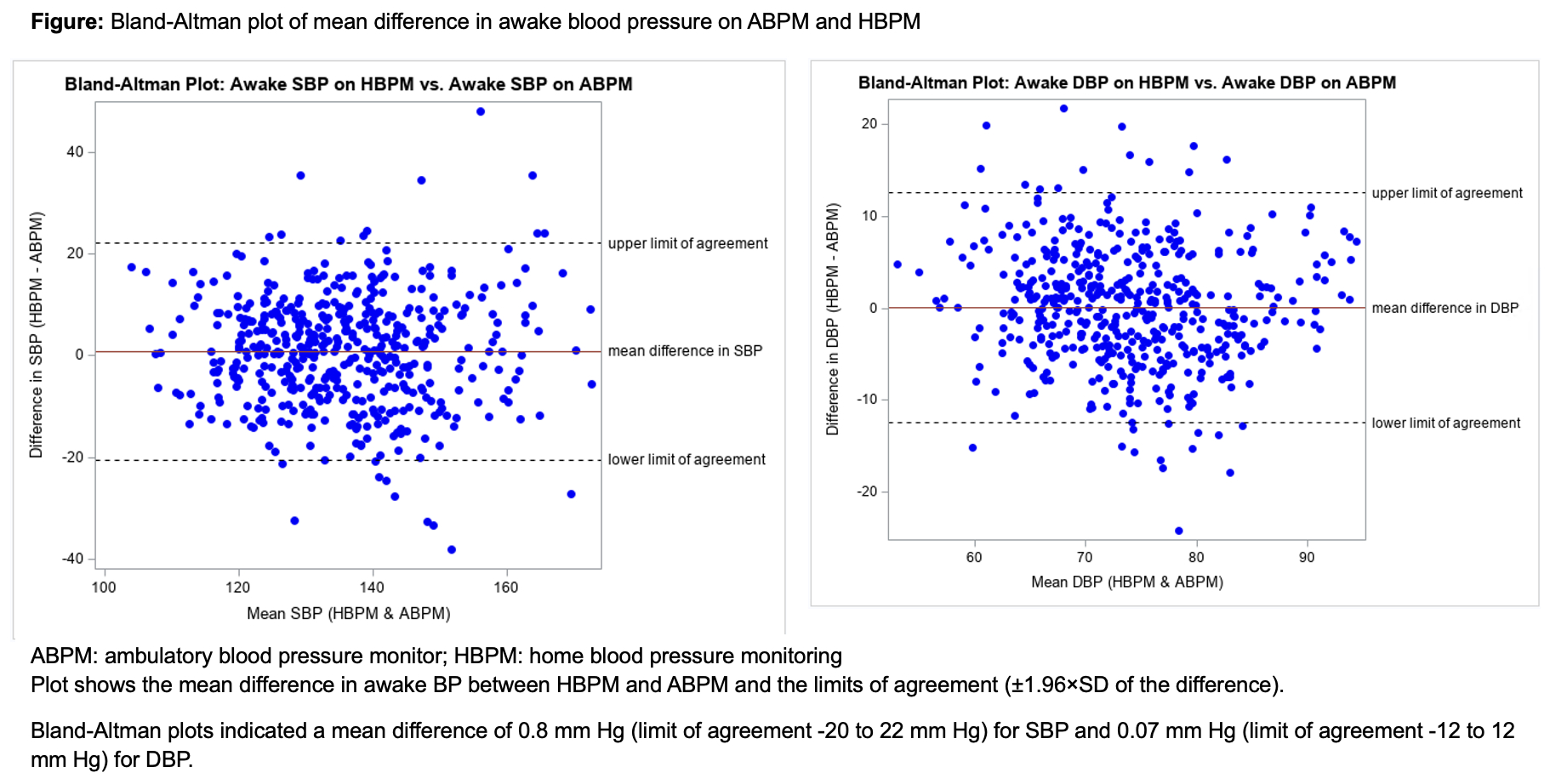
Results: We included 470 participants (mean age 74 years; 57% female; 45% non-Hispanic white). Mean (standard deviation [SD]) of awake SBP on HBPM and ABPM was 135.9 (13.8) and 135.1 (13.0) mmHg, respectively. Mean (SD) of awake DBP on HBPM and ABPM was 73.9 (7.9) and 73.8 (8.6) mmHg, respectively. Bland-Altman plots shown in Figure. The ICC was 0.68 (95%CI: 0.63, 0.73) for SBP and 0.70 (95% CI: 0.65, 0.74) for DBP. Overall agreement between HBPM and ABPM for identifying uncontrolled BP, masked uncontrolled hypertension, and white coat effect was 0.75 (95%CI: 0.72, 0.79), 0.87 (95%CI: 0.84, 0.90), 0.88 (95%CI: 0.85, 0.91), respectively. The Kappa statistic between HBPM and ABPM for identifying uncontrolled BP, masked uncontrolled hypertension, and white coat effect was 0.46 (95%CI: 0.38, 0.55), 0.62 (95%CI: 0.53, 0.70) and 0.47 (95%CI: 0.35, 0.59), respectively.
Conclusion: HBPM and ABPM demonstrated good overall agreement and moderate reliability in identifying BP phenotypes among older adults. However given the wide intra-individual variability, the two methods may not yield the same BP values for a given individual and the choice of method may depend on factors such as availability, patient preference, or cost.
Ghazi, Lama
(
University of Alabama at Birmingham
, Huntsville , Alabama , United States )
Dubal, Medha
(
University of Alabama at Birmingham
, Birmingham , Alabama , United States )
Reynolds, Kristi
(
KAISER PERMANENTE
, Pasadena , California , United States )
Wei, Rong
(
Kaiser Permanente So. California
, Pasadena , California , United States )
Harrison, Teresa
(
KAISER PERMANENTE SOUTHERN CA
, Pasadena , California , United States )
Muntner, Paul
(
University of Alabama at Birmingham
, Huntsville , Alabama , United States )
Shimbo, Daichi
(
COLUMBIA UNIVERSITY
, New York , New York , United States )
Levitan, Emily
(
UNIVERSITY ALABAMA AT BIRMINGHAM
, Birmingham , Alabama , United States )
Author Disclosures:
Lama Ghazi:DO NOT have relevant financial relationships
| Medha Dubal:No Answer
| Kristi Reynolds:DO have relevant financial relationships
;
Research Funding (PI or named investigator):Merck & Co:Past (completed)
| Rong Wei:DO NOT have relevant financial relationships
| Teresa Harrison:DO NOT have relevant financial relationships
| Paul Muntner:No Answer
| Daichi Shimbo:DO NOT have relevant financial relationships
| Emily Levitan:DO have relevant financial relationships
;
Research Funding (PI or named investigator):Amgen:Past (completed)
; Other (please indicate in the box next to the company name):University of Pittsburgh, DSMB member:Active (exists now)