
Logo

American Heart Association

  61
  0


Final ID: 010

Machine Learning and Longitudinal Blood Pressure Data Enhance Prediction of Hypertensive Disorders of Pregnancy

Abstract Body:
Introduction. Early identification of pregnant women at risk of hypertensive disorders of pregnancy (HDP) is critical for improving pregnancy outcomes. The USPSTF risk stratification approach (hereafter called USPSTF checklist), typically used to assess preeclampsia risk for prophylactic aspirin use, does not account for nuanced relationships between risk factors and does not account for how a patient’s clinical profile evolves during pregnancy. Our objectives were to determine: 1) if a machine learning model to predict HDP could outperform the current checklist used in clinical practice, and 2) whether incorporating longitudinal blood pressure (BP) measurements further enhances predictive performance.

Hypothesis. We hypothesize that 1) a baseline prediction model using machine learning will provide improved identification of HDP risk compared with the USPSTF checklist, and 2) a dynamic prediction model that additionally incorporates longitudinal BP measures after the first prenatal visit will further boost model performance.

Methods. Pregnant individuals prospectively enrolled in a digital health platform from 2022-2024 were included. Using electronic health records and platform-collected data, we trained a baseline prediction model for HDP based on the USPSTF checklist risk factors using a machine learning approach (ridge logistic regression). We then incorporated longitudinal BP values taken during pregnancy at-home with a remote patient monitoring device and in-clinic. BP features included in the model were computed as a set of 13 summary statistics characterizing centrality, spread, and trends. Performance of both models was assessed using area under the curve (AUC).

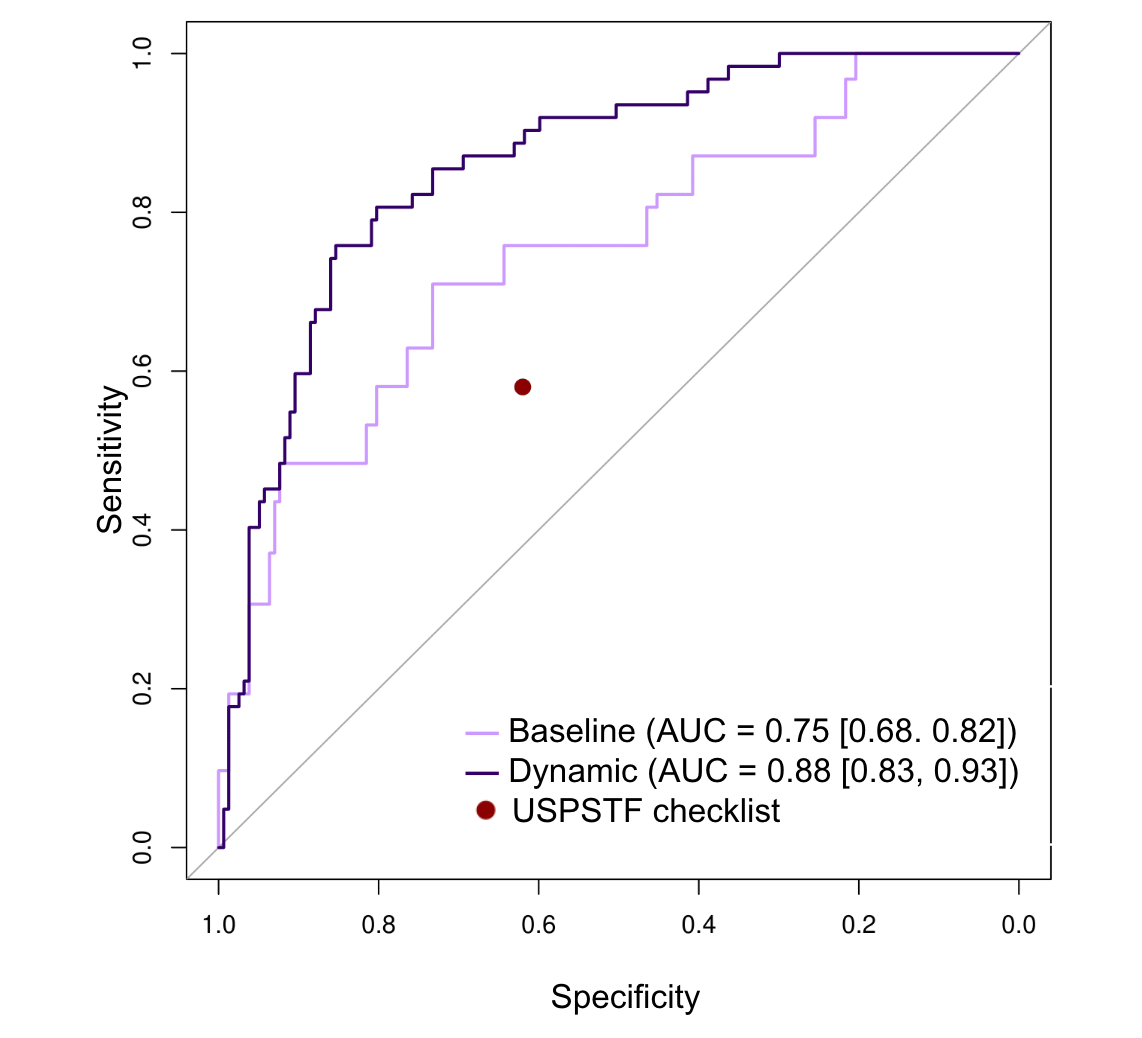
Results. Among 568 assessed women, the frequency of HDP was 18.1%. The AUC for the baseline model was 0.75 (95% CI: 0.68, 0.82) while the AUC for the dynamic model was 0.88 (95% CI: 0.83,0.93). The USPSTF checklist had a specificity of 0.62 and a sensitivity of 0.58. In contrast at this specificity level, the baseline and dynamic models had a sensitivity of 0.76 and 0.92, respectively.

Conclusions. Both prediction models using machine learning and dynamic longitudinal BP data outperformed the current standard USPSTF checklist for identification of patients at risk of HDP. Dynamic incorporation of longitudinal BP measures after the first prenatal care visit improves the ability to identify patients at risk of HDP compared to a model that only uses baseline inputs.
  • Sauer, Sara  ( Delfina Care Inc , San Francisco , California , United States )
  • Wen, Timothy  ( University of California , San Diego , California , United States )
  • Finkelstein, Noam  ( Delfina Care Inc , San Francisco , California , United States )
  • Charifson, Mia  ( Delfina Care Inc , San Francisco , California , United States )
  • Kadambi, Adesh  ( Delfina Care Inc , San Francisco , California , United States )
  • Li, Chloe  ( Delfina Care Inc , San Francisco , California , United States )
  • Kadambi, Shreyas  ( Delfina Care Inc , San Francisco , California , United States )
  • Venkatesh, Kartik  ( The Ohio State University , Columbus , Ohio , United States )
  • Fulcher, Isabel  ( Delfina Care Inc , San Francisco , California , United States )
  • Author Disclosures:
    Sara Sauer: DO have relevant financial relationships ; Employee:Delfina Care Inc:Active (exists now) | Timothy Wen: No Answer | Noam Finkelstein: No Answer | Mia Charifson: No Answer | Adesh Kadambi: No Answer | Chloe Li: No Answer | Shreyas Kadambi: No Answer | kartik venkatesh: No Answer | Isabel Fulcher: No Answer
Meeting Info:
Session Info:

Concurrent C: Blood Pressure Monitoring

Thursday, 09/04/2025 , 10:30AM - 12:00PM

Oral Abstract Session

More abstracts on this topic:
A Rare Combination: Postpartum SCAD With Fibromuscular Dysplasia

Hassan Rafla, Humayun Sara, Callejas Liam, Woosman Miranda, Nguyen-luu Tristan, Singh Anil

A multifaceted family intervention for blood pressure management in rural China: an open label, parallel group, cluster randomized trial (Healthy Family Program)

Jiang Chao, Dong Jianzeng, Cai Jun, Anderson Craig, Du Xin, Tang Yangyang, Han Rong, Song Yanna, Wang Chi, Lin Xiaolei, Yi Yang, Rodgers Anthony, Ma Changsheng

More abstracts from these authors:
Validating a Predictive Model for Postpartum Hypertension Readmission with Incorporation of Social Vulnerability Index

Green Celeste, Jochum Michael, Venkatesh Kartik, Jelovsek J. Eric, Adams April, Williams Dominique

Racial and Ethnic Differences in First-Trimester Prenatal Care Initiation Among Pregnant People with Pre-Pregnancy Hypertension

Pedamallu Havisha, Bolakale-rufai Ikeoluwapo, Venkatesh Kartik, Khan Sadiya, Cameron Natalie

You have to be authorized to contact abstract author. Please, Login
Not Available