Racial and Ethnic Differences in First-Trimester Prenatal Care Initiation Among Pregnant People with Pre-Pregnancy Hypertension
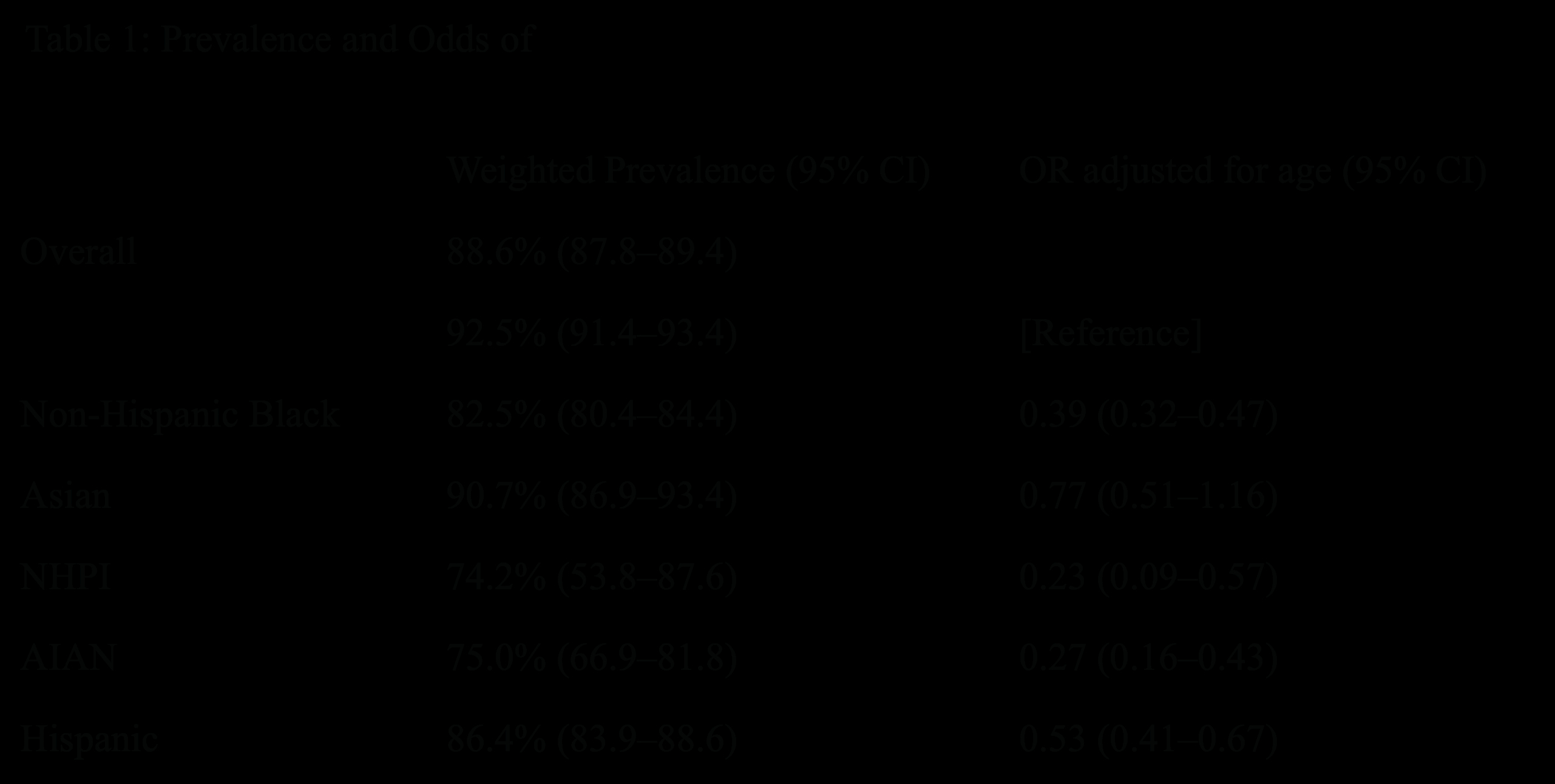
Abstract Body (Do not enter title and authors here): Introduction: Pre-pregnancy hypertension (HTN) is significant cause of adverse maternal and neonatal outcomes, particularly among historically minoritized groups in the US. Early prenatal care may mitigate these risks, but disparities in access to care exist across race and ethnicity as a social construct. To inform efforts to promote equitable maternal care, we examined the prevalence of and barriers to early prenatal care initiation by race and ethnicity among individuals with pre-pregnancy HTN. Methods: We analyzed self-reported data from the Pregnancy Risk Assessment Monitoring System (PRAMS), a national survey of postpartum individuals, from 2016–2022. We included individuals aged 15-45 with pre-pregnancy HTN. We calculated the weighted prevalence of first trimester prenatal care initiation stratified by self-identified race and ethnicity. Logistic regression assessed odds of early care initiation adjusted for age. We secondarily examined self- reported barriers to prenatal care initiation among individuals who did not start first trimester care. Results: Of 11,426,110 individuals, 613,310 (5.4%; weighted) had pre-pregnancy HTN. The prevalence of early prenatal care initiation was highest among non-Hispanic White individuals (92%), followed by those who identified as Hispanic (86%), non-Hispanic Black (82%), American Indian/Alaska Native (AIAN: 75%) and Native Hawaiian/Pacific Islander (NHPI: 74%). Compared with self-identified non-Hispanic White individuals, the adjusted odds of early prenatal care initiation were significantly lower among those who identified as non-Hispanic Black (0.39 [95% CI: 0.32–0.47]), NHPI (0.23 [0.09–0.57]), AIAN (0.27 [0.16–0.43]), and Hispanic (0.53 [0.41–0.67]). Barriers to early care initiation varied by race and ethnicity, with the most common barriers being: 1) not knowing pregnancy status (AIAN: 69.7%, Asian: 30.6%, Black: 71.3%, Hispanic: 59.1%, White 43.6%) and 2) lack of available prenatal care appointments (AIAN: 69.5%, Asian: 14.1%, Black: 39.6%, Hispanic: 29.4%, White: 34.9%). Conclusions: In this nationally representative U.S. sample of individuals with pre-pregnancy HTN, significant racial and ethnic disparities exist in the prevalence of early prenatal care initiation, as well as with barriers to accessing timely care. Targeted public health efforts to address structural barriers and ensure timely, equitable prenatal care for high-risk populations are needed.
Pedamallu, Havisha
(
Northwestern University
, Chicago , Illinois , United States )
Bolakale-rufai, Ikeoluwapo
(
Northwestern University
, CHICAGO , Illinois , United States )
Venkatesh, Kartik
(
The Ohio State University
, Columbus , Ohio , United States )
Khan, Sadiya
(
Northwestern University
, Oak Park , Illinois , United States )
Cameron, Natalie
(
Northwestern University
, Chicago , Illinois , United States )
Author Disclosures:
Havisha Pedamallu:DO NOT have relevant financial relationships
| Ikeoluwapo Bolakale-Rufai:DO NOT have relevant financial relationships
| kartik venkatesh:No Answer
| Sadiya Khan:DO NOT have relevant financial relationships
| Natalie Cameron:DO NOT have relevant financial relationships