
Logo

American Heart Association

  55
  0


Final ID: 075

Blood pressure polygenic score predicts long-term blood pressure control and treatment-resistant hypertension

Abstract Body: Introduction Suboptimal blood pressure (BP) control remains a major cardiovascular disease risk factor globally. Whether genetic contributors to elevated BP independently predict long-term BP control and treatment-resistant hypertension is unknown.

Objectives We examined the associations of BP polygenic score (PGS) with long-term BP control and treatment-resistant hypertension among patients with hypertension.

Methods Using Mass General Brigham Biobank nested within the U.S. healthcare system, we identified 22,466 individuals aged 18-64 years with established hypertension between January 2018 and May 2019. Multiancestral BP PGS was fine-tuned using the external UK Biobank cohort. Longitudinal BP control was defined as cumulative duration above target systolic BP (SBP) ≥130 mmHg or diastolic BP (DBP) ≥80 mmHg in percentage over a 5-year follow-up. Treatment-resistant hypertension was defined as SBP ≥140 or DBP ≥90 mmHg despite the concurrent use of 3 antihypertensive classes, use of ≥4 antihypertensive classes at any BP level, or physician adjudication. Using multivariable regression, we assessed the associations of BP PRS with 5-year BP control and lifetime resistant hypertension incidence adjusting for traditional cardiometabolic risk factors and comorbidities. Incremental prognostic utility of BP PRS was assessed based on improvement in discrimination C-index or the likelihood ratio test.

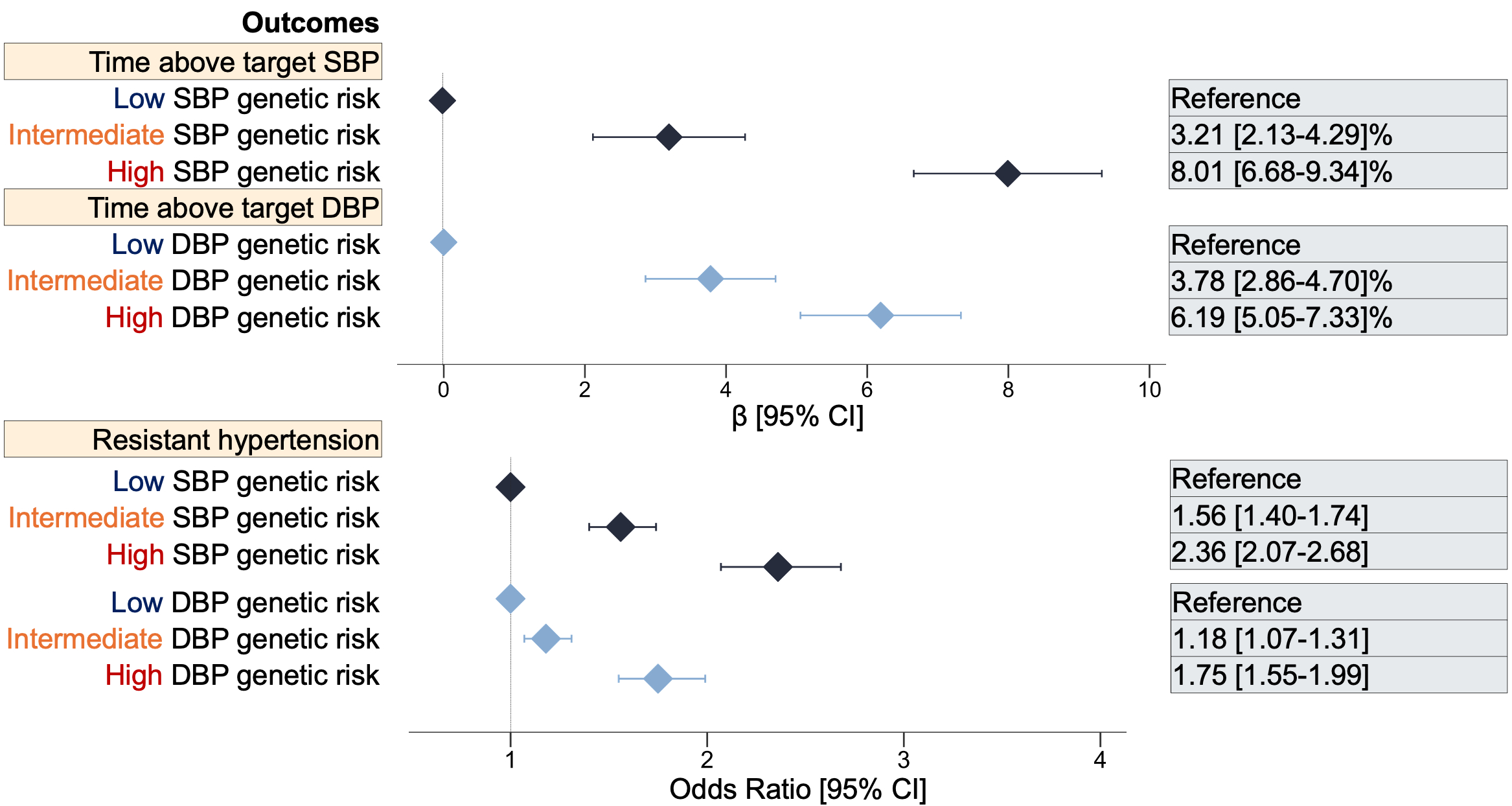
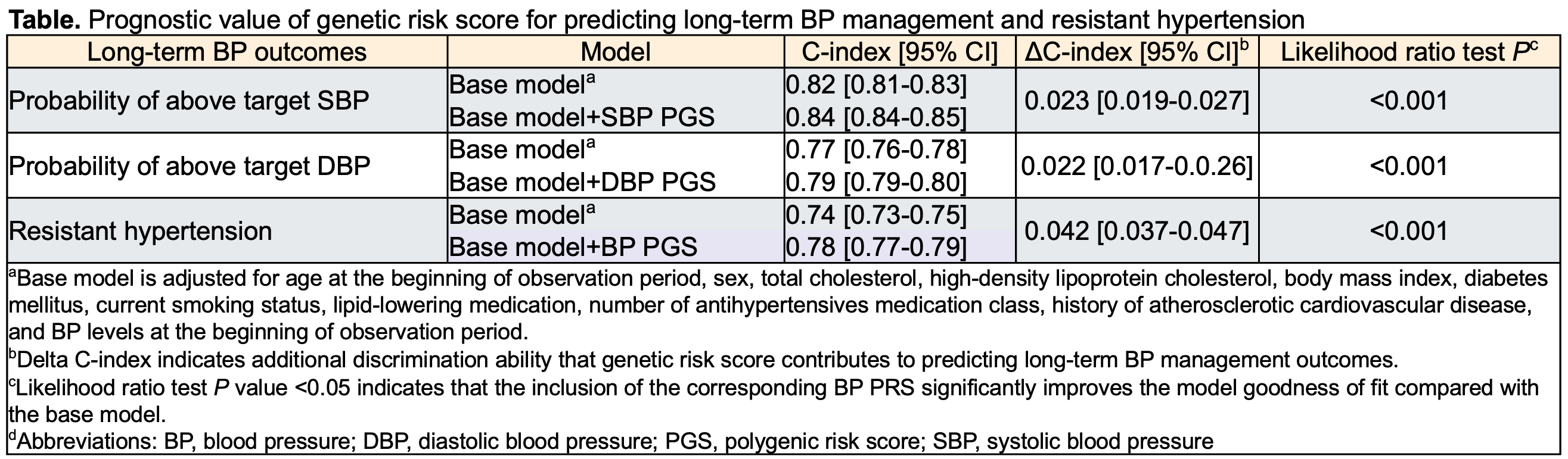
Results The mean SBP/DBP (standard deviation) at index date was 132(18) / 75(11) mmHg, and 4126 (18.4%) developed resistant hypertension over a lifetime. In reference to the low (<20th percentile) PGS group, the high (≥80th percentile) genetic risk group was associated with 8.01 [6.68-9.34]% longer duration lived with above-target SBP and 6.19 [5.05-7.33]% longer with high DBP. In parallel, the high SBP genetic risk group had a 2.36 [2.07-2.68]-folds higher odds of developing treatment-resistant hypertension. Adding BP PGSs to traditional risk factors improved discrimination C-index [95% CI] for predicting resistant hypertension from 0.74 [0.73-0.75] to 0.78 [0.77-0.79] (P <0.001). BP PGS consistently predicted longitudinal BP management in the validation population-based UK Biobank cohort in adherence to the UK clinical guideline.
Conclusions BP PGS predicts long-term BP control and treatment-resistant hypertension. Harnessing BP PGS may inform anticipated trends in long-term BP control to better enable optimal hypertension management.
  • Cho, So Mi  ( Massachusetts General Hospital , Boston , Massachusetts , United States )
  • Honigberg, Michael  ( Massachusetts General Hospital , Boston , Massachusetts , United States )
  • Fahed, Akl  ( Massachusetts General Hospital , Boston , Massachusetts , United States )
  • Patel, Aniruddh  ( Massachusetts General Hospital , Boston , Massachusetts , United States )
  • Hornsby, Whitney  ( Massachusetts General Hospital , Boston , Massachusetts , United States )
  • Natarajan, Pradeep  ( Massachusetts General Hospital , Boston , Massachusetts , United States )
  • Ruan, Yunfeng  ( Massachusetts General Hospital , Boston , Massachusetts , United States )
  • Lee, Hyeok-hee  ( Beth Israel Deaconess Medical Center , Boston , Massachusetts , United States )
  • Koyama, Satoshi  ( Massachusetts General Hospital , Boston , Massachusetts , United States )
  • Juraschek, Stephen  ( Beth Israel Deaconess Medical Center , Boston , Massachusetts , United States )
  • Allen, Norrina  ( NORTHWESTERN UNIVERSITY , Chicago , Illinois , United States )
  • Yang, Eugene  ( University of Washington , Seattle , Washington , United States )
  • Mcevoy, John  ( University of Galway , Galway , Ireland )
  • Secemsky, Eric  ( Beth Israel Deaconess Medical Center , Boston , Massachusetts , United States )
  • Author Disclosures:
    So Mi Cho: DO NOT have relevant financial relationships | Michael Honigberg: DO have relevant financial relationships ; Research Funding (PI or named investigator):Genentech:Active (exists now) ; Advisor:Miga Health:Past (completed) ; Consultant:Comanche Biopharma:Past (completed) ; Research Funding (PI or named investigator):Novartis:Active (exists now) | Akl Fahed: No Answer | Aniruddh Patel: No Answer | Whitney Hornsby: No Answer | Pradeep Natarajan: DO have relevant financial relationships ; Researcher:Allelica:Past (completed) ; Ownership Interest:TenSixteen Bio:Active (exists now) ; Ownership Interest:Candela:Active (exists now) ; Consultant:BMS:Past (completed) ; Ownership Interest:MyOme:Active (exists now) ; Ownership Interest:Parameter Health:Active (exists now) ; Consultant:Foresite Capital:Active (exists now) ; Consultant:Foresite Labs:Active (exists now) ; Consultant:Tourmaline Bio:Active (exists now) ; Consultant:TenSixteen Bio:Past (completed) ; Consultant:Eli Lilly & Co:Past (completed) ; Consultant:Novo Nordisk:Past (completed) ; Consultant:Genentech:Past (completed) ; Consultant:Allelica:Past (completed) ; Researcher:Genentech:Active (exists now) | Yunfeng Ruan: No Answer | Hyeok-Hee Lee: DO NOT have relevant financial relationships | Satoshi Koyama: No Answer | Stephen Juraschek: DO NOT have relevant financial relationships | Norrina Allen: No Answer | Eugene Yang: DO have relevant financial relationships ; Advisor:SkyLabs:Active (exists now) ; Advisor:Qure.ai:Past (completed) ; Advisor:Mineralys:Past (completed) ; Advisor:Idorsia:Past (completed) | John McEvoy: No Answer | Eric Secemsky: No Answer
Meeting Info:
Session Info:

Concurrent A: Genetics, Proteomics, and Metabolomics

Saturday, 09/06/2025 , 01:30PM - 03:00PM

Oral Abstract Session

More abstracts on this topic:
More abstracts from these authors:
Premature Menopause and Polygenic Risk on Incident Coronary Artery Disease among Postmenopausal Women

Ganesh Shriienidhie, Hornsby Whitney, Paruchuri Kaavya, Ruan Yunfeng, Patel Aniruddh, Honigberg Michael, Natarajan Pradeep

Comparing East and South Asian population-specific blood pressure trajectories and their associations with cardiovascular disease risk

Cho So Mi, Yang Eugene, Shimbo Daichi, Natarajan Pradeep, Urbut Sarah, Ruan Yunfeng, Bhatnagar Aarushi, Ganesh Shriienidhie, Hornsby Whitney, Bhattacharya Romit, Honigberg Michael, Juraschek Stephen

You have to be authorized to contact abstract author. Please, Login
Not Available