Pathways Linking Neighborhood Crime to Diabetes Risk among Predominantly African American Adults: Insights from Two Pittsburgh Communities
Abstract Body: Introduction: Neighborhood crime is recognized as an essential contributor to diabetes risk, but pathways linking the associations remain unclear. Thus, this study aimed to investigate whether higher crime is related to diabetes, serially mediated through perceived neighborhood safety and psychosocial stressors.
Hypothesis: Higher neighborhood crime is related to higher odds of diabetes, serially mediated through perceived safety and psychosocial stressors.
Methods: Data came from the 2018 Pittsburgh Hill/Homewood Research on Neighborhood Change and Health study (n=745; mean age=60.0 [SD=14.7] years, African American adults=94%). Diabetes status (yes/no) was defined as either self-reported physician diagnosis or medication use. Total neighborhood crime events were calculated within a 1/10-mile radius of participants’ home addresses. Perceived neighborhood safety, perceived stress, and psychological distress were tested as mediators in cross-sectional associations between total neighborhood crimes and diabetes (odds ratio [OR]; 95% bias-corrected confidence interval [BC CI]), adjusting for age, sex, education, marital status, and alcohol consumption.
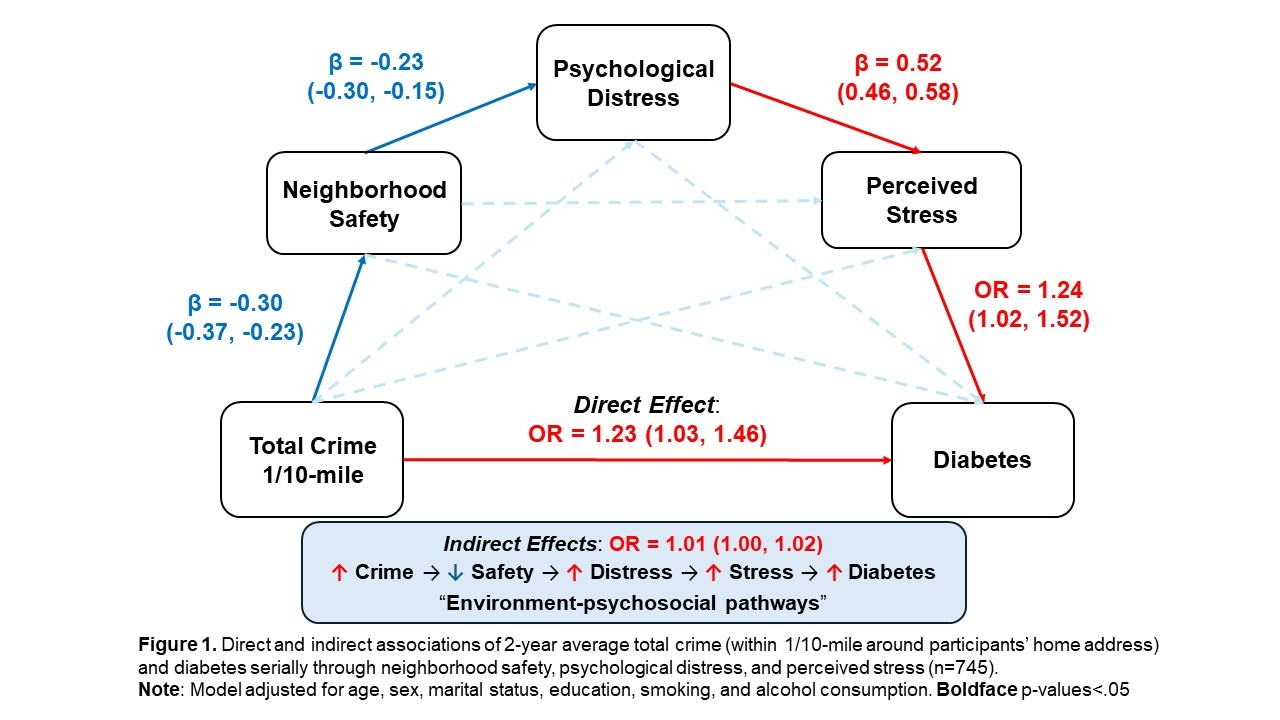
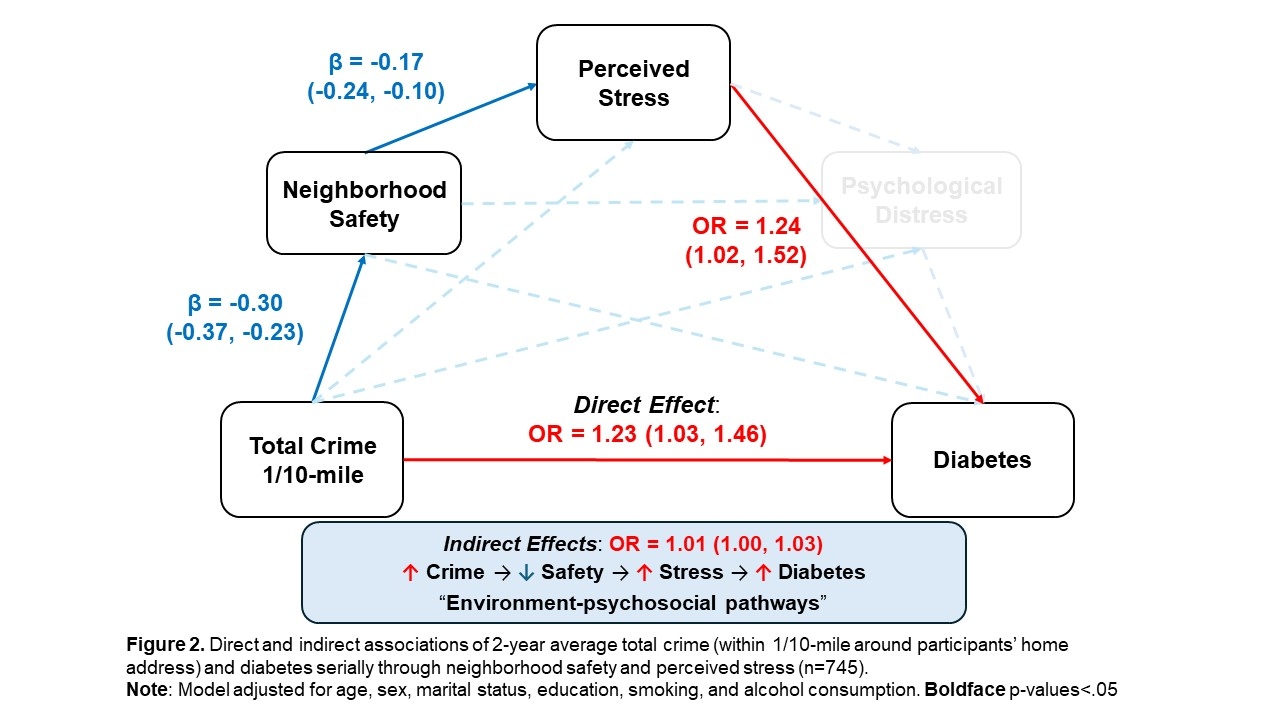
Results: Higher total crimes were significantly associated with greater odds of diabetes, serially mediated through three mediators (i.e., neighborhood safety, psychological distress, and perceived stress; OR=1.01; 95% BC CI [1.00, 1.02], Figure 1). The serial mediation analyses revealed significant pathways linking total crimes and diabetes, through crime and neighborhood safety (β=-0.30 [-0.37, -0.23]), neighborhood safety and distress (β=-0.23 [-0.30, -0.15]), distress and stress (β=0.52 [0.46, 0.58]), and stress and diabetes (OR=1.24 [1.02, 1.52], all p-values<.05). Similar serial mediation pathways were observed, via neighborhood safety and stress (OR=1.01 [1.00, 1.03], Figure 2). Significant pathways were identified for total crimes and neighborhood safety (β=-0.30 [-0.37, -0.23]), neighborhood safety and stress (β=-0.17 [-0.24, -0.10]), and stress and diabetes nexus (OR=1.24 [1.02, 1.52]).
Conclusions: Crime could worsen diabetes risk through neighborhood safety and psychosocial stressors. These pathways suggest potential interventions to improve neighborhood conditions and reduce perceived stress and psychological distress, thereby lowering the risk of diabetes for at-risk populations. Future research should investigate this relationship with longitudinal data.
Tamura, Kosuke
(
National Institutes of Health
, Bethesda , Maryland , United States )
Leonard, Kelsey
(
University of Pittsburgh
, Pittsburgh , Pennsylvania , United States )
Richardson, Andrea
(
RAND
, Pittsburgh , Pennsylvania , United States )
Beckman, Robin
(
RAND
, Pittsburgh , Pennsylvania , United States )
Deng, Yangyang
(
National Institutes of Health
, Bethesda , Maryland , United States )
Moniruzzaman, Mohammad
(
National Institutes of Health
, Bethesda , Maryland , United States )
Hu, Lu
(
NYU Grossman School of Medicine
, New York , New York , United States )
Cantor, Jonathan
(
RAND
, Santa Monica , California , United States )
Jagannathan, Ram
(
Emory University
, Atlanta , Georgia , United States )
Dubowitz, Tamara
(
University of Pittsburgh
, Pittsburgh , Pennsylvania , United States )