Psychosocial Stressors Linking Perceived Neighborhood Physical Disorder to Stroke Risk Among U.S. Adults
Abstract Body: Introduction: Neighborhood disorder, defined as adverse physical features of neighborhoods (e.g., vandalism, vacant houses), has been linked to elevated risks of chronic diseases, such as stroke. Adverse neighborhoods may elevate psychosocial stressors related to stroke. However, the relationship between perceived neighborhood physical disorder and stroke, and the psychosocial pathways that may drive the association, remains understudied.
Hypothesis: Greater neighborhood physical disorder is associated with higher odds of stroke, mediated by higher levels of perceived stress and anxiety, and these relationships are moderated by sex and racial and/or ethnic groups.
Methods: Cross-sectional data came from the nationally representative sample of middle-aged-to-older adults in the 2022 Health and Retirement Study (n=3,755; mean age=69.1 years; female=54.1%; White adults=84.6%). Stroke status (yes/no) was assessed by self-reported physician diagnosis. Respondents reported their perceived neighborhood physical disorder on four items: vandalism/graffiti, safety after dark, litter, and vacant houses. Using multivariable regressions, we tested perceived stress and anxiety as mediators in the association between neighborhood physical disorder and stroke, adjusting for all covariates. Bootstrap resampling (k=5000) with 95% bias-corrected confidence intervals (BC CIs) for the indirect effects was used to assess mediated associations. Analyses were stratified by sex and racial and/or ethnic groups.
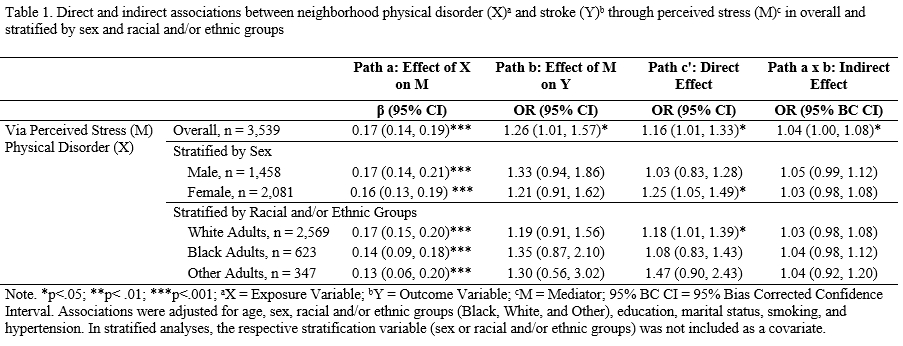
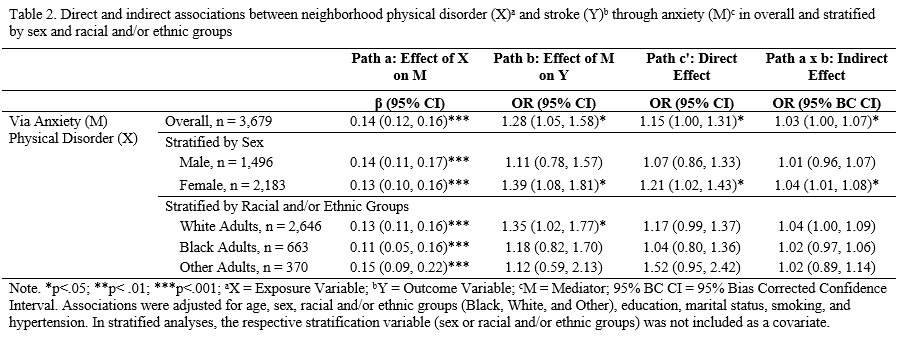
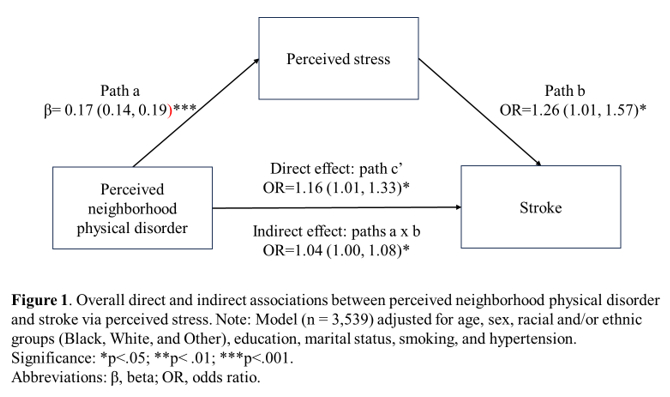
Results: Overall, neighborhood physical disorder was directly associated with higher odds of stroke (OR=1.16, 95% CI=1.01–1.33), with an indirect effect via perceived stress (OR=1.04, 95% BC CI=1.00–1.08; Table 1, Figure 1). Similarly, neighborhood physical disorder was directly related to stroke (OR=1.15, 95% CI=1.00–1.31), with an indirect effect via anxiety (OR=1.03, 95% BC CI=1.00–1.07; Table 2). In sex-stratified analyses, the observed association was mediated by anxiety only in females (OR=1.04, 95% BC CI=1.01–1.08, all p<.05), with neither significant results in males nor by racial and/or ethnic groups.
Conclusions: Individuals living in neighborhoods with greater physical disorder had higher odds of stroke, and elevated levels of perceived stress and anxiety may be important drivers of this association. Local efforts to improve adverse neighborhood contexts, which in turn could ease psychological stress, may help lower stroke risk.
Moniruzzaman, Mohammad
(
National Institute on Minority Health and Health Disparities
, Bethesda , Maryland , United States )
Deng, Yangyang
(
National Institute on Minority Health and Health Disparities
, Bethesda , Maryland , United States )
Khan, Sana
(
National Institute on Minority Health and Health Disparities
, Bethesda , Maryland , United States )
Xiao, Qian
(
The University of Texas Health Science Center at Houston (UTHealth) School of Public Health
, Houston , Texas , United States )
Nguyen, Quynh
(
National Institute of Nursing Research
, Bethesda , Maryland , United States )
Jagannathan, Ram
(
Rollins School of Public Health, Emory University
, Atlanta , Georgia , United States )
Hu, Lu
(
NYU Grossman School of Medicine
, New York , New York , United States )
El Shahawy, Omar
(
NYU Grossman School of Medicine
, New York , New York , United States )
Tamura, Kosuke
(
National Institute on Minority Health and Health Disparities
, Bethesda , Maryland , United States )