Advancing Life’s Essential 8: Machine Learning Reveals Actionable Predictors of Cardiovascular Mortality in NHANES 1999–2018
Abstract Body: Introduction: In 2022, the American Heart Association introduced the Life's Essential 8 (LE8) enhanced metric of cardiovascular health (CVH), a strong predictor of all-cause and cardiovascular disease (CVD) mortality in US adults, with evidence of a dose-response relationship. We aimed to identify the LE8 factors most strongly associated with lower all-cause and CVD mortality to inform prevention strategies.
Methods: Data from 55,879 U.S. adults aged ≥20 years (mean age 47.5 years, 51.7% women) from NHANES 1999–2018 with mortality linkage through December 31, 2019 (mean follow-up 9.8 years) were used. LE8 lifestyle and biological factors and covariate data (age, sex, race/ethnicity, education, marital status, and poverty-income ratio) were imputed using multiple imputation (m=5 and m=10, predictive mean matching). Adaptive Least Absolute Shrinkage and Selection Operator (Lasso) variable selection was performed separately on each imputed dataset to identify the dominant LE8 predictors for all-cause and CVD mortality by removing less important variables. Factors selected in ≥60% of imputations were included in Cox proportional hazards adjusted models. Hazard ratios and 95% confidence intervals were pooled across imputations using Rubin's rules. Discrimination was assessed with Harrell's C-index.
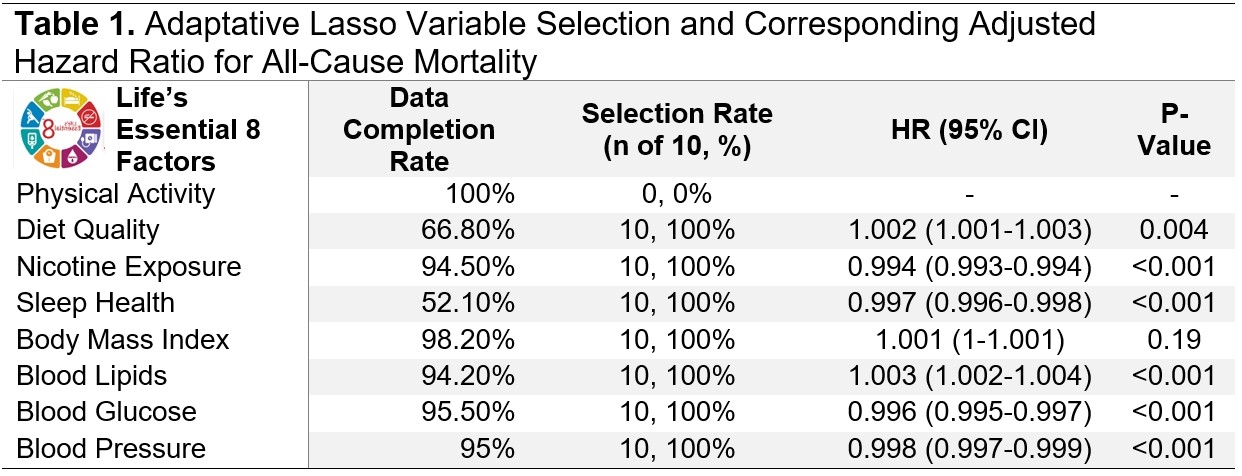
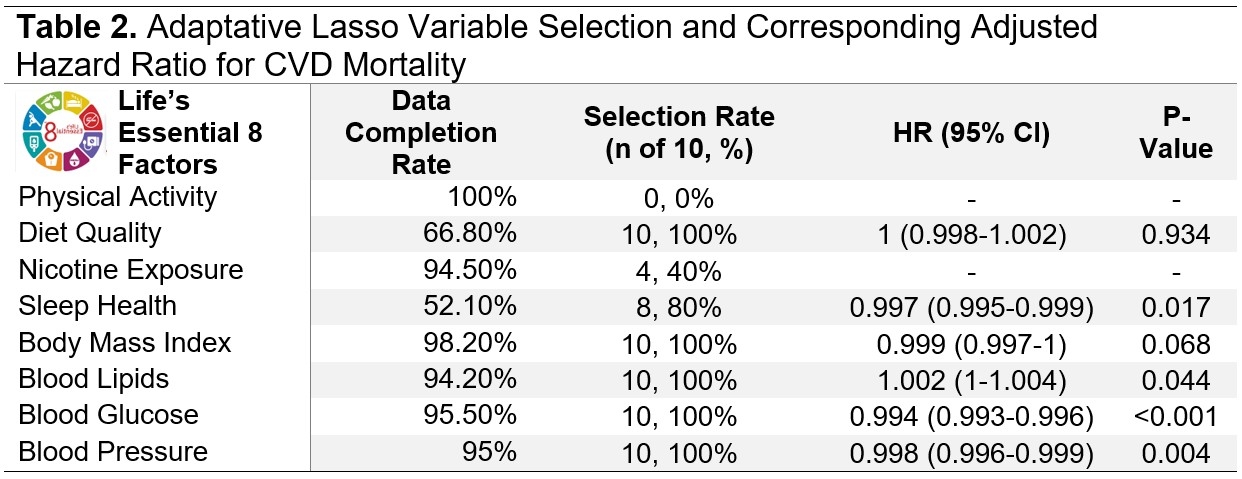
Results: During follow-up, 8,254 all-cause deaths (14.8%) and 2,112 CVD deaths (3.8%) occurred. Adaptive lasso consistently selected seven LE8 predictors of all-cause mortality (Table 1) and six predictors of CVD mortality (Table 2). Physical Activity was not selected (0%). Nicotine exposure was selected only in 40% of CVD models. Each 10-point increases in blood lipids were associated with small increments in all-cause and CVD mortality (HR for all-cause mortality 1.003, 95% CI 1.002-1.004, and for CVD mortality 1.002,1.0, 1.004). Each 10-point increases in nicotine exposure showed the largest reduction in all-cause mortality (HR 0.994, 95% CI 0.993–0.994). Meanwhile, each 10-point reduction in blood glucose yielded the greatest drop in CVD mortality (0.994, 0.993–0.996). The model C-index was 0.742 (95% CI 0.716–0.768) for all-cause mortality and 0.781 (0.751–0.811) for CVD mortality, both indicating good discrimination.
Conclusion: Machine learning models identified six key CVH predictors most strongly associated with CVD mortality. Findings suggest that improving blood glucose and sleep health may offer the greatest mortality risk reduction.
Aguayo, Liliana
(
Emory University
, Atlanta , Georgia , United States )
Okitondo, Christian
(
University of Georgia
, Athens , Georgia , United States )
Sattler, Elisabeth
(
UNIVERSITY OF GEORGIA
, Athens , Georgia , United States )