Performance of Machine Learning-based Weighted Life’s Essential 8 Scores in Predicting Cardiovascular and All-Cause Mortality
Abstract Body: Background: The American Heart Association's Life's Essential 8 (LE8) metric uses equal weighting across eight components to predict CVD risk and mortality. However, there is evidence suggesting variability in the associations between individual components and mortality.
Objective: Compare the performance of machine learning-based, data-driven component weighted LE8 scores to an equal-weighted LE8 score in predicting cardiovascular and all-cause mortality.
Methods: We analyzed 55,879 adults aged ≥18 years from NHANES 1999-2018 survey waves with mortality linkage through 2019 (mean follow-up 9.8 years). Using multiple imputation (m=10) with predictive mean matching, we performed a machine learning-based adaptive lasso variable selection across imputed datasets to identify LE8 components predictive of all-cause and CVD mortality. Component weights were derived from selection frequencies: components selected in 100% of imputations received proportionately higher weights, while those selected less frequently received lower weights. We created outcome-specific weighted LE8 scores and compared the discriminative performance against the equal-weighted LE8 using Cox proportional hazards models adjusted for age, sex, and race/ethnicity. Performance was evaluated using C-statistics and hazard ratios.
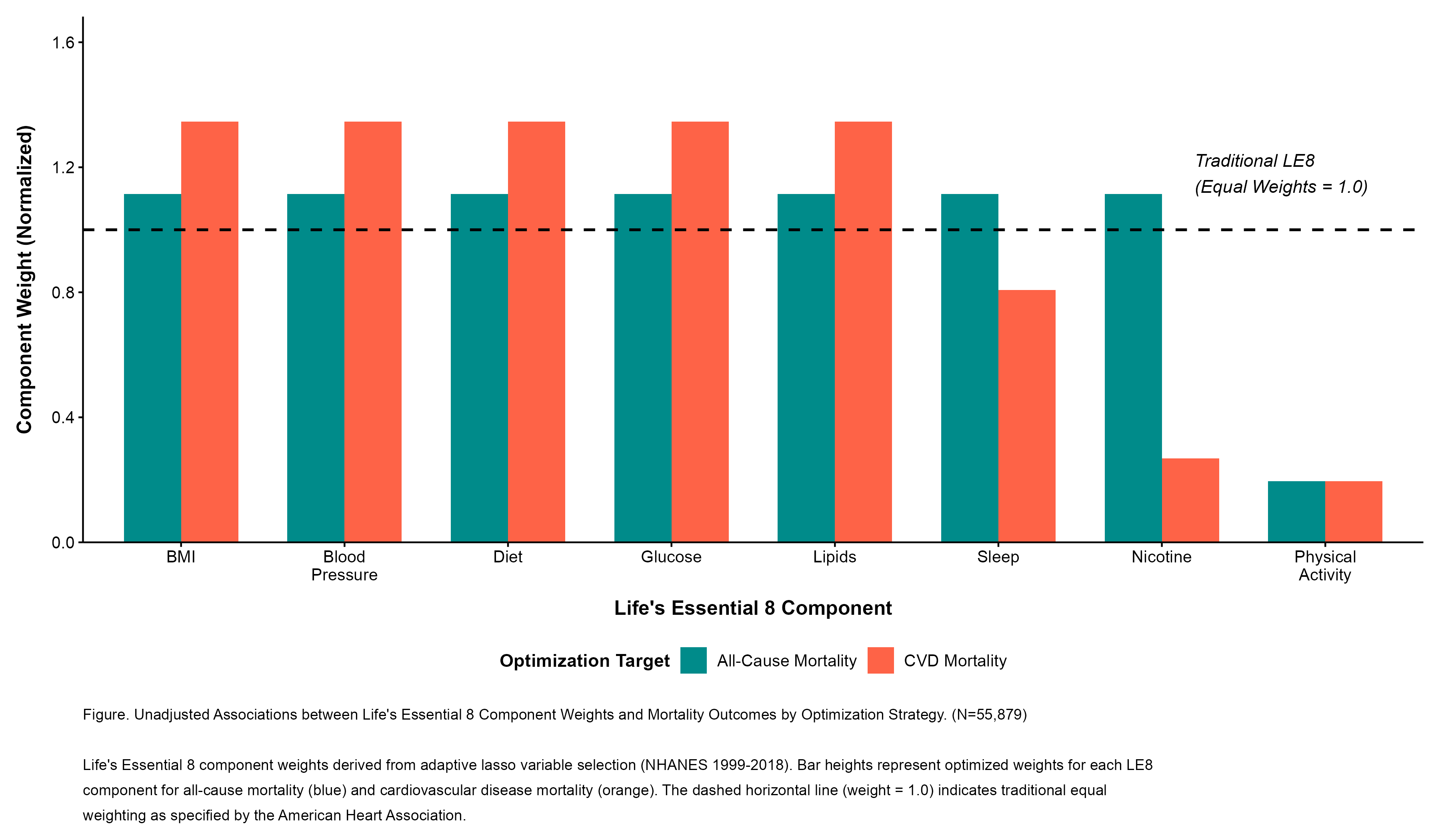
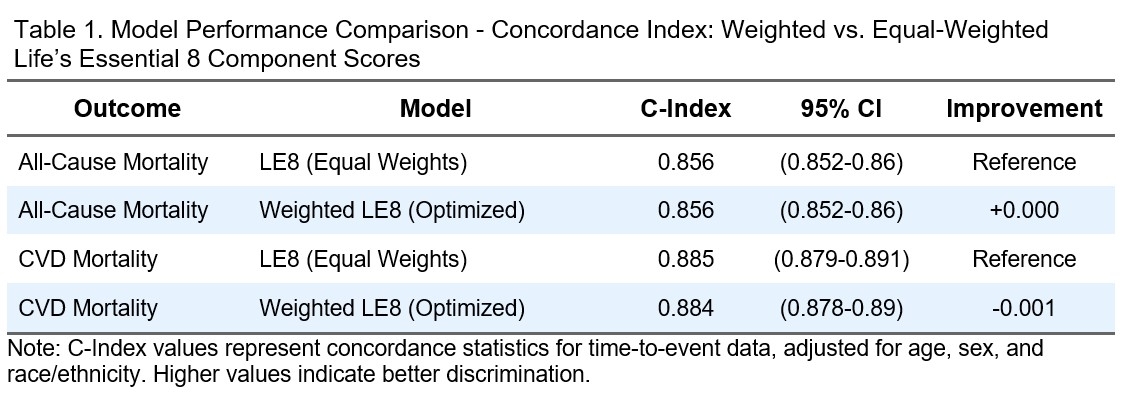
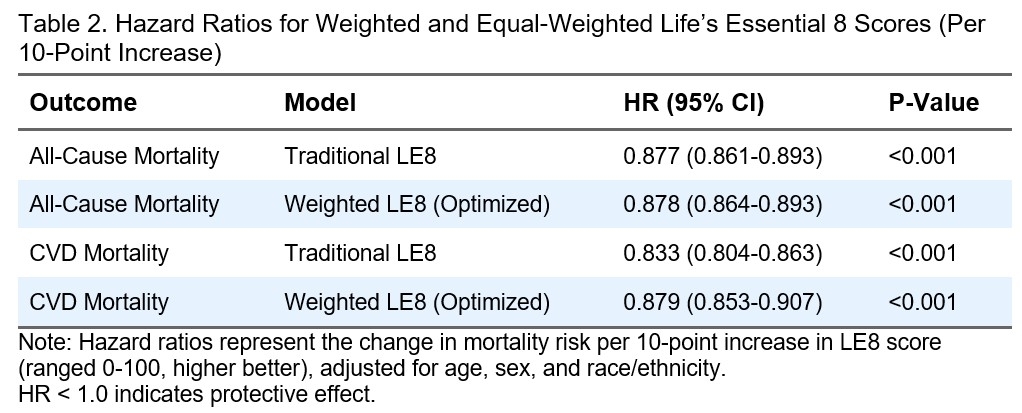
Results: For all-cause mortality, seven components were consistently selected (100% selection: diet quality, nicotine exposure, sleep health, body mass index, blood lipids and glucose, blood pressure); physical activity was never selected. For CVD mortality, five components showed 100% selection, sleep health 70%, nicotine exposure 30%, and physical activity 0% (Figure). The weighted LE8 scores (five and seven components, respectively) and the equal-weighted LE8 score performed identically for all-cause mortality (C-statistic weighted 0.856 vs equal-weighted 0.856, 95% CI: 0.852-0.860) and nearly identically for CVD mortality (C-statistic 0.884 vs 0.885; Table 1). Hazard ratios per 10-point increases in LE8 score demonstrated similar protective effects (all-cause mortality: HR 0.877 vs 0.872; CVD mortality: HR 0.869 vs 0.827; Table 2). Risk reclassification occurred in 15.1% (all-cause) and 17.9% (CVD) of participants without improving discrimination.
Conclusion: A subset of five and seven machine learning–selected LE8 components predicted CVD and all-cause mortality as well as the full equal-weighted LE8 score.
Sattler, Elisabeth
(
University of Georgia
, Athens , Georgia , United States )
Okitondo, Christian
(
University of Georgia
, Athens , Georgia , United States )
Aguayo, Liliana
(
Emory University
, Atlanta , Georgia , United States )