Association Between Social Determinants of Health and Cardiovascular-Kidney-Metabolic Syndrome in U.S. Adults From the National Health and Nutrition Examination Survey
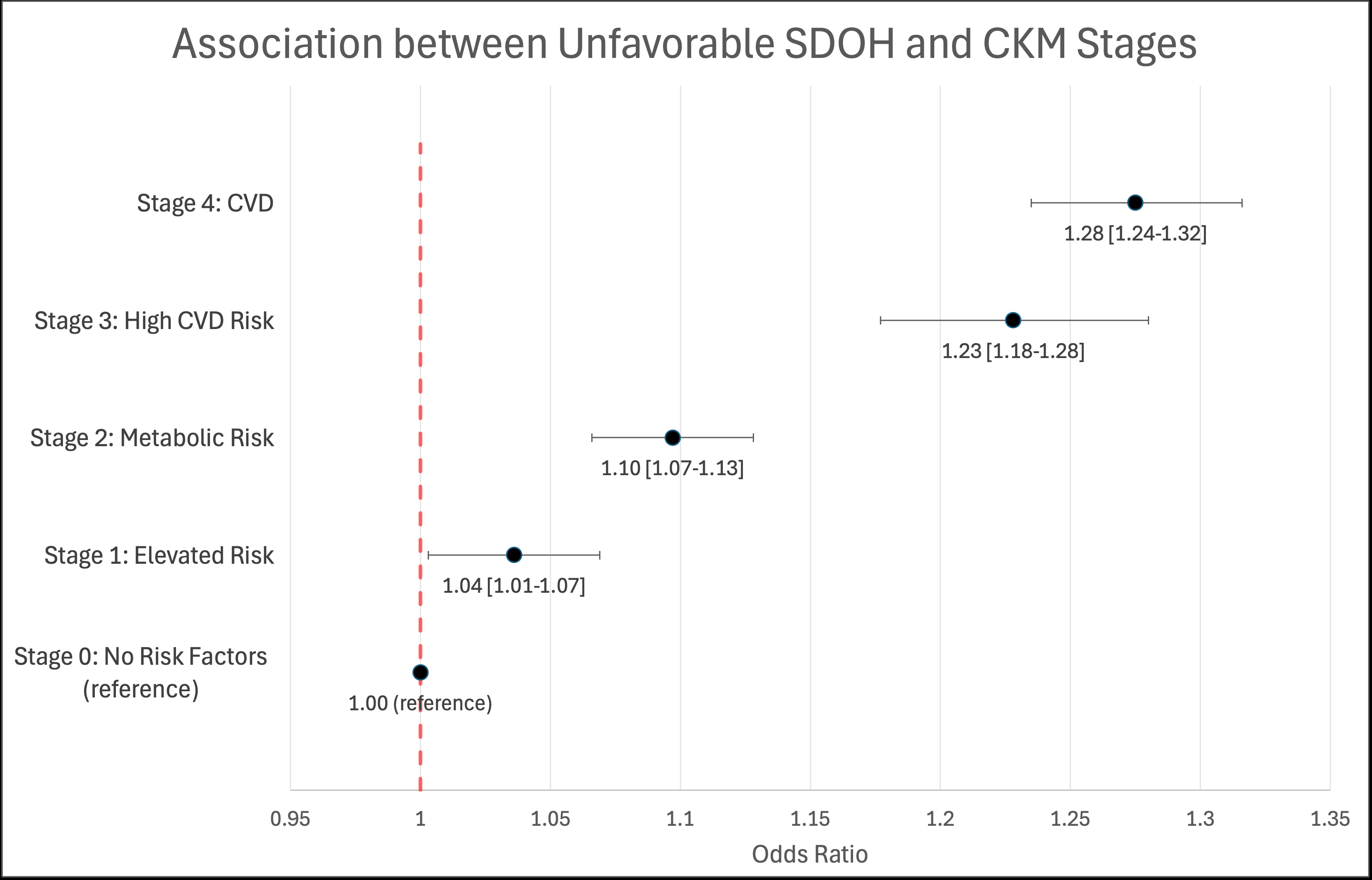
Abstract Body (Do not enter title and authors here): Introduction: Cardiovascular-kidney-metabolic (CKM) syndrome describes the interaction between cardiovascular disease (CVD), chronic kidney disease (CKD) and metabolic syndrome. While social determinants of health (SDOH) are known to influence CVD risk factors and outcomes, their cumulative effect on CKM syndrome stage distribution in US adults has not been well characterized. We hypothesize that individuals with greater SDOH burden are more likely to present with advanced CKM stages. Methods: We analyzed data from 13,678 participants of the 2011-2020 National Health and Nutrition Examination Survey (NHANES), a population-based sample of US adults. Based on prior literature, we developed a cumulative SDOH score encompassing economic stability, social environment, food security, education, and healthcare access; 20 variables were scored as 0 (favorable) or 1 (unfavorable) and summed to generate a total score (0-20). Per CKM guidelines, participants were categorized into 5 stages: Stage 0 (no risk factors), Stage 1 (excess adiposity), Stage 2 (metabolic risk factors and CKD), Stage 3 (PREVENT-predicted 10-year CVD risk ≥20%) and Stage 4 (clinical CVD). Multinominal logistic regression models were used to examine the association between SDOH score and CKM stage, adjusting for age, sex and race. Results: Mean age was 52.3 years and 50.7% were male. Overall, mean SDOH score was 3.09 (95% CI: 3.04-3.14). Mean SDOH score was 2.80 (95% CI: 2.64-2.96) in CKM Stage 0, 2.96 (95% CI: 2.83-3.10) in Stage 1, 3.02 (95% CI: 2.96-3.09) in Stage 2, 2.65 (95% CI: 2.46-2.84) in Stage 3, and 3.70 (95% CI: 3.56-3.84) in Stage 4. Compared to those with no risk factors (Stage 0), each 1-point increment in SDOH score was associated with 4% greater odds of being in Stage 1 (95% CI: 1.01-1.07), 10% greater odds for Stage 2 (95% CI: 1.07-1.13), 23% greater odds for Stage 3 (95% CI: 1.18-1.28) and 28% greater odds for Stage 4 (95% CI: 1.24-1.32). Conclusion: US adults with greater burden of adverse SDOH are more likely to present with more advanced CKM syndrome stages, which are associated with worse health outcomes. A dose-response relationship across CKM syndrome stages emphasizes the cumulative impact of social disadvantage on CKM disease progression. These findings highlight the critical need to address social inequities as a key strategy in preventing the onset and progression of CKM syndrome, including clinical CVD.
Chakrabarti, Amit
(
University of Miami
, Miami , Florida , United States )
Le, Austin
(
University of Illinois - Chicago
, Chicago , Illinois , United States )
Elfassy, Tali
(
University of Miami
, Miami , Florida , United States )
Yang, Eugene
(
University of Washington
, Seattle , Washington , United States )
Author Disclosures:
Amit Chakrabarti:DO NOT have relevant financial relationships
| Austin Le:No Answer
| Tali Elfassy:No Answer
| Eugene Yang:DO have relevant financial relationships
;
Advisor:Qure.ai:Past (completed)
; Advisor:Mineralys:Active (exists now)
; Other (please indicate in the box next to the company name):American College of Cardiology:Active (exists now)
; Advisor:Idorsia:Active (exists now)
; Advisor:Genentech:Past (completed)
; Advisor:SkyLabs:Active (exists now)
Jiang Chao, Dong Jianzeng, Cai Jun, Anderson Craig, Du Xin, Tang Yangyang, Han Rong, Song Yanna, Wang Chi, Lin Xiaolei, Yi Yang, Rodgers Anthony, Ma Changsheng