Acculturation and Cardiovascular-Kidney-Metabolic Syndrome: a Study of Immigrant Adults From the National Health and Nutrition Examination Survey
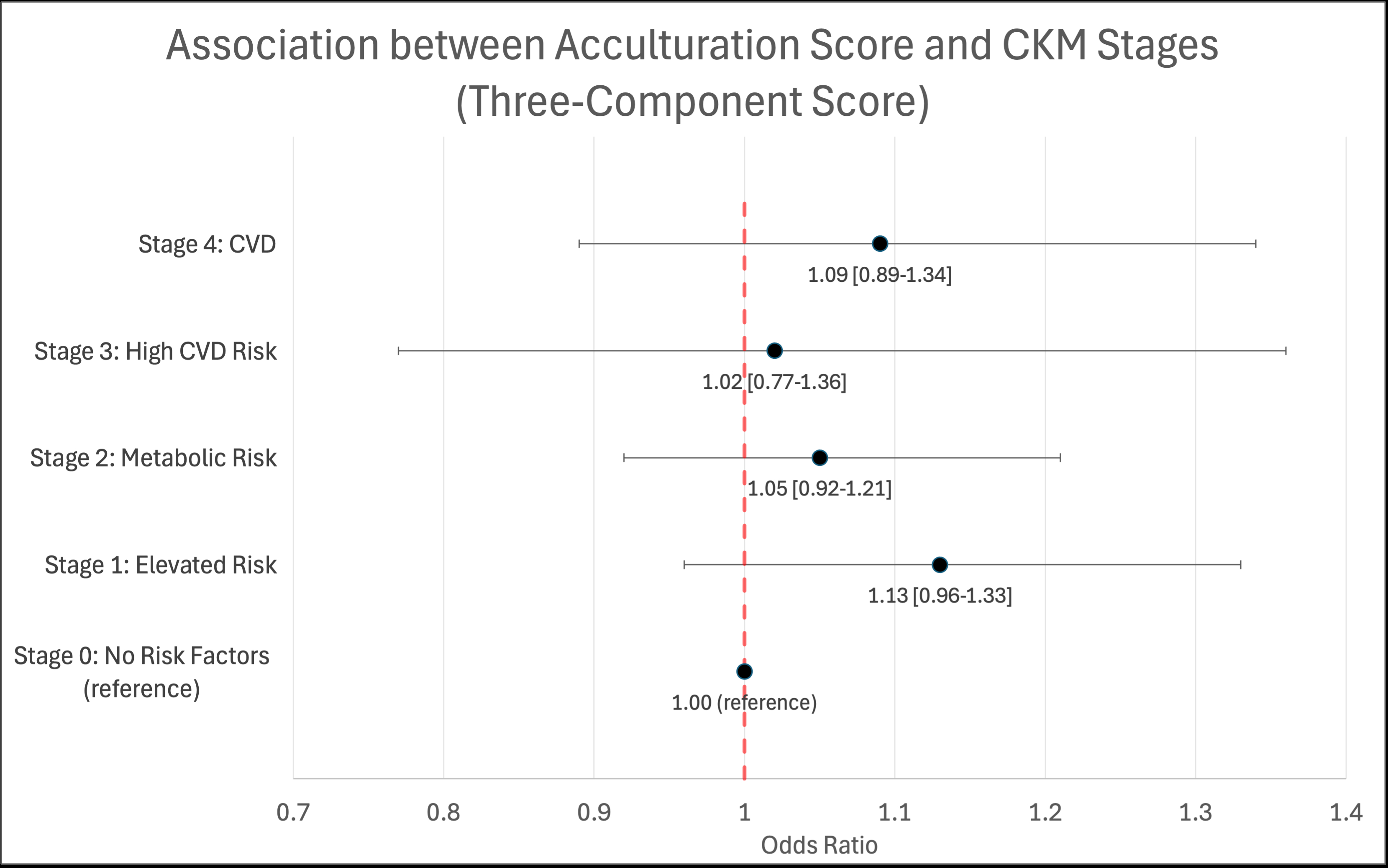
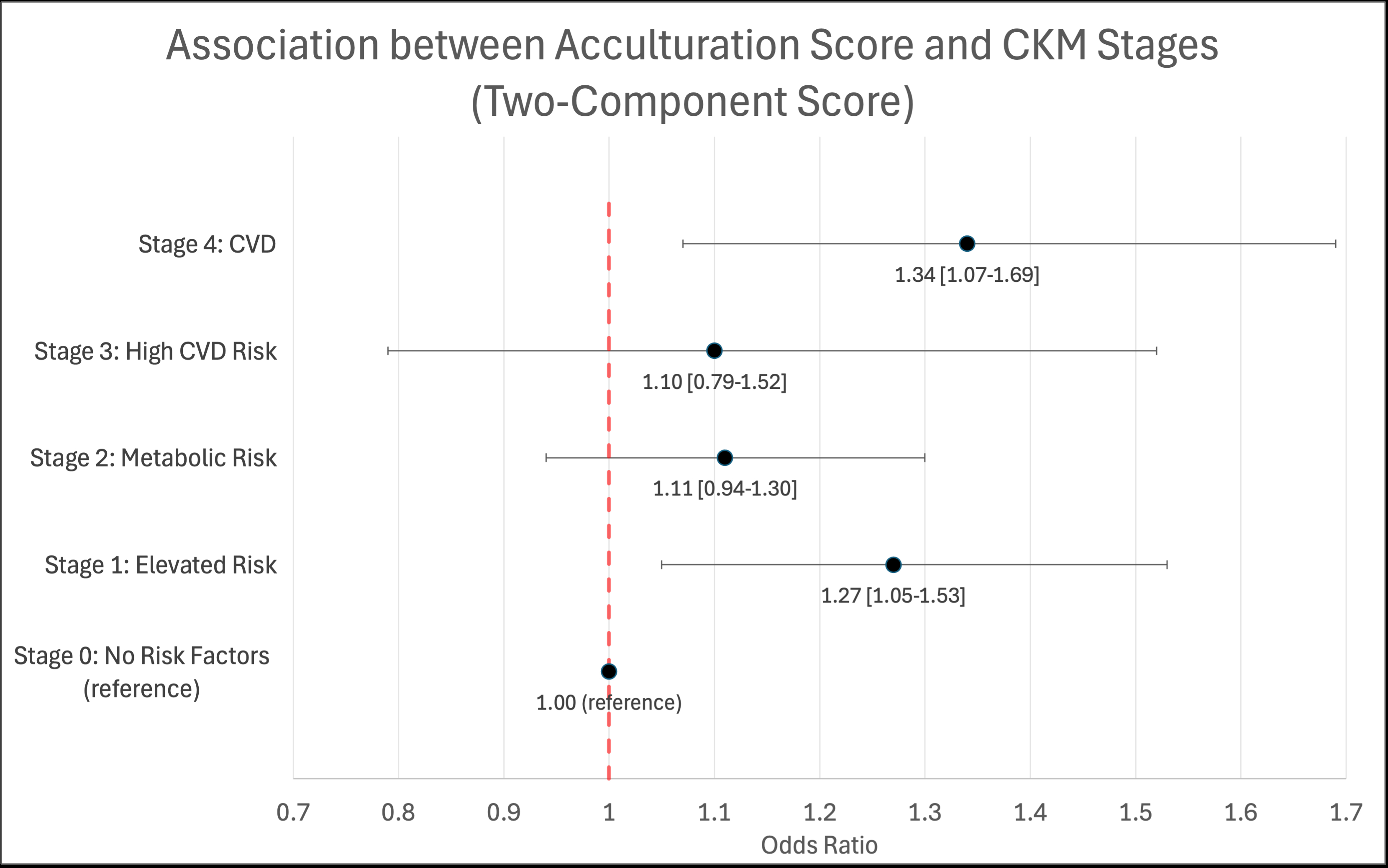
Abstract Body (Do not enter title and authors here): Introduction: Cardiovascular-kidney-metabolic (CKM) syndrome describes the interaction between cardiovascular disease (CVD), chronic kidney disease (CKD), and metabolic dysfunction. While acculturation has been associated with increased risk of CVD, less is known about how acculturation associates with CKM syndrome. To date, no studies have examined the relationship between acculturation and CKM syndrome staging. We hypothesize that higher levels of acculturation are associated with more advanced stages of CKM syndrome. Methods: We analyzed data from 4,319 participants of the 2011–2016 National Health and Nutrition Examination Survey (NHANES), a population-based sample of US adults, focusing on adults born outside the US. Based on prior literature, we developed an acculturation score (0-4) based on citizenship (1 point for US citizen), home language (1 point for English spoken ≥50% of the time) and years lived in the US (1 point for ≥5 years, 2 for ≥15 years). We also developed an abridged score using only citizenship and home language (range 0-2) to include more participants. CKM stages were defined as: Stage 0 (no risk factors), Stage 1 (excess adiposity), Stage 2 (metabolic risk or CKD), Stage 3 (predicted 10-year CVD risk ≥20%), and Stage 4 (clinical CVD). Multinominal logistic regression models were used to examine the association between acculturation and CKM stage, adjusting for age, sex, and race. Results: The abridged two-component acculturation score was significantly associated with CKM stage (p=0.02), whereas the three-component score was not (Figures 1a and 1b). Compared to CKM Stage 0, each one-point increment in the abridged score was associated with 27% higher odds of being in CKM Stage 1 (OR 1.27; 95% CI: 1.05–1.53; p < 0.01) and 34% higher odds of being in CKM Stage 4 (OR 1.34; 95% CI: 1.07–1.69; p < 0.01). For the abridged score, mean age was 49.1 years and 51.1% were male (n=2,907). Conclusion: An acculturation score comprising home language and citizenship status was significantly associated with more advanced CKM stages. An acculturation score that also included years lived in the US was not associated with CKM stage, likely due to limited statistical power from missing data. Higher acculturation was associated with both low-risk CKM Stage 1 and clinical CVD in CKM Stage 4. These findings emphasize the need for more comprehensive longitudinal research to better understand the effects of acculturation on CKM progression.
Chakrabarti, Amit
(
University of Miami
, Miami , Florida , United States )
Le, Austin
(
University of Illinois - Chicago
, Chicago , Illinois , United States )
Elfassy, Tali
(
University of Miami
, Miami , Florida , United States )
Yang, Eugene
(
University of Washington
, Seattle , Washington , United States )
Author Disclosures:
Amit Chakrabarti:DO NOT have relevant financial relationships
| Austin Le:No Answer
| Tali Elfassy:No Answer
| Eugene Yang:DO have relevant financial relationships
;
Advisor:Qure.ai:Past (completed)
; Advisor:Mineralys:Active (exists now)
; Other (please indicate in the box next to the company name):American College of Cardiology:Active (exists now)
; Advisor:Idorsia:Active (exists now)
; Advisor:Genentech:Past (completed)
; Advisor:SkyLabs:Active (exists now)