Logo

American Heart Association

  1
  0


Final ID: WE505

A WHO Nutrient Profile Model Provides The Most Robust Limits For Sugar, Sodium, And Saturated Fats To Underpin Nutrition Policy In Bangladesh

Abstract Body: Background: Sodium, saturated fat, and sugar intake in Bangladesh is rising, primarily driven by increasing consumption of packaged foods high in these nutrients. A front-of-package nutrient warning label (FoPL) policy is being proposed by the national government to protect against rising rates of diet-related chronic disease. The government is seeking to develop evidence-based limits for sodium, sugar, and saturated fat to support this policy.

Objective: To compare the proportion of packaged products that would receive FoPL when three nutrient profile models (NPM) are applied: the Brazil NPM and Chile NPM, based on product weight, and World Health Organization (WHO) NPM (modified from the Pan American Health Organization (PAHO) NPM), based on calories. All three NPMs divide liquids from solids but do not vary across food categories.

Methods: Packaged foods and beverages in the Mintel Global New Products Database eligible for a FoPL and displaying information necessary to calculate nutrient content were evaluated. NPM limits were applied to each product. The proportions of products that would display FoPL for each nutrient under each NPM were calculated overall, for foods and beverages separately, and by product category.

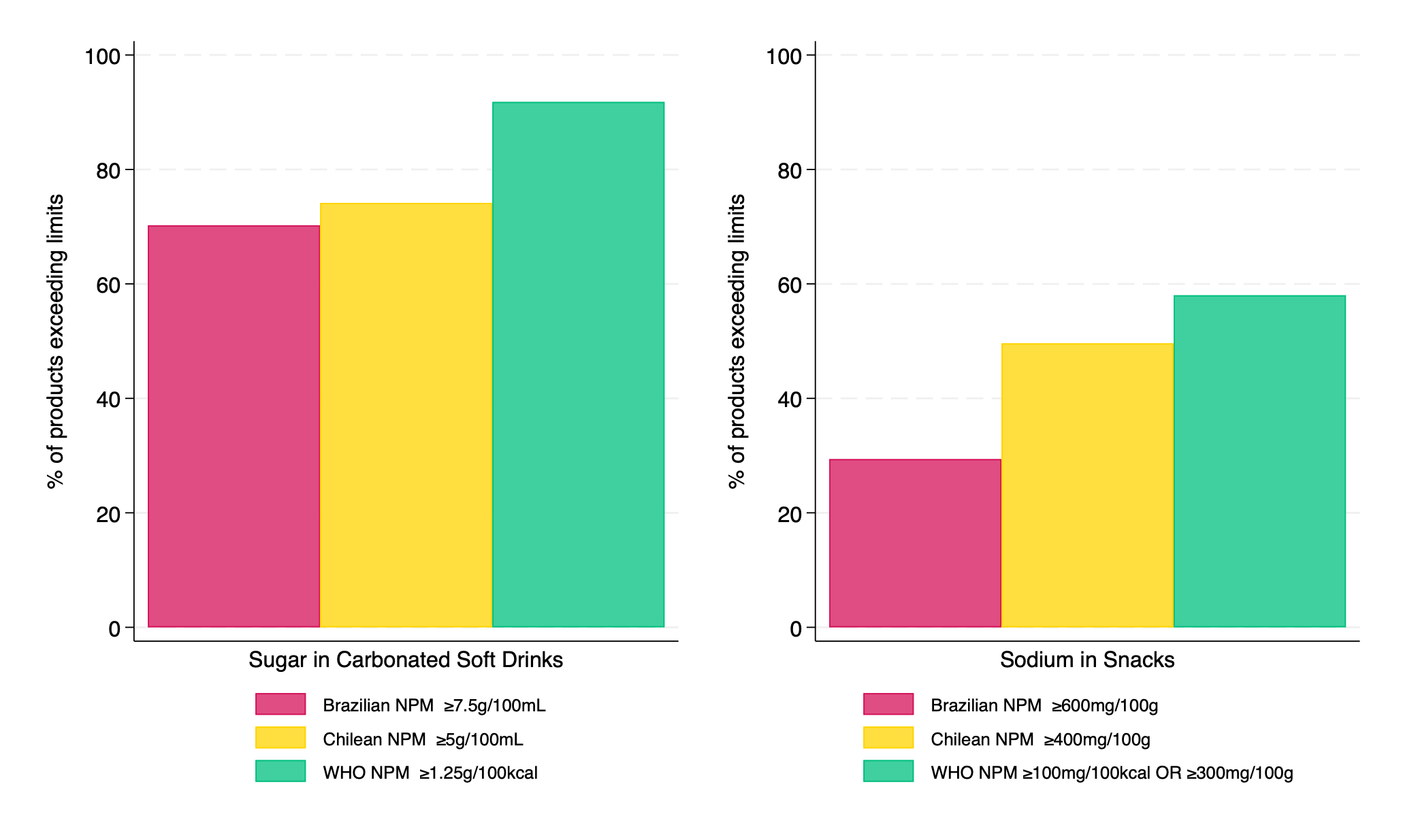
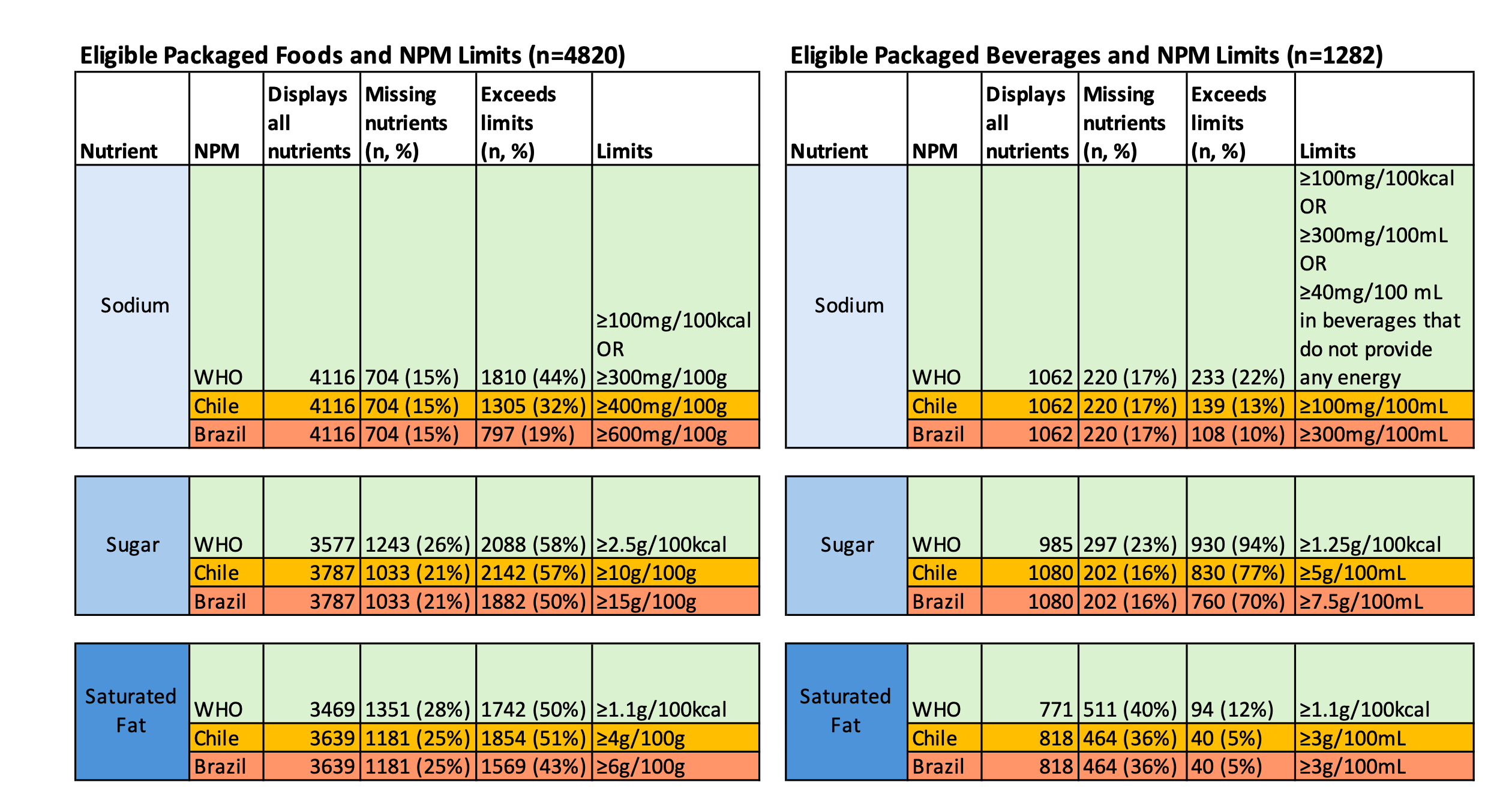
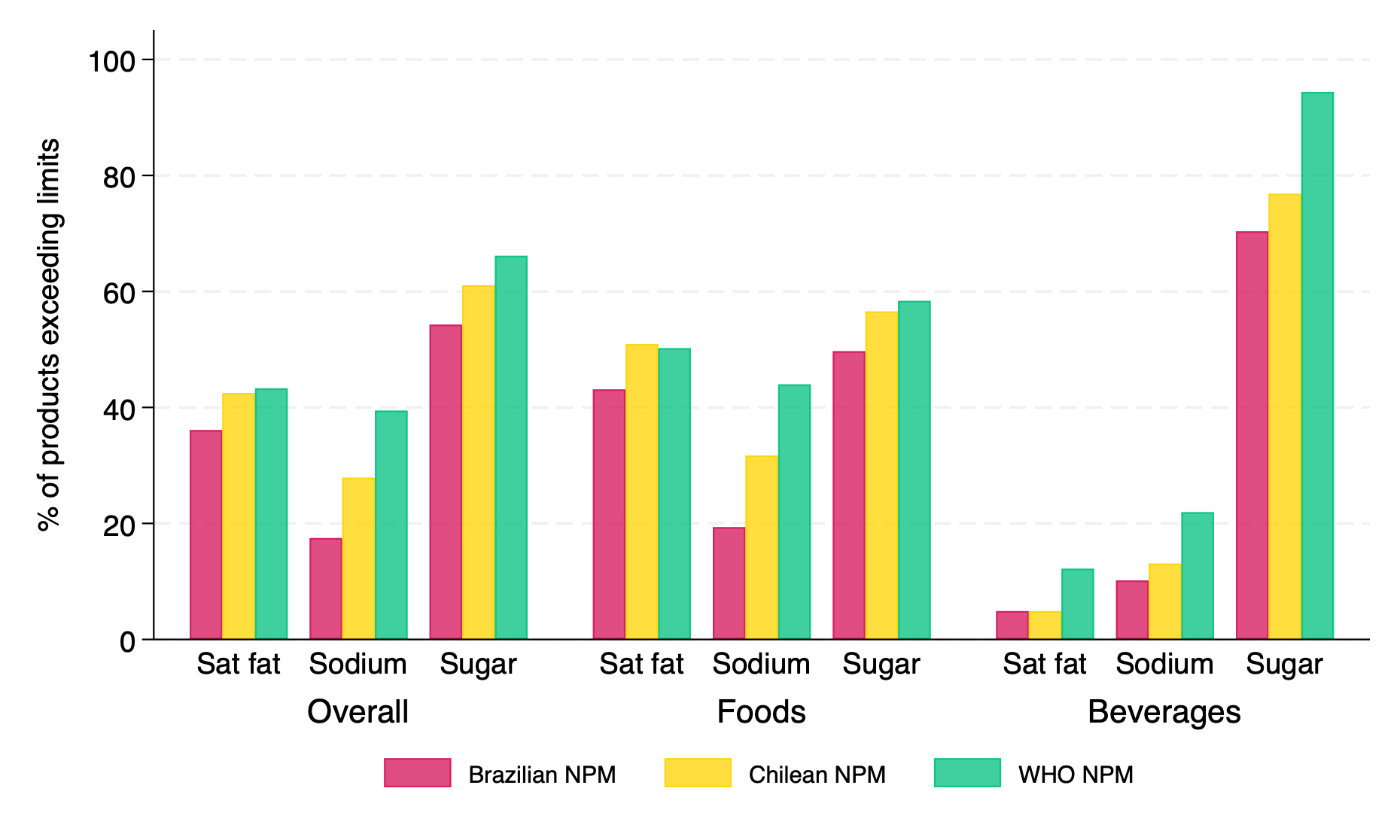
Results: The display of nutrient values varied across food categories. Among eligible food products, 15% lacked information on sodium content, 25-28% on saturated fat, and 21-26% on sugar (Figure 1). Among the three NPMs used, the Brazil NPM consistently captured fewer eligible products while the WHO NPM captured the most (Figure 2). A “high in sugar” FoPL would be applied to 92% of carbonated soft drinks using the WHO NPM, compared to 74% (Chile NPM) and 70% (Brazil NPM) (Figure 3). 58% of snacks would receive a “high in salt” FoPL (WHO NPM) compared to 50% (Chile NPM), and 29% (Brazil NPM) (Figure 3).

Conclusions: The WHO NPM identifies the highest percentage of packaged foods and beverages in Bangladesh high in sodium, saturated fat, and sugar. Because it is grounded in WHO population nutrient intake goals for preventing diet-related chronic disease, it provides a health-protective basis for a FoPL system. This model ensures that the FoPL framework aligns with global public health standards and supports healthier food environments. Irrespective of NPM model used, stronger regulatory enforcement and compliance with nutrient disclosures on labels is needed for comprehensive product classification and effective FoPL policy implementation.
  • Hu, Xiao  ( Johns Hopkins University Bloomberg School of Public Health , Baltimore , Maryland , United States )
  • Henry, Megan  ( Johns Hopkins University Bloomberg School of Public Health , Baltimore , Maryland , United States )
  • Abrar, Ahmad  ( National Heart Foundation Hospital & Research Institute , Dhaka , Bangladesh )
  • Afroza, Ummay  ( National Heart Foundation Hospital & Research Institute , Dhaka , Bangladesh )
  • Pries, Alissa  ( Resolve to Save Lives , Alexandria , Virginia , United States )
  • Steele, Lindsay  ( Resolve to Save Lives , Alexandria , Virginia , United States )
  • Cobb, Laura  ( Resolve to Save Lives , Alexandria , Virginia , United States )
  • Choudhury, Sohel  ( National Heart Foundation Hospital & Research Institute , Dhaka , Bangladesh )
  • Marklund, Matti  ( Johns Hopkins University , Baltimore , Maryland , United States )
  • Appel, Lawrence  ( Johns Hopkins University Bloomberg School of Public Health , Baltimore , Maryland , United States )
  • Author Disclosures:
Meeting Info:

EPI-Lifestyle Scientific Sessions 2026

2026

Boston, Massachusetts

Session Info:

Poster Session 2

Wednesday, 03/18/2026 , 05:00PM - 07:00PM

Poster Session

More abstracts on this topic:
More abstracts from these authors:
Impact of Extended Opportunistic Hypertension Screening on Cardiovascular Disease Outcomes: A Simulation Study

Ogungbe Bunmi, Commodore-mensah Yvonne, Brady Tammy, Appel Lawrence, Matsushita Kuni, Marklund Matti, Hu Xiao, Hussain Tasfia, Nguyen Binh, Abrar Ahmad, Jubayer Shamim, Choudhury Sohel, Bhuiyan Mahfuzur Rahman, Moran Andrew

Opportunistic Screening versus Population-Wide for Hypertension: A Microsimulation Study

Ogungbe Bunmi, Commodore-mensah Yvonne, Brady Tammy, Appel Lawrence, Matsushita Kunihiro, Marklund Matti, Hu Xiao, Hussain Tasfia, Nguyen Binh, Abrar Ahmad, Jubayer Shamim, Choudhury Sohel, Bhuiyan Mahfuzur Rahman, Moran Andrew
You have to be authorized to contact abstract author. Please, Login
Not Available