Logo

American Heart Association

  1
  0


Final ID: WE426

An Environmentally Friendly Dietary Pattern is Associated with Adequate Dietary Intake of Protein and Inadequate Intake of Calcium in NHANES Pre-Pandemic (2017-2020)

Abstract Body: Introduction
Approaches to limit the environmental impact of food typically focus on reducing the consumption of animal products. Adherence to the EAT-Lancet Commission reference diet (2019), designed to limit the environmental impact of foods, has been shown to lower CVD risk in other studies. Limited literature exists to investigate the link between this dietary pattern and nutrient intake across the US population. We hypothesized that there would be an inverse association between the EAT-Lancet Commission reference diet and nutrients of concern for CVD or known to be under-consumed in vegetarian and vegan dietary patterns.
Methods
The National Health and Nutrition Examination Survey (NHANES) 2017-2020 Pre-Pandemic dataset was used for this analysis. Non-pregnant participants with two dietary recalls, aged 20-85, with plausible energy intake (500-8000 kcals/day) were included (N=6374). The Planetary Health Diet Index (PHDI) is a measure of alignment with the EAT-Lancet reference diet, comprised of 14 components scored 0-10 for a maximum ideal score of 140. We used 2-day averages to estimate all dietary components of the PHDI scores and calculated PHDI scores with the DietaryIndex R package. We applied the NCI (National Cancer Institute) method to estimate usual intakes at the population level for nutrient outcomes (vitamin B12, calcium, vitamin D, iron, protein, sodium, and zinc). We estimated the survey-weighted relationship between PHDI quintile and adequate dietary intake of our outcomes.
Results
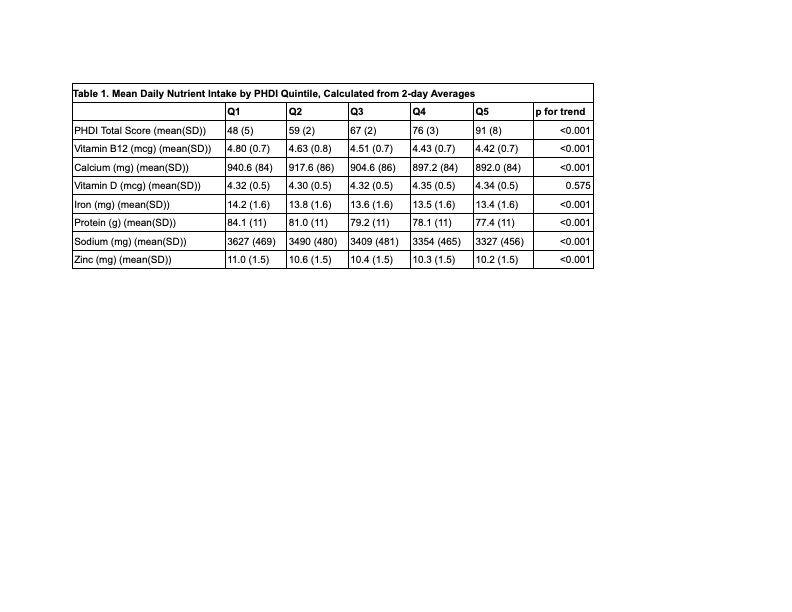
In our sample, the average age was 49 years, with 51% identifying as women. The mean PHDI score was 68 (range 27-129), and the mean energy intake was 2085 kcals/day (range 552-6695). Higher quintiles of PHDI scores were generally associated with a lower 2-day average intake of all nutrient outcomes, except vitamin D, which showed no association (Table 1). When using NCI estimates, calcium intake as %≥Estimated Average Requirement (EAR) was inversely associated with PHDI quintile, while protein was positively associated. No trend was observed for vitamin B12, vitamin D, iron, sodium, or zinc.
Conclusion
We observed a positive relationship between PHDI score and recommended intake of protein, and an inverse relationship with calcium. Public health strategies, such as fortification or supplementation, could be useful to help populations reach adequate calcium intake levels as diets emphasizing planetary health and plant-based products are promoted for CVD prevention.
  • Copp, Katherine  ( University of Minnesota , Minneapolis , Minnesota , United States )
  • Harnack, Lisa  ( University of Minnesota , Minneapolis , Minnesota , United States )
  • Pereira, Mark  ( University of Minnesota , Minneapolis , Minnesota , United States )
  • Wolfson, Julian  ( University of Minnesota , Minneapolis , Minnesota , United States )
  • Johnson, Abigail  ( University of Minnesota , Minneapolis , Minnesota , United States )
  • Author Disclosures:
Meeting Info:

EPI-Lifestyle Scientific Sessions 2026

2026

Boston, Massachusetts

Session Info:

Poster Session 2

Wednesday, 03/18/2026 , 05:00PM - 07:00PM

Poster Session

More abstracts on this topic:
More abstracts from these authors:
The Effect of Physical Activity on the Gut Microbiome in Prediabetes: Results from a Randomized Controlled Trial

Demmer Ryan, Johnson Abigail, Pereira Mark, Pope Zachary, Avenido Francis Ryan, Mitchell Nathan, Richmond Hubbard Paige, Johnson Stephen, Sharma Shweta, Mcdonough Dj, Rydell Sarah

The Planetary Health Diet Score is Inversely Associated with Sodium Intake in NHANES, Pre-Pandemic (2017-2020)

Copp Katherine, Johnson Abigail, Harnack Lisa

You have to be authorized to contact abstract author. Please, Login
Not Available