Logo

American Heart Association

  4
  0


Final ID: TH907

Assessing the Impact of Unmet Social Needs on Clinical Outcomes in Reproductive-Aged Women with Atrial Fibrillation

Abstract Body: Objective
To explore the association between unmet social needs (USN) and atrial fibrillation (AF) outcomes in reproductive aged women.
Background
Individuals with USN often face barriers to regular medical care. In patients with AF, regular follow up with appropriate intervention is essential to mitigate long term complications. Thus, it is crucial to identify risk factors that limit monitoring and intervention of AF.
Methods
We included reproductive aged women (18-50 years) with hospital admissions due to AF from the 2013 to 2024 AHA Get With The Guidelines-AF registry. USN were defined as lacking or using public insurance (Medicaid and Medicare, which was used as a surrogate of low income and/or disability), homelessness, low education level, unemployment, financial strain, substance abuse and a lack of environmental safety. Rhythm control strategies included cardioversion, ablation, or anti-arrhythmic therapies. AF recurrence was defined as a discharge rhythm of AF and used as a marker of poor outcomes. Statistical analysis to compare baseline characteristics and outcomes between those with and without USN was performed with Chi-square test and t-test.
Results
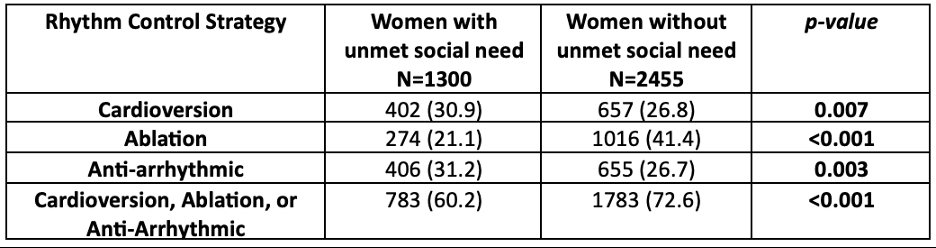
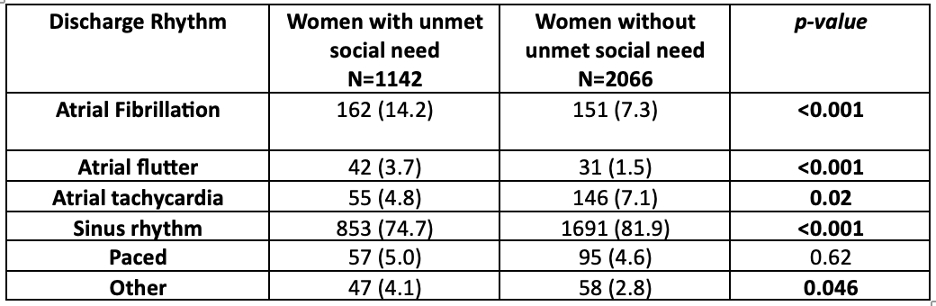
Our study included 3,755 reproductive age women with a mean age of 42.4 (SD 7.1). Of this cohort, 34.6% were identified to have USN and 65.4% did not have an USN. A higher proportion of rhythm control strategies were used in the women without USN group (72.6% vs. 60.2%, p<0.001). Women with USN were less likely to have an AF ablation than in women without USN (21.1% vs. 41.4%, p<0.001) (Table 1). Of those with USN, 14.2% had a discharge rhythm of AF versus 7.3% without a USN (p<0.001). Additionally, sinus rhythm at discharge was observed in 74.7% of women with USN compared to 81.9% in those without an USN (p <0.001, Table 2).
Conclusion
In our study, women with an USN had a significantly higher rate of AF at discharge and lower rate of AF ablation, suggesting a potential link between USN, worse AF-related outcomes, and inequities in rhythm control strategies. These findings underscore the importance of identifying USN and highlight the need for targeted interventions to support this vulnerable population.
  • Tarar, Nazish  ( UMass Chan Medical School , Worcester , Massachusetts , United States )
  • Arthur, Abigail  ( UMass Chan Medical School , Worcester , Massachusetts , United States )
  • Denoncourt, Cailey  ( UMass Chan Medical School , Worcester , Massachusetts , United States )
  • Wang, Ziyue  ( UMass Chan Medical School , Worcester , Massachusetts , United States )
  • Wilkie, Gianna  ( UMass Chan Medical School , Worcester , Massachusetts , United States )
  • Kovell, Lara  ( UMass Chan Medical School , Worcester , Massachusetts , United States )
  • Author Disclosures:
Meeting Info:

EPI-Lifestyle Scientific Sessions 2026

2026

Boston, Massachusetts

Session Info:

Poster Session 3

Thursday, 03/19/2026 , 05:00PM - 07:00PM

Poster Session

More abstracts on this topic:
An Evaluation of Stroke Literature Pamphlets For Stroke Patients

Degen Nathaniel, Sivakumar Milan, Varkey Thomas, Alexandrov Andrei, Singh Savdeep

A Heart-pounding Case of Cardiomyopathy in Pregnancy

Tran Linh, Everitt Ian, Vaught Arthur, Barth Andreas, Minhas Anum

More abstracts from these authors:
Social Vulnerability and Direct Oral Anticoagulant Use in Reproductive-Aged Women with Atrial Arrhythmias

Arthur Abigail, Denoncourt Cailey, Tarar Nazish, Wang Ziyue, Wilkie Gianna, Kovell Lara

Sex Disparities in Accuracy of Physician-Reported Versus Computed CHA2DS2-VASc Scores in the Get With The Guidelines–AFIB Registry

Barnes Jenna, Denoncourt Cailey, Wang Ziyue, Wilkie Gianna, Alhuarrat Majd Al Deen, Kiani Soroosh, Kovell Lara

You have to be authorized to contact abstract author. Please, Login
Not Available