Association Between Health Care Access and Cardiovascular Health Risk Among Reproductive-Aged Women in the SAFE HEART Study
Abstract Body: Background: Limited access to healthcare can influence cardiovascular health behaviors and outcomes. Few studies have examined this relationship, especially among women of reproductive age who often face unique barriers to care. We examined how indicators of access to care relate to overall CVH risk, defined by Life’s Essential 8 (LE8), among women in the SAFE HEART Study.
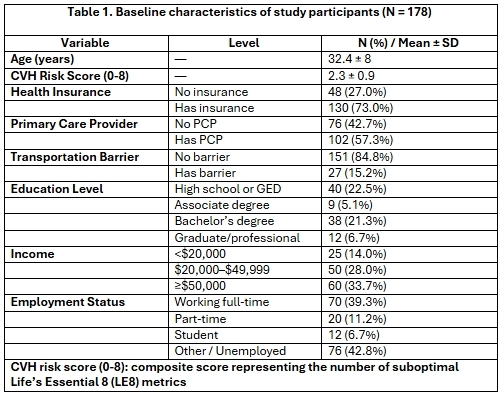
Methods: We analyzed a cross-sectional sample of women aged 18–50 years. LE8 metrics (diet, physical activity, smoking, sleep health, body mass index, blood lipids, blood glucose, and blood pressure) were self-reported and scored as 0 vs 1 (optimal vs suboptimal levels as per AHA’s LE8 recommendations). Each participant received a composite CVH risk score (0-8), representing the number of suboptimal LE8 metrics. Access-to-care indicators included insurance status, PCP status, and self-reported transportation barriers (yes vs no for each indicator). Covariates included age, race, education, income, and employment status. Descriptive statistics and fully adjusted linear regression were used to assess associations between healthcare access and CVH risk.
Results: Among N =178 women, the mean age was 32.4 years (SD = 8.0) and the mean CVH risk score was 2.26 + 0.88. Participants without insurance (n = 48) had a mean score of 2.29 + 0.80 versus 2.25 + 0.92 among those with insurance (n = 130; p = 0.79). Those without a PCP (n = 76) had a mean score of 2.25 + 0.84 versus 2.27 + 0.92 for those with a PCP (n = 102; p = 0.85). Participants reporting transportation barriers (n = 27) had a mean score of 2.22 + 0.93, compared with 2.27 + 0.88 among those without barriers (n = 151; p = 0.80). In fully adjusted linear regression, none of the healthcare access indicators were significantly associated with CVH risk: insurance (β = 0.22, p = 0.30), PCP (β = 0.09, p = 0.59), and transportation barrier (β = -0.03, p = 0.88).
Conclusion: In this sample of reproductive-aged women, insurance, primary care provider, and transportation barriers were not independently associated with cardiovascular risk as measured by LE8 metrics. Beyond healthcare access, other social and behavioral determinants may play a larger role in cardiovascular health risk among reproductive-aged women.
Dankwa, Kwabena
(
Johns Hopkins University
, Baltimore , Maryland , United States )
Metlock, Faith
(
John Hopkins University School of N
, Baltimore , Maryland , United States )
Odei-kumi, Kwabena
(
Johns Hopkins University
, Baltimore , Maryland , United States )
Ateh Stanislas, Ketum
(
Johns Hopkins University
, Baltimore , Maryland , United States )
Rayani, Asma
(
Johns Hopkins University
, Baltimore , Maryland , United States )
Baez Mateo, Ana
(
John Hopkins University School of N
, Baltimore , Maryland , United States )
Hernandez, Lilian
(
Johns Hopkins School of Nursing
, Baltimore , Maryland , United States )
Etelier, Feodora
(
John Hopkins University School of N
, Baltimore , Maryland , United States )
Ezuma, Chioma
(
Johns Hopkins University
, Baltimore , Maryland , United States )
Vaidya, Dhananjay
(
Johns Hopkins University
, Baltimore , Maryland , United States )
Ouyang, Pamela
(
JOHNS HOPKINS UNIVERSITY
, Towson , Maryland , United States )
Hladek, Melissa
(
John Hopkins University School of N
, Baltimore , Maryland , United States )
Sharma, Garima
(
Inova Heart and Vascular Institate
, Fairfax , Virginia , United States )
Commodore-mensah, Yvonne
(
John Hopkins University School of N
, Baltimore , Maryland , United States )
Lartey Kwame, Matambo Sean, Smith Shabrya, Sivakumar Sadhana, Davis Loletia, Gillespie Shannon, Nolan Timiya, Gregory John, Joseph Joshua, Ojembe Nnanna, Wilson Amani, Williams Amaris, Brock Guy, Zhao Songzhu, Grant Jeremy, Greer Darreon, Griffin Madison