Phthalate Exposure as a Second Hit for APOL1-Associated Chronic Kidney Disease Progression
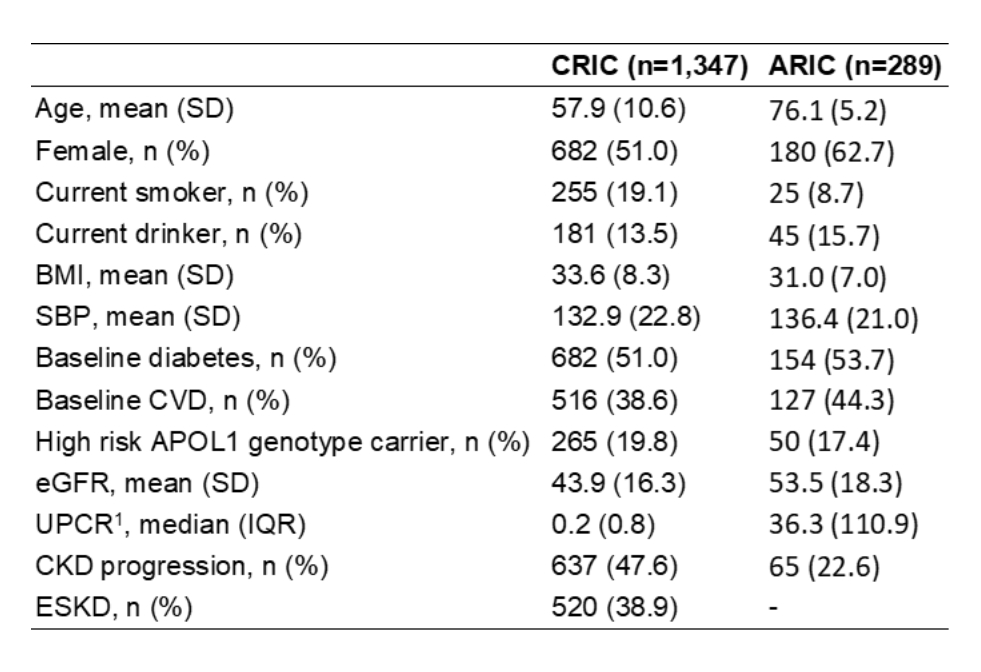
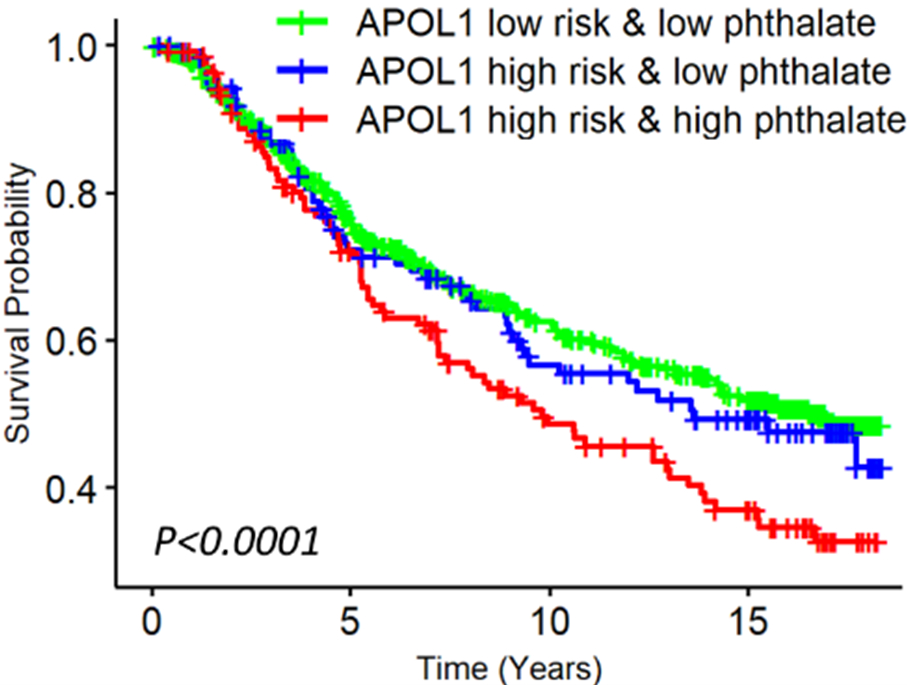
Abstract Body: Introduction: Carrying two risk alleles in the apolipoprotein L1 (APOL1) gene is a well-established risk factor for chronic kidney disease (CKD) and its progression among African Americans. However, many high-risk individuals do not develop CKD or experience rapid progression, suggesting that environmental “second hits” may be required to trigger the adverse effects. We tested the hypothesis that phthalates, ubiquitous environmental pollutants linked to podocyte injury, act as a “second hit” that exacerbates APOL1-associated CKD progression. Methods: We examined APOL1-phthalate interactions among 1,347 African American patients with CKD from the Chronic Renal Insufficiency Cohort (CRIC) and replicated findings in 289 African American CKD patients from the Atherosclerosis Risk in Communities (ARIC) study (Table). APOL1 genotypes were classified as high-risk (2 risk alleles) or low-risk (0/1 risk alleles). Phthalate exposure was assessed by monobutyl phthalate acyl-β-glucuronide (MBPAG) and monoethyl phthalate O-β-glucuronide (MEPOG) measured from 24-hour urine samples at baseline and dichotomized at cohort-specific medians. CKD progression was defined as incident end-stage kidney disease (ESKD) or ≥50% estimated glomerular filtration rate (eGFR) decline in CRIC and as ESKD or ≥30% eGFR decline in ARIC. Multivariable Cox models adjusted for age, sex, study sites, BMI, smoking, drinking, blood pressure, diabetes, and cardiovascular disease in the base model, and additionally for eGFR and proteinuria in the full model. Results: Over a mean 6.5 years of follow-up in both CRIC and ARIC, MBPAG significantly modified the association between APOL1 genotypes and CKD progression (P for interaction=5.3×10⁻⁵ in CRIC and 0.04 in ARIC, Figure). In CRIC, the APOL1 high-risk genotype was associated with increased risk only among participants with high MBPAG levels (Hazard ratio [HR]=1.97; 95% confidence interval [CI]: 1.49–2.62; P=2.3×10⁻⁶), but not in those with low MBPAG (HR=1.03; 95% CI: 0.79–1.35; P=0.80). Similar findings were observed in ARIC, where high MBPAG levels amplified the effect of APOL1 high-risk genotypes on CKD progression (HR=2.62; 95% CI: 1.26–5.47; P=0.01), but not at low MBPAG levels (HR=0.19; 95% CI: 0.02–1.51; P=0.12). The interactions remained significant in fully adjusted models, with consistent results for MEPOG. Conclusions: Phthalate exposure amplified the adverse effect of APOL1 high-risk genotypes on CKD progression among African Americans.
Zhang, Ruiyuan
(
UT Southwestern Medical Center
, Dallas , Texas , United States )
Surapaneni, Aditya
(
NYU Grossman School of Medicine
, New York , New York , United States )
Liu, Tingting
(
Florida State University
, Tallahassee , Florida , United States )
Sun, Yixi
(
University of Illinois Chicago
, Chicago , Illinois , United States )
Liu, Yizhuo
(
UT Southwestern Medical Center
, Dallas , Texas , United States )
Huang, Zhijie
(
University of Illinois Chicago
, Chicago , Illinois , United States )
Li, Xiang
(
University of Illinois Chicago
, Chicago , Illinois , United States )
Kelly, Tanika
(
University of Illinois Chicago
, Chicago , Illinois , United States )
He, Jiang
(
UT Southwestern Medical Center
, Dallas , Texas , United States )
Chen, Jing
(
UT Southwestern Medical Center
, Dallas , Texas , United States )
Grams, Morgan
(
NYU Grossman School of Medicine
, New York , New York , United States )
Li, Changwei
(
UT Southwestern Medical Center
, Dallas , Texas , United States )