EPI-Lifestyle Scientific Sessions 2026
/
Poster Session 1
/
Associations between per- and polyfluoroalkyl substance (PFAS) levels during early pregnancy and circulating cardiovascular proteins in women at 3 years postpartum: results from Project Viva
American Heart Association
81
0
Final ID: TU145
Associations between per- and polyfluoroalkyl substance (PFAS) levels during early pregnancy and circulating cardiovascular proteins in women at 3 years postpartum: results from Project Viva
Abstract Body: Introduction: PFAS are synthetic chemicals that persist in the environment and accumulate in humans. Higher PFAS exposure during pregnancy has been associated with poorer long-term cardiovascular health in women, but the biological pathways are unclear. Circulating cardiovascular proteins may help elucidate these mechanisms.
Methods: We studied 173 women from Project Viva, a prospective cohort enrolled between 1999 and 2002 in Eastern MA. We measured plasma concentrations of 6 PFAS (PFOA, PFOS, PFHxS, PFNA, EtFOSAA, MeFOSAA) during early pregnancy. In plasma collected at 3 years postpartum, we quantified 92 proteins using the Olink Target 92 Cardiovascular II panel. We used linear regression models to examine associations of each log2-transformed PFAS with Normalized Protein eXpression (NPX) levels, adjusting for age at enrollment, education, marital status, pre-pregnancy BMI, parity, smoking status, and first-trimester DASH diet score. We report associations with nominal P<0.05 and used the False Discovery Rate (FDR) approach to account for multiple testing, considering FDR<0.10 as statistically significant.
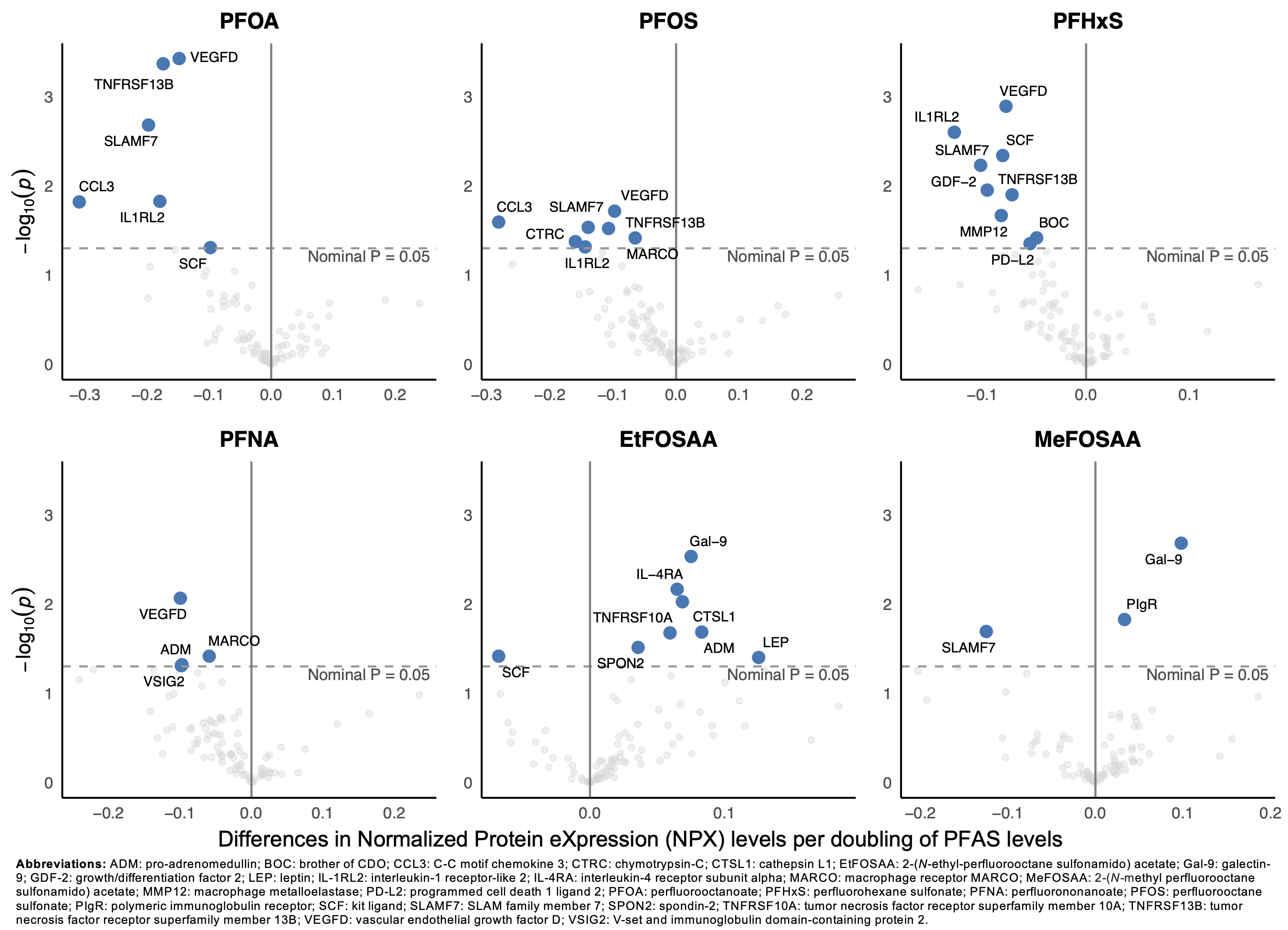
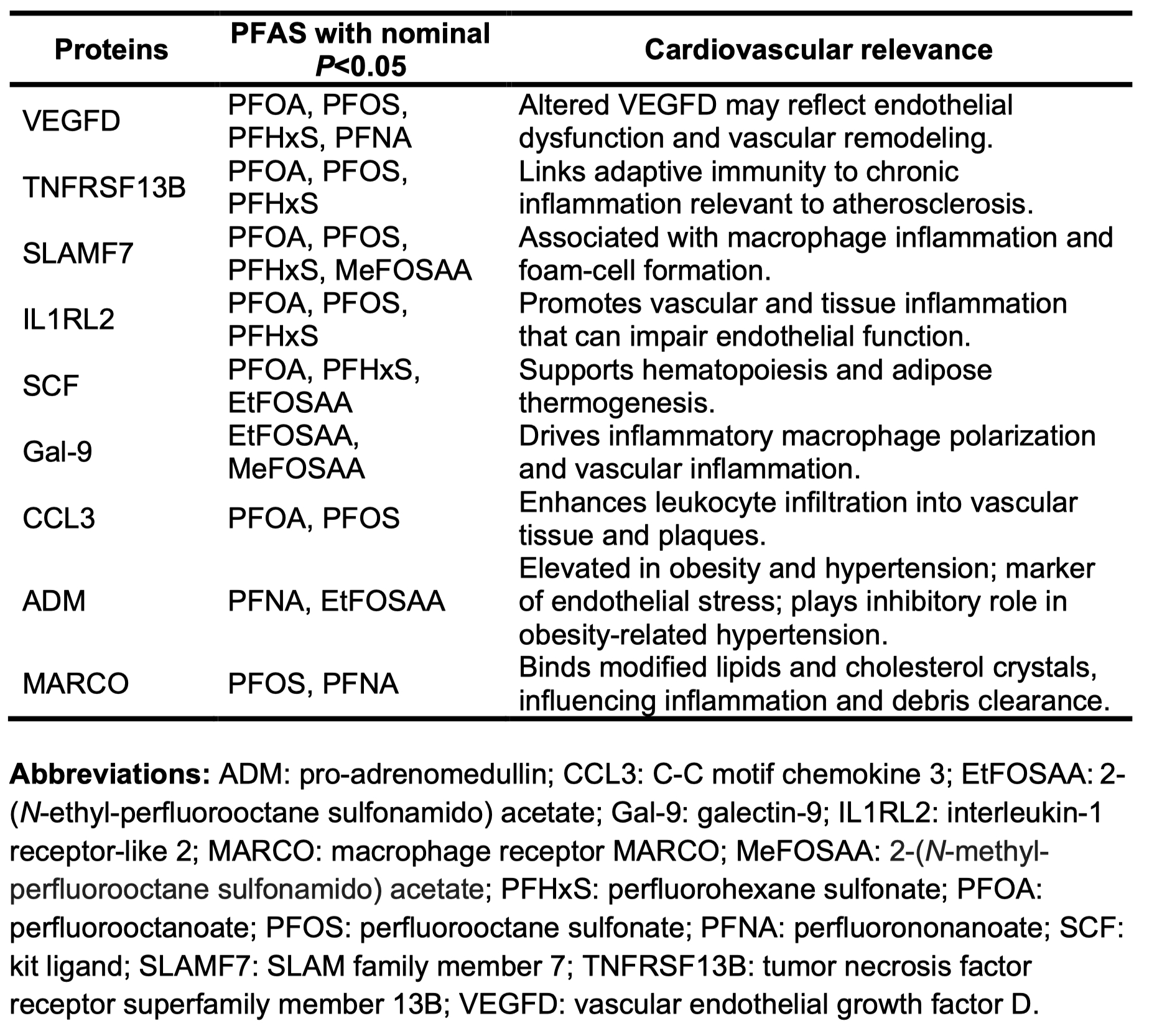
Results: The mean (SD) age at enrollment was 33.0 (4.8) years; 80% were college graduates, and 50% were nulliparous. In adjusted models, PFOA, PFOS, PFHxS, PFNA, EtFOSAA, and MeFOSAA were associated with 6, 7, 9, 4, 8, and 3 proteins, respectively, at nominal P<0.05 (Figure). Nine proteins, including vascular endothelial growth factor D (VEGFD), tumor necrosis factor receptor superfamily member 13B (TNFRSF13B), SLAM family member 7 (SLAMF7), interleukin-1 receptor-like 2 (IL1RL2), kit ligand (SCF), galectin-9 (Gal-9), C-C motif chemokine 3 (CCL3), pro-adrenomedullin (ADM), and macrophage receptor MARCO, were each associated with ≥ 2 PFAS at nominal P<0.05; Table summarizes the cardiovascular relevance of these proteins. After FDR correction, PFOA remained associated with lower levels of VEGFD (implicated in endothelial dysfunction and vascular remodeling), TNFRSF13B (implicated in adaptive immunity and chronic inflammation), and SLAMF7 (implicated in macrophage inflammation and foam cell formation) (Figure). No other PFAS-protein associations reached FDR<0.10.
Conclusion: PFAS levels during pregnancy were associated with alterations in multiple cardiovascular proteins involved in inflammation, vascular remodeling, and atherosclerosis at 3 years postpartum. These results suggest potential pathways linking PFAS to women’s long-term cardiovascular health.
Grobman, Benjamin
(
Harvard Medical School
, Boston , Massachusetts , United States )
Rifas-shiman, Sheryl L.
(
Harvard Medical School and Harvard Pilgrim Health Care Institute
, Boston , Massachusetts , United States )
Aris, Izzuddin
(
Harvard Medical School and Harvard Pilgrim Health Care Institute
, Boston , Massachusetts , United States )
Lin, Pi-i
(
Harvard Medical School and Harvard Pilgrim Health Care Institute
, Boston , Massachusetts , United States )
James-todd, Tamarra
(
Harvard T.H. Chan School of Public Health
, Boston , Massachusetts , United States )
Fleisch, Abby
(
MaineHealth Institute for Research
, Portland , Maine , United States )
Juraschek, Stephen
(
Beth Israel Deaconess Medical Center, Harvard Medical School
, Boston , Massachusetts , United States )
Oken, Emily
(
Harvard Medical School and Harvard Pilgrim Health Care Institute
, Boston , Massachusetts , United States )
Hivert, Marie-france
(
Harvard Medical School and Harvard Pilgrim Health Care Institute
, Boston , Massachusetts , United States )
Zhang, Mingyu
(
Beth Israel Deaconess Medical Center, Harvard Medical School
, Boston , Massachusetts , United States )