Gestational weight gain, post-partum weight retention, and women’s mid-life cardiovascular health in Project Viva
Abstract Body: Background: Inadequate or excessive gestational weight gain (GWG) is associated with adverse pregnancy outcomes. Less is known about how GWG and post-partum weight retention impact women’s long-term cardiovascular health (CVH).
Methods: Participants are from Project Viva, a prospective cohort of pregnant women and their offspring. We defined GWG as the last clinically measured pre-delivery weight from clinical records minus pre-pregnancy weight (from self-report). We defined post-partum weight retention as post-partum weight (measured at 6 months; self-reported at 1 and 2 years) minus pre-pregnancy weight. At the Mid-life Visit (2017-2021), we measured blood pressure, body mass index (BMI), glucose, hemoglobin A1c, cholesterol, and participants self-reported health behaviors (sleep, diet, physical activity, smoking). We derived American Heart Association Life’s Essential 8 (LE8) scores (0-100, higher=better) and used linear regression to examine associations of overall and trimester-specific GWG and post-partum weight retention at 6 months, 1, and 2 years post-partum with overall LE8, its biomedical and behavioral domains, and individual metrics. Models were adjusted for pre-pregnancy body mass index, age of mother at enrollment, and mother’s educational attainment at enrollment.
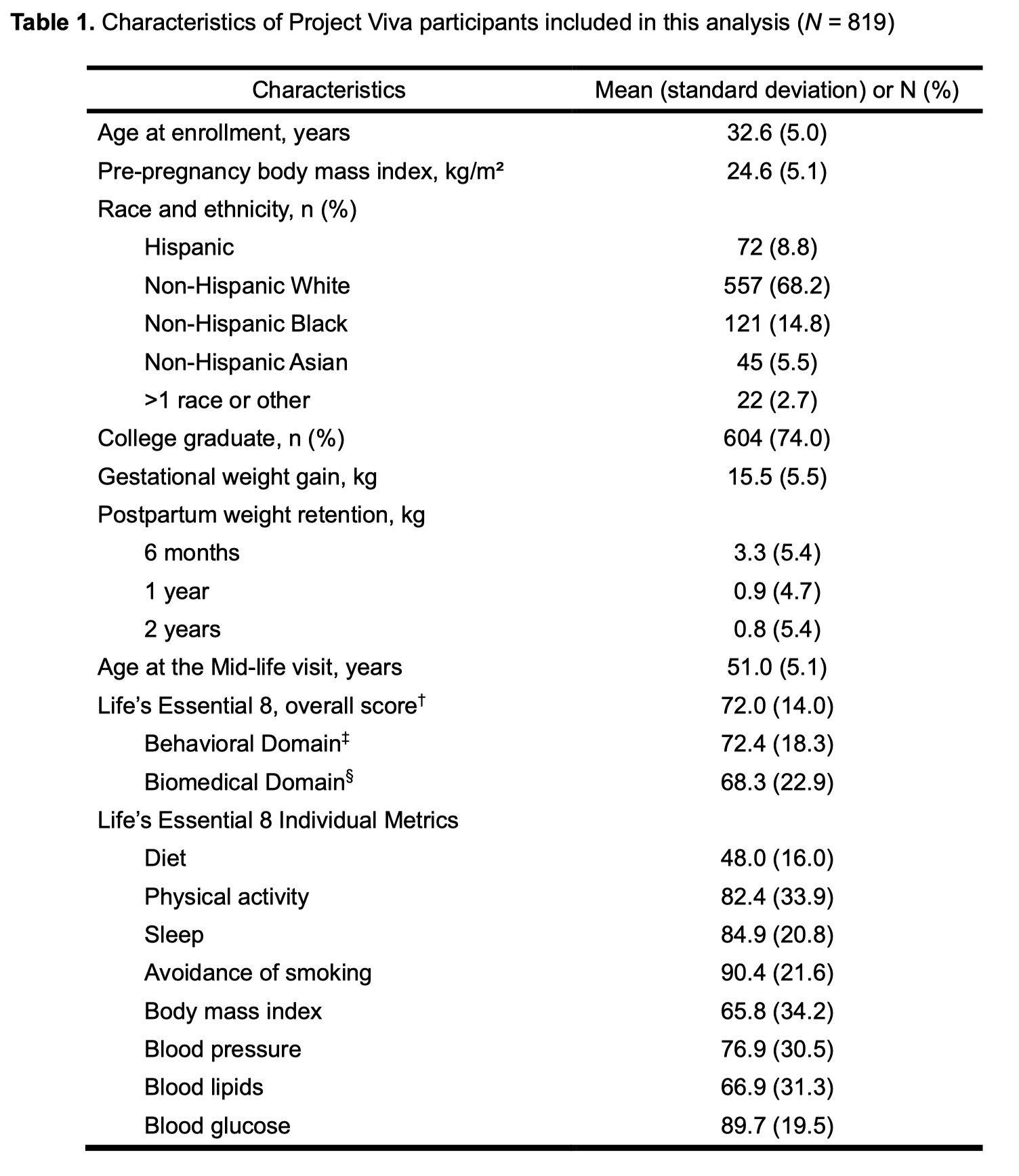
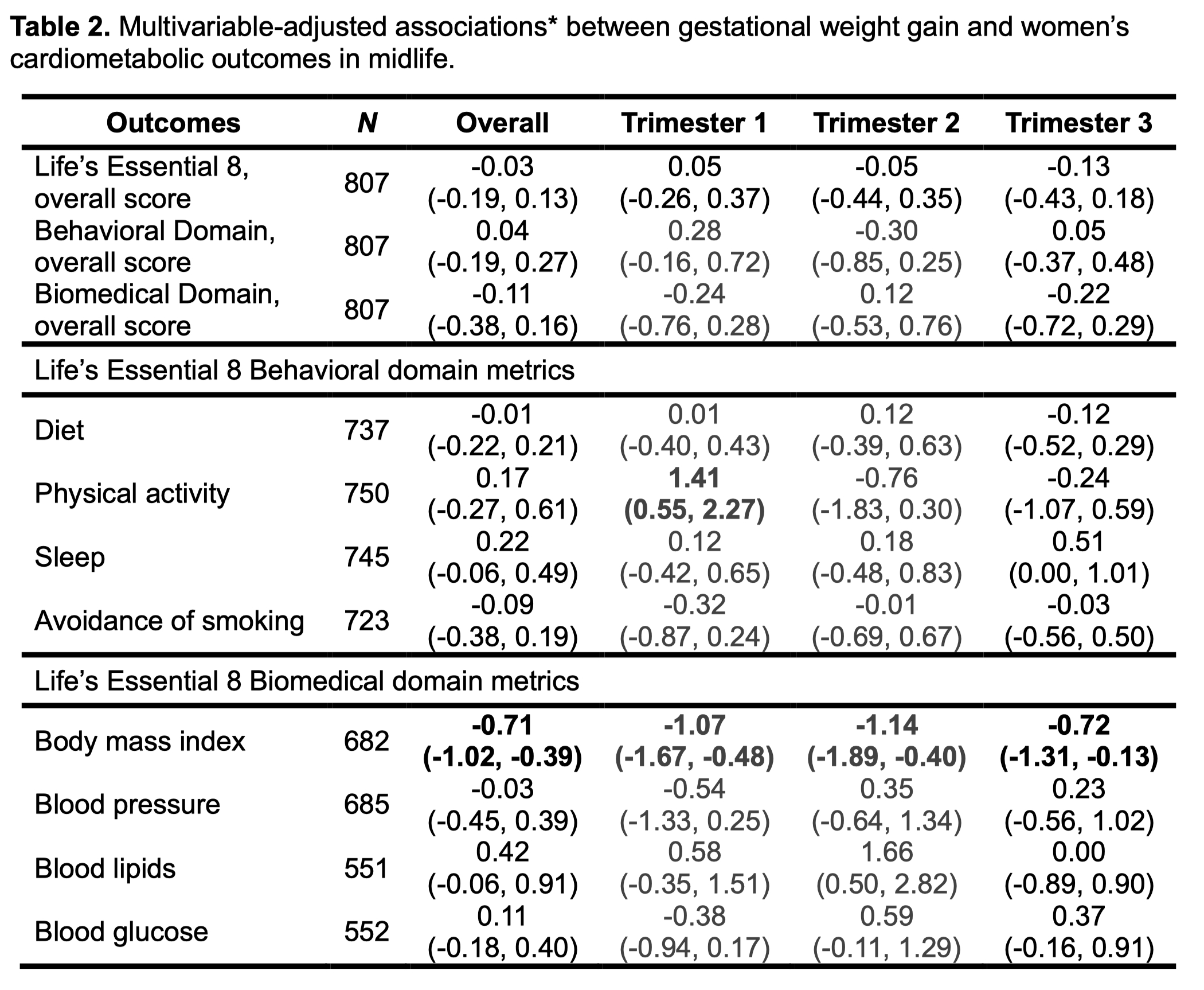
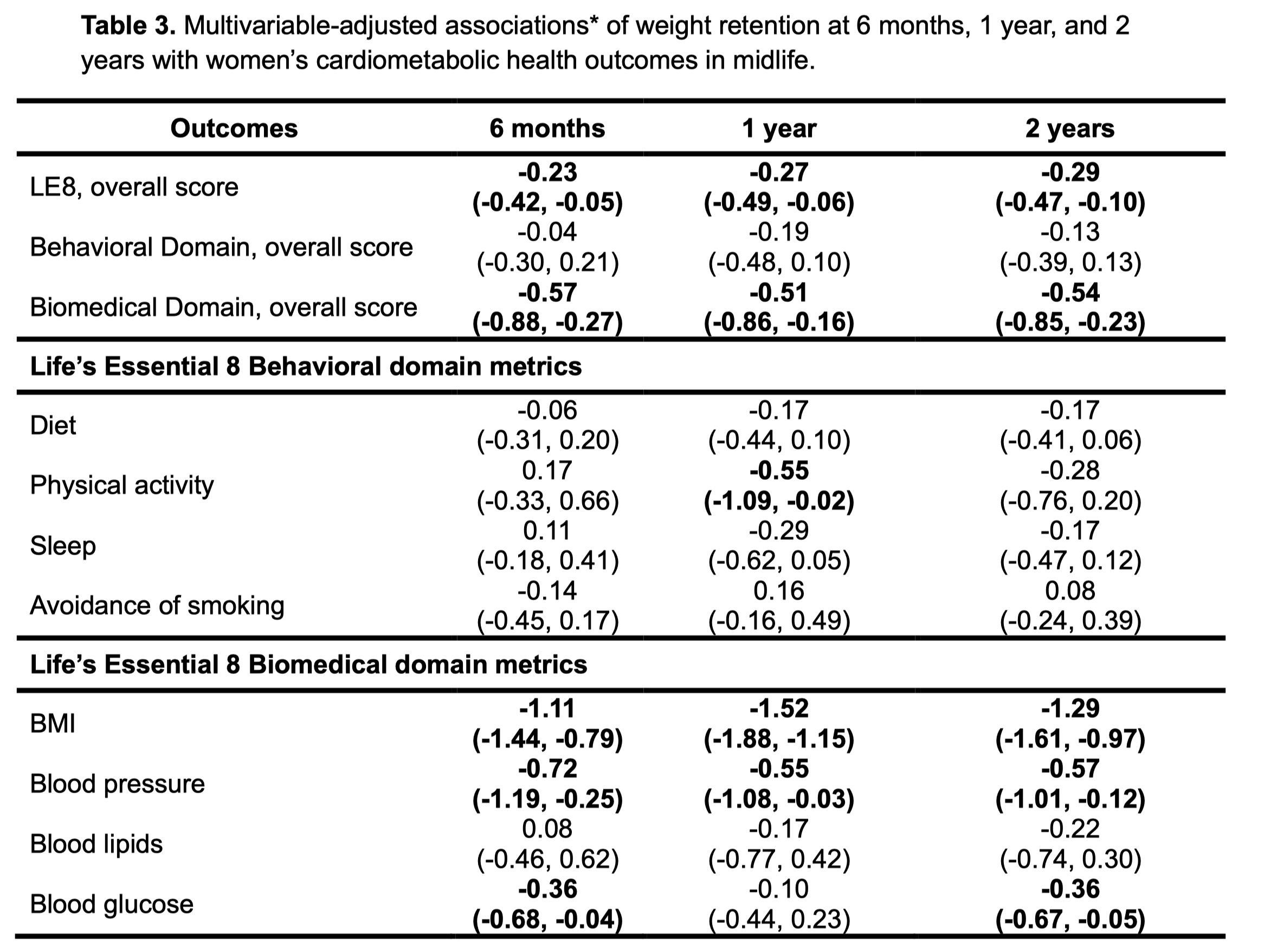
Results: Among 819 women (mean [SD] age 32.6 [5.0] years at enrollment and 51.0 [5.1] years at mid-life; 68% Non-Hispanic White, 15% Non-Hispanic Black), pre-pregnancy BMI was 24.6 (5.1) kg/m2 (Table 1). Higher GWG (per 1 kg) was associated with a worse BMI score at mid-life for pregnancy overall (β = -0.71, 95% CI: -1.02, -0.39), and for the 1st (β = -1.07, 95% CI: -1.67, -0.48), 2nd (β = -1.14, 95% CI: -1.89, -0.40) and 3rd (β = -0.72, 95% CI: -1.31, -0.13) trimesters individually (Table 2). Higher post-partum weight retention (per 1 kg) at all time points was associated with a worse LE8 biomedical domain (indicating worse CVH), a worse BMI score, and a worse BP score (Table 3). Higher post-partum weight retention at 6 months (β = -0.36, 95% CI: -0.68, -0.04) and 2 years (β = -0.36, 95% CI: -0.67, -0.05) was also associated with a worse blood glucose score.
Conclusion: In this prospective cohort, higher GWG was associated with higher mid-life BMI, and higher post-partum weight retention was associated with higher BMI, BP, and worse overall CVH. Minimizing post-partum weight retention may be an important target for optimizing women’s long-term CVH.
Grobman, Benjamin
(
Harvard Medical School
, Boston , Massachusetts , United States )
Rifas-shiman, Sheryl L.
(
Harvard Medical School and Harvard Pilgrim Health Care Institute
, Boston , Massachusetts , United States )
Aris, Izzuddin
(
Harvard Medical School and Harvard Pilgrim Health Care Institute
, Boston , Massachusetts , United States )
Perng, Wei
(
Colorado School of Public Health, University of Colorado Anschutz Medical Campus
, Aurora , Colorado , United States )
Juraschek, Stephen
(
Beth Israel Deaconess Medical Center, Harvard Medical School
, Boston , Massachusetts , United States )
Oken, Emily
(
Harvard Medical School and Harvard Pilgrim Health Care Institute
, Boston , Massachusetts , United States )
Hivert, Marie-france
(
Harvard Medical School and Harvard Pilgrim Health Care Institute
, Boston , Massachusetts , United States )
Zhang, Mingyu
(
Beth Israel Deaconess Medical Center, Harvard Medical School
, Boston , Massachusetts , United States )