High Left Ventricular Mass on Cardiac Magnetic Resonance Imaging is Associated with Incident Frailty in Community-dwelling Adults
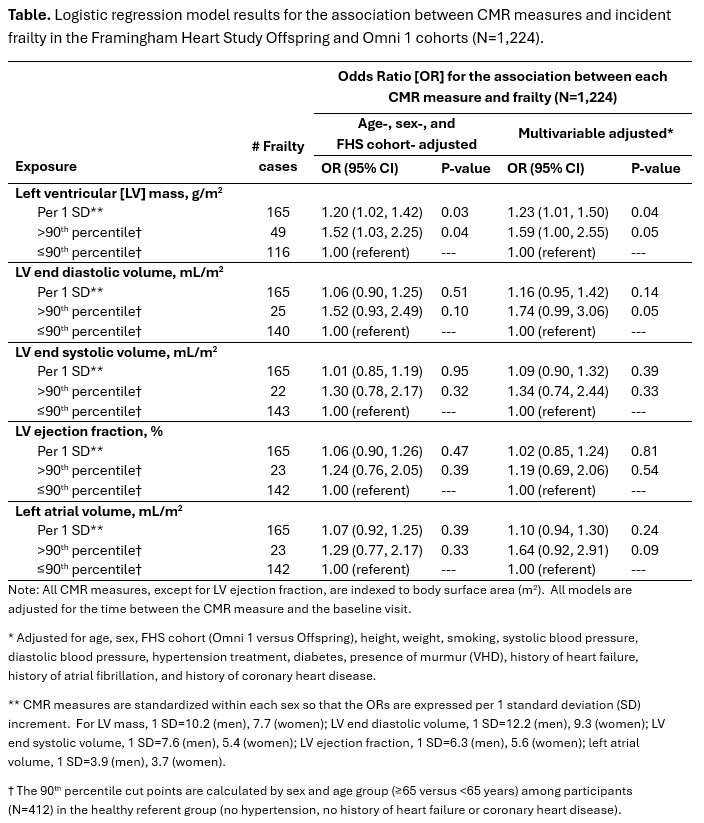
Abstract Body: Introduction: Cardiovascular disease (CVD) and frailty share pathophysiology and risk factors. Markers of subclinical CVD on cardiac magnetic resonance imaging (CMR) have been associated with adverse CVD events. However, the data are limited on whether these markers may be associated with incident frailty. We sought to determine whether measures of myocardial structure and function on CMR are associated with incident frailty in community-dwelling adults. Methods: The study sample included Framingham Heart Study (FHS) Offspring and Omni 1 cohort participants who attended both a baseline (2005-2008) and a follow-up study visit (2011-2014), underwent CMR (1.5-T system, Gyroscan NT, Philips Healthcare), and were free of prevalent frailty at baseline. All CMR measures (left ventricular (LV) mass, end systolic volume, end diastolic volume, and ejection fraction, and left atrial volume) were 1) standardized by sex (per 1 standard deviation (SD) increment) and 2) categorized into >90th (“high”) versus ≤90th percentile. The 90th percentile (P90) cut points were calculated by sex and age group (≥65 versus <65 years) using a healthy referent sample (free of hypertension, heart failure, and coronary heart disease). Incident frailty assessed at follow-up was defined using a 37-item Framingham Rockwood Frailty Index (FHS-FI; ≤0.1 non-frail, >0.1 to 0.21 prefrail, and >0.21 frail). Multivariable-adjusted logistic regression models were constructed to examine the association between each CMR marker and incident frailty. Results: Of 1,224 participants (mean age 64 ± 8 years, 52% women), 165 (13%) developed incident frailty over 5.7±0.5 years). In multivariable adjusted models (Table), a 1 SD increment of LV mass was associated with 23% higher odds of incident frailty. Participants with high LV mass had a 59% increase in odds of frailty as compared to those with LV mass ≤90th percentile, although this finding did not achieve statistical significance (95% CI: 1.00-2.55, p=0.05). Conclusion: High LV mass was significantly associated with increased odds of frailty in community-dwelling adults, independent of prevalent CVD and associated risk factors. Further studies of the association between CMR measures and frailty are warranted, as they may provide insight into the mechanisms linking subclinical CVD to frailty.
Qazi, Saadia
(
Brigham and Womens Hospital
, Boston , Massachusetts , United States )
Preis, Sarah
(
BOSTON UNIVERSITY SCHOOL PUB HLTH
, Boston , Massachusetts , United States )
Salton, Carol
(
Framingham Heart Study
, Framingham , Massachusetts , United States )
Odonnell, Christopher
(
Novartis
, Wellesley , Massachusetts , United States )
Manning, Warren
(
BETH ISRAEL DEACONESS MED CTR
, Boston , Massachusetts , United States )
Chuang, Michael
(
Cardiovascular Research Foundation
, Newton , Massachusetts , United States )
Murabito, Joanne
(
Boston Medical Center/Framingham Study
, Framingham , Massachusetts , United States )
Orkaby, Ariela
(
VA Boston Healthcare System
, Boston , Massachusetts , United States )