Impact of Adverse Pregnancy Outcomes on Long-term Outcomes in Women with Heart Failure
Abstract Body: Introduction: Adverse pregnancy outcomes (APOs) are risk factors for future cardiovascular disease, including heart failure (HF). However, the impact of a history of APOs among women diagnosed with HF is unclear. We investigated whether women with HF and a history of APOs, including gestational hypertension, preeclampsia, eclampsia, gestational diabetes mellitus, and fetal growth restriction, experienced worse long-term HF-related outcomes than those without APOs.
Methods: Using the TriNetX Global Collaborative Network, we conducted a retrospective cohort study of women aged 25-80 years with HF (both HFpEF and HFrEF) and a history of pregnancy. Cohort 1 included women with prior APOs (ICD O13-15, O16.1, O254.41, O36.59), and Cohort 2 included women with documented pregnancy but no APOs, all based on International Classification of Diseases, 10th Revision (ICD-10) encounter diagnosis. Cohorts were propensity-score matched (PSM) on 27 variables, including demographics and established cardiovascular comorbidities, yielding 5,061 matched pairs. Index event was the date of initial documented HF diagnosis (I50). Baseline characteristics were evaluated over 5 years preceeding the index date. Outcomes were assessed over 10 years following index and included HF exacerbations (I50.23, I50.33, I50.31, I50.21, I50.43, I50.51), ischemic stroke (I63), myocardial infarction (I21), and all-cause mortality. Statistical analyses were performed using Z-statistics and Kaplan-Meier survival analyses.
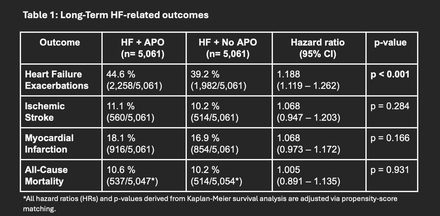
Results: Cohorts were well matched demographically (mean age 45.7 vs 45.4 years; 47.9% vs 46.9% White; 36.7% vs 37.3% Black) and across all major cardiovascular risk factors after PSM. Women with APOs had significantly higher rates of HF exacerbations (44.6% vs 39.2%, HR 1.19, 95% CI 1.12–1.26, p<0.001). No significant differences were observed in ischemic stroke (p=0.284), myocardial infarction (p=0.166), or all-cause mortality (p=0.931).
Conclusions: Among women with HF, a history of APOs is associated with more HF exacerbations. These findings highlight APO history as an important marker for identifying women who may benefit from more intensive HF management.
Thaker, Vishrut
(
Emory University School of Medicine
, Morrow , Georgia , United States )
Mouawad, Celine
(
Emory University School of Medicine
, Morrow , Georgia , United States )
Evenhuis, Bernard
(
Emory University School of Medicine
, Morrow , Georgia , United States )
Ahmed, Taha
(
Emory University School of Medicine
, Morrow , Georgia , United States )
Kaelber, David
(
Case Western Reserve University
, Shaker Heights , Ohio , United States )
Chandrasekaran, Suchitra
(
Emory University School of Medicine
, Morrow , Georgia , United States )
Mehta, Puja
(
Emory University School of Medicine
, Morrow , Georgia , United States )