SGLT2 Inhibitors Are Associated with Improved Outcomes in HFpEF Patients with ESRD
Abstract Body (Do not enter title and authors here): Introduction Heart failure with preserved ejection fraction (HFpEF) commonly coexists with end-stage renal disease (ESRD, together increasing cardiovascular risk [1,2,3,4,5]. While SGLT2 inhibitors (SGLT2i) reduce HF hospitalizations and cardiovascular death in trials like EMPEROR-Preserved and DELIVER, patients with very low eGFR or on dialysis were excluded [6,7]. While trials are ongoing, data on SGLT2i in this high-risk population remain limited.
Hypothesis SGLT2i is associated with improved cardiovascular outcomes in HFpEF patients with ESRD.
Methods We conducted a retrospective cohort analysis of deidentified, aggregate patient data from the TriNetX research network. Patients with HFpEF and ESRD between age 18-85 were included. Patients were stratified by SGLT2i use and propensity matched by demographics, baseline cardiac risk factors, DM medications, and etiology of HFpEF. Outcomes were evaluated within 18-months from the HFpEF + ESRD diagnosis. Primary endpoints included acute decompensated heart failure (ADHF) events, all-cause mortality, hospitalizations for any cause, and emergency department visits for any cause. Z-tests were used to calculate risk difference and Cox regression was used to compute hazard ratios over an 18-month period.
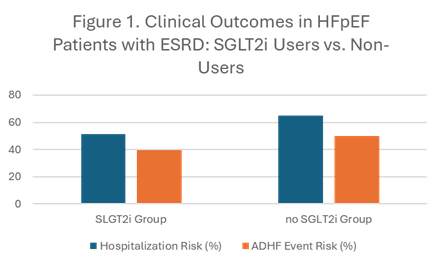
Results The study cohort included 7,238 patients (n = 3,619 per group; mean age 65.3 ± 11.0 years; 40.9% female; 47.3% White). In time-to-event analysis, the SGLT2i group had reduced risk of all-cause mortality (HR=0.49, 95%CI 0.43-0.55, p<0.001) and ADHF events (HR=0.72, 95%CI 0.67-0.77, p < 0.001). At 18 months SGLT2i group had lower rates of all-cause mortality (11.8% vs. 24.4%; RD -12.6%, p < 0.001), ADHF events (39.8% vs. 50.1%; RD -10.4%, p < 0.001) [Figure 1], hospitalizations (51.3% vs. 65.0%; RD -13.8%, p < 0.001) [Figure 1], and at least one ED visit (35.9% vs. 40.6%; RD -4.7%; p < 0.001).
Conclusion In this retrospective propensity-matched analysis, SGLT2i use in HFpEF with ESRD was associated with reduced mortality, ADHF, hospitalizations, and ED visits. Further investigation is needed to clarify mechanisms and guide clinical recommendations.
Evenhuis, Bernard
(
Emory University School of Medicine
, Atlanta , Georgia , United States )
Weiss, Allison
(
Emory University School of Medicine
, Atlanta , Georgia , United States )
Rim, Austin
(
Emory University School of Medicine
, Atlanta , Georgia , United States )
Ahmed, Taha
(
Emory University School of Medicine
, Atlanta , Georgia , United States )
Kaelber, David
(
Case Western Reserve University
, Shaker Heights , Ohio , United States )
Mehta, Puja
(
EMORY UNIVERSITY
, Atlanta , Georgia , United States )
Author Disclosures:
Bernard Evenhuis:DO NOT have relevant financial relationships
| Allison Weiss:No Answer
| Austin Rim:DO NOT have relevant financial relationships
| Taha Ahmed:No Answer
| David Kaelber:No Answer
| Puja Mehta:DO NOT have relevant financial relationships