
Obstructive Sleep Apnea Positively Correlated with hs-CRP and Not With Other Key Inflammatory Markers
Abstract Body: Intro: Obstructive sleep apnea (OSA), classified by apnea-hypopnea index (AHI) of 3% or 4% desaturation, has been associated with elevated hs-CRP levels, but little is known about the association of OSA with other oxidative inflammatory biomarkers. In addition to hs-CRP, lipoprotein-associated phospholipase A2 (Lp-PLA2), myeloperoxidase (MPO), and F2-isoprostane normalized to creatinine were observed to determine the effect of OSA on vascular-specific inflammation, neutrophil activation, and reoxygenation injuries.
Hypothesis: We hypothesize that patients with higher AHI sleep apnea scores will exhibit significantly elevated levels of certain inflammatory biomarkers compared to patients with lower AHI scores due to the contributory role of sleep apnea in systemic inflammation.
Methods: This correlational biomarker analysis used a non-randomized, observational retrospective cohort study design. Eligible adult patients had a diagnostic overnight polysomnography and laboratory testing for inflammatory biomarkers performed within one year. Both linear OLS regression and M-estimator robust regression was calculated to account for outliers.
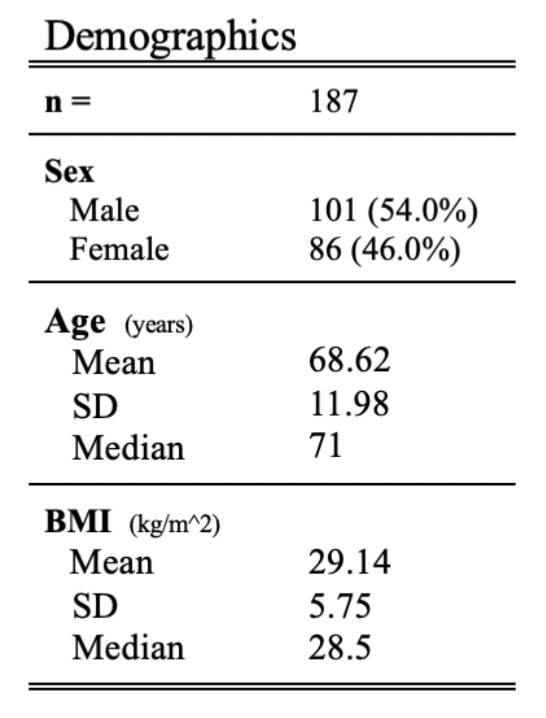
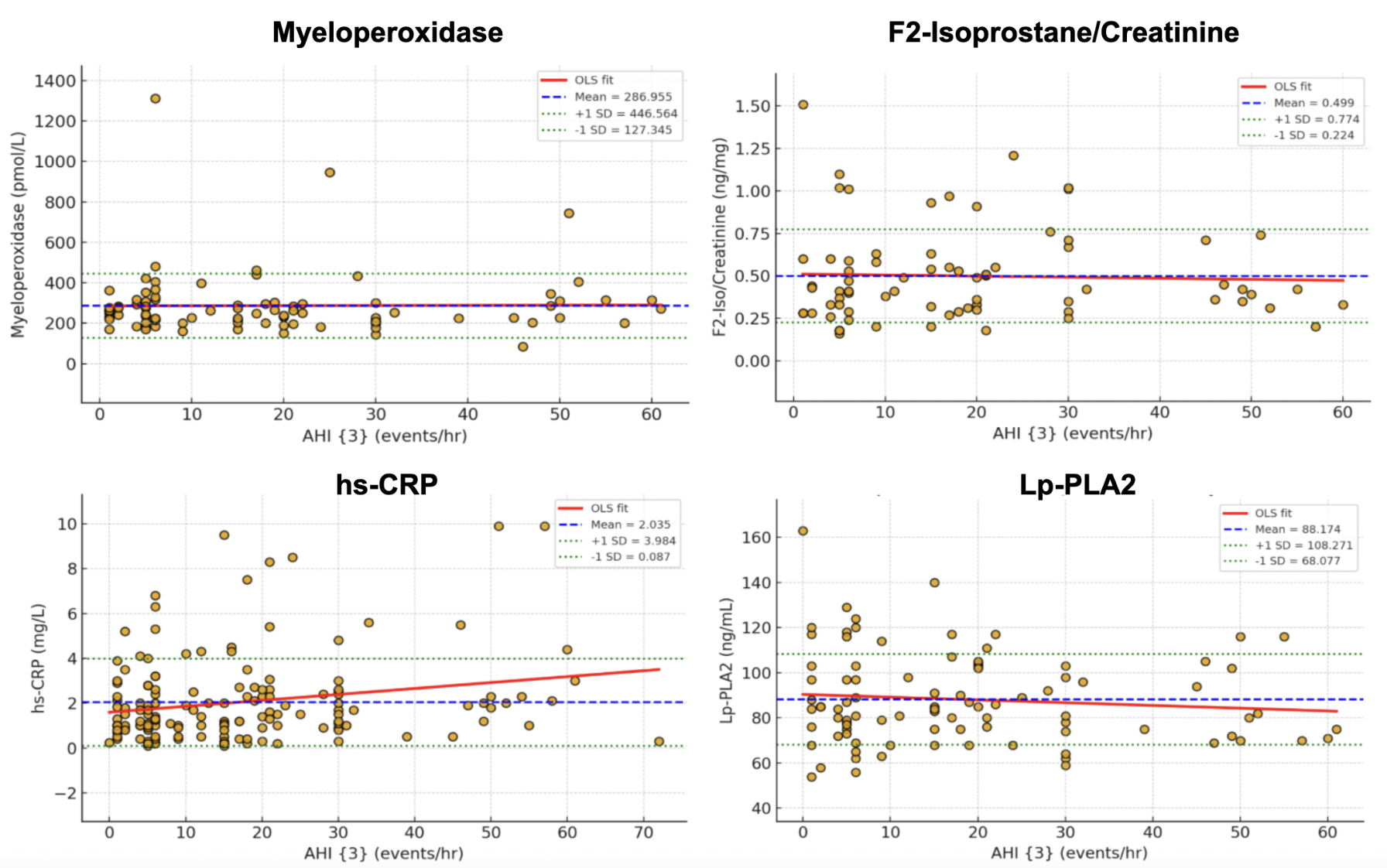
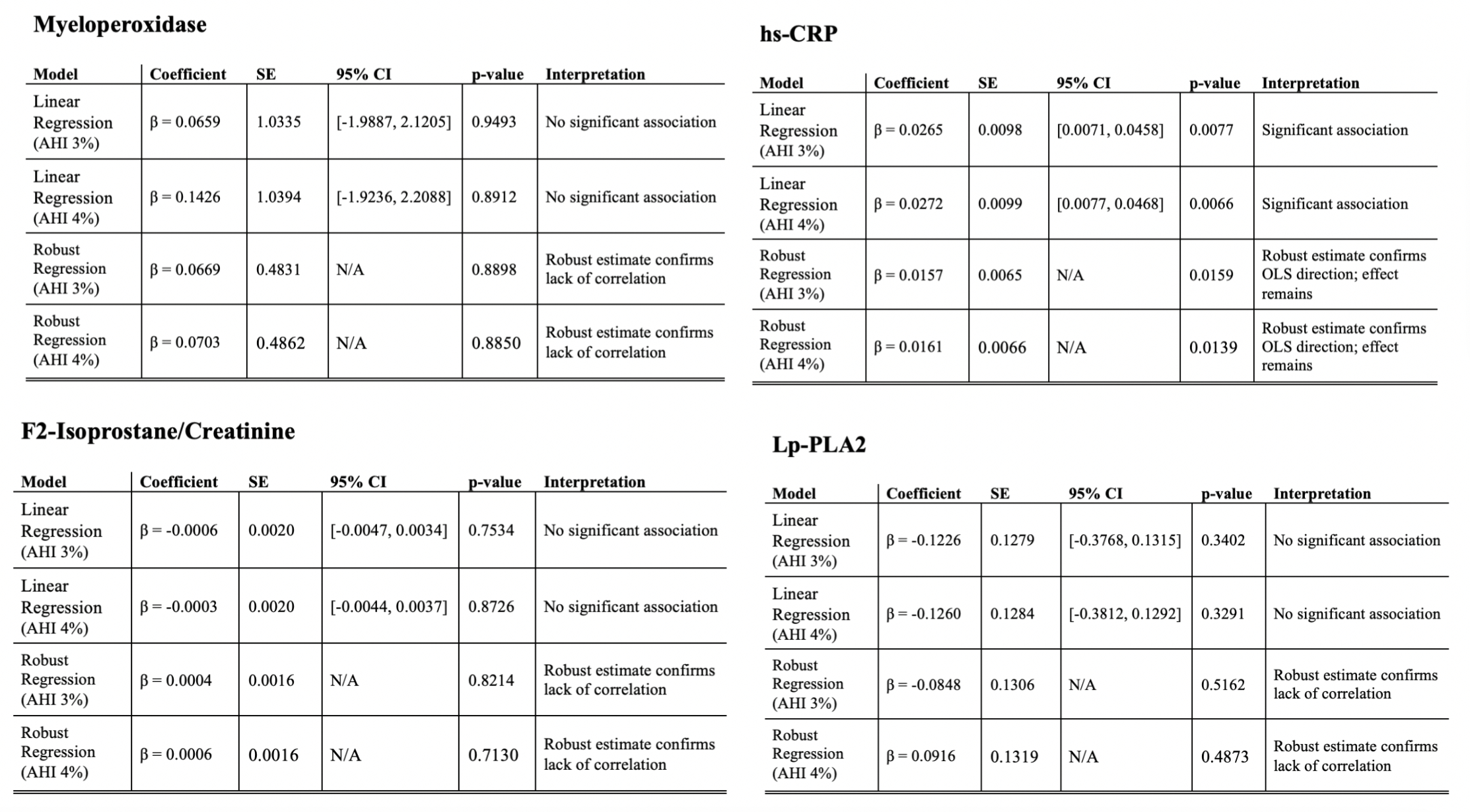
Results: This study observed 187 patients (Figure 1). No statistically significant correlation was found between AHI 3% or 4% and myeloperoxidase, F2-isoprostane/creatinine, or Lp-PLA2 levels (p > 0.05). A statistically significant positive correlation was found between AHI 3% and 4% and hs-CRP levels (p < 0.05) with coefficients of 0.0265 and 0.0272 respectively (Figures 2 and 3). The robust regression confirmed the results of positive correlation between AHI 3% and 4% and hs-CRP, while maintaining no significant correlation between AHI and other inflammatory biomarkers.
Conclusions: The findings of this study corroborate existing literature associating OSA with elevated levels of hs-CRP. While other biomarkers were hypothesized to reflect oxidative stress and vascular injury, the lack of significant correlation indicates a discrepancy in hypothetical and practical inflammatory stress. The high sensitivity and low specificity of hs-CRP make it an excellent indicator of early-stage OSA disease. Severe OSA may be required to affect more specific markers, or its effect on these markers may be masked by other, more potent factors. We conclude that while a theoretical link may exist between OSA and other inflammatory markers, hs-CRP remains the best indicator of early, systemic inflammation related to OSA.
Miller, Jered
(
Lake Country Medical Group
, Eatonton , Georgia , United States )
Edge, Michael
(
Lake Country Medical Group
, Eatonton , Georgia , United States )
Dzin, Tara
(
Lake Country Medical Group
, Eatonton , Georgia , United States )
Patel, Dhruv
(
Lake Country Medical Group
, Eatonton , Georgia , United States )
Miller, Samuel
(
Rush Medical College
, Chicago , Illinois , United States )
Chronos, Nicolas
(
Lake Country Medical Group
, Eatonton , Georgia , United States )