Speech-Based Smartphone App Improves Adherence to Remote Monitoring in Rural Heart Failure Patients
Abstract Body (Do not enter title and authors here): Background: Heart failure is a major driver of hospitalizations and readmissions in older adults. Remote patient monitoring (RPM), including tracking blood pressure, weight, heart rate, and symptoms through questionnaires and care coordination, facilitates early detection of heart failure decompensation. However, patient engagement with these tools remains limited, particularly in rural settings. The Cordio HearO app, approved in the EU and under clinical evaluation in the US, uses daily voice recordings to detect early fluid retention through speech analysis, directing clinicians to remotely monitor heart failure patients at risk for hospitalization due to impending decompensation, while also supporting ongoing patient engagement.
Research Question: How does adherence and usability differ between Cordio HearO and standard RPM in rural heart failure patients?
Methods: Adherence was evaluated in a single center cohort of HF patients using Cordio HearO (N=21) and a control group using standard RPM monitoring (N=96). Adherence was defined as the percentage of days with submitted vital signs at 91 and 182 days. Welch’s t-tests were used to account for unequal sample sizes, and 95% confidence intervals (CIs) were calculated. Usability was assessed in a separate cohort (Cordio: N=11, Control: N=16) using a 5-point Likert scale (1 = extremely difficult, 5 = extremely easy). Group differences were analyzed using an independent t-test assuming unequal variances.
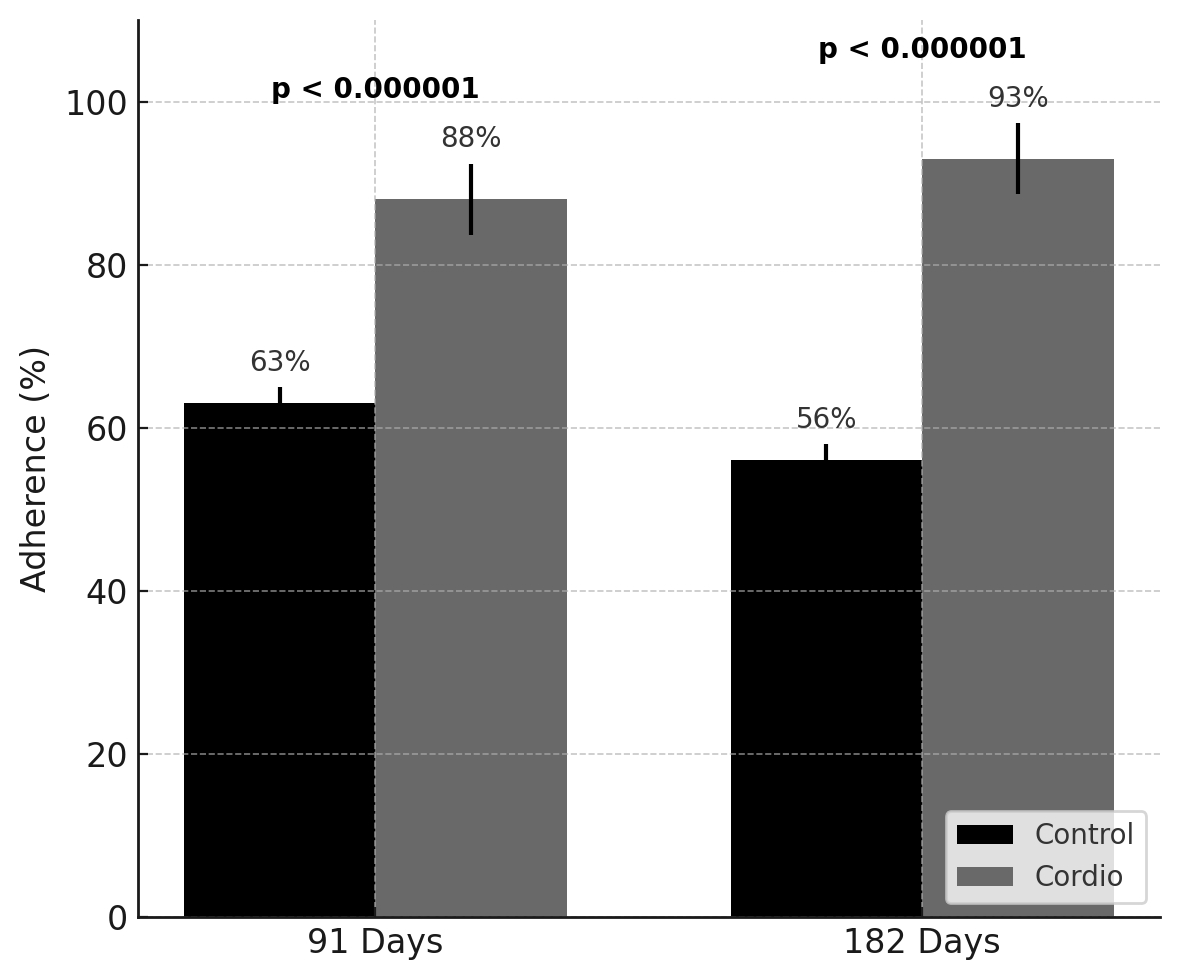
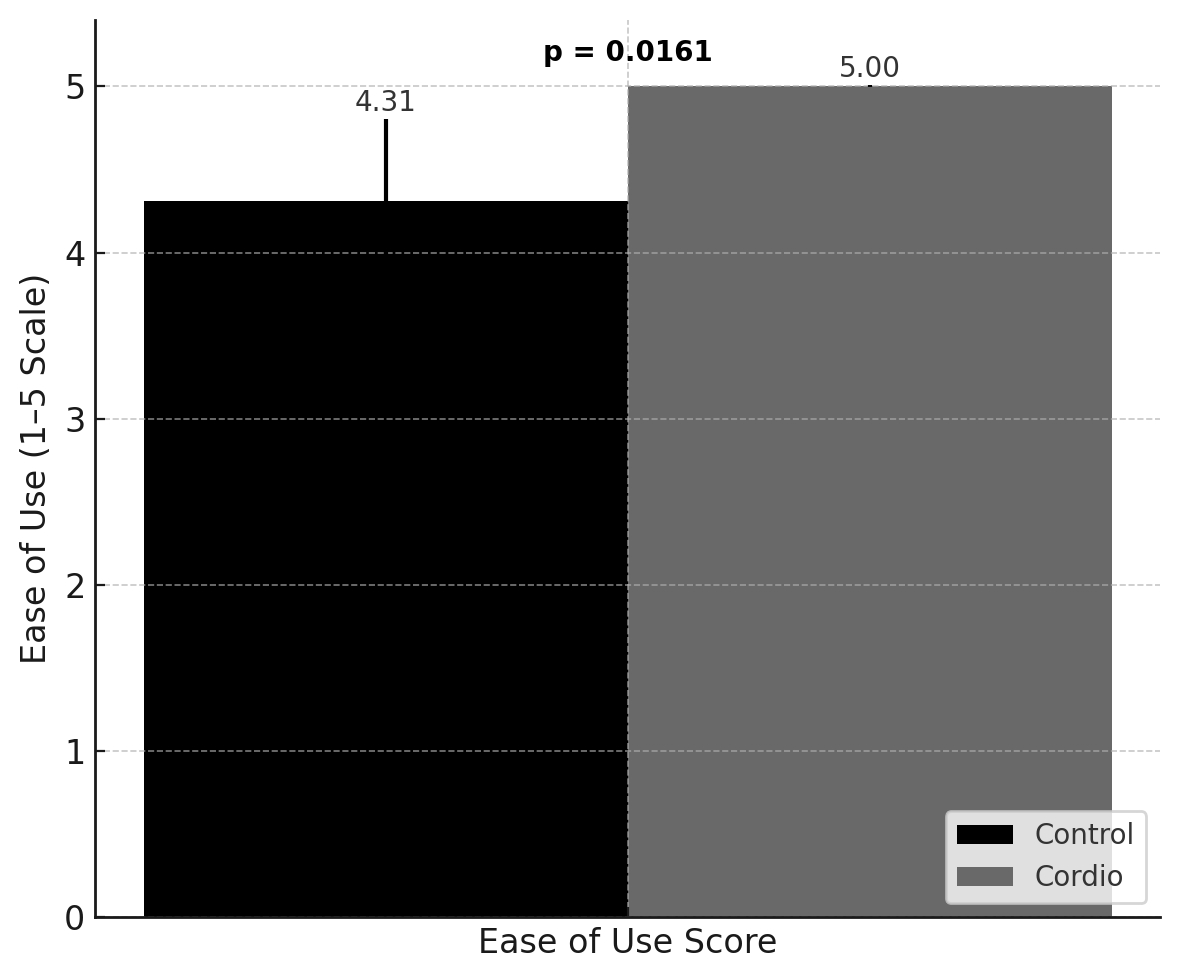
Results: At 91 days, Cordio users had a mean adherence of 88% (95% CI: 83.6%–92.4%), significantly higher than controls at 63% (95% CI: 61.0%–65.0%) (t = 10.17, p < 0.000001). At 182 days, adherence further improved among Cordio users to 93% (95% CI: 89.5%–96.5%), while adherence declined in the control group to 56% (95% CI: 53.9%–58.1%) (t = 15.05, p < 0.000001). Perceived ease-of-use scores were also higher in the Cordio group (mean = 5.00, SD = 0.00) compared to controls (mean = 4.31, SD = 1.01), with all Cordio users rating the system as “extremely easy” (t(25) = -2.71, p = 0.0161).
Conclusion: Preliminary analysis of the Cordio HearO app demonstrated significantly higher adherence and usability among heart failure patients compared to traditional RPM approaches. These findings support the utility of speech-based digital tools to enhance long-term engagement and remote care delivery, particularly in rural settings where daily monitoring is key to reducing hospitalizations and improving outcomes.
Miller, Samuel
( Rush Medical College
, Chicago
, Illinois
, United States
)
Miller, Jered
( Cardiology Care Clinic
, Eatonton
, Georgia
, United States
)
Haviv, Ronit
( Cordio Medical
, Or-Yehuda
, Israel
)
Elpaz Mezan, Moran
( Cordio Medical
, Or-Yehuda
, Israel
)
Abraham, William
( Ohio State University
, Powell
, Ohio
, United States
)
Chronos, Nicolas
( Cardiology Care Clinic
, Eatonton
, Georgia
, United States
)
Author Disclosures:
Samuel Miller:DO NOT have relevant financial relationships
| Jered Miller:DO NOT have relevant financial relationships
| Ronit Haviv:DO have relevant financial relationships
;
Employee:Cordio medical:Active (exists now)
| Moran Elpaz Mezan:No Answer
| William Abraham:DO have relevant financial relationships
;
Advisor:Abbott:Active (exists now)
; Executive Role:scPharmaceuticals:Active (exists now)
; Executive Role:V-Wave:Active (exists now)
; Advisor:Zoll Respicardia:Active (exists now)
; Advisor:WhiteSwell:Active (exists now)
; Advisor:Vectorious Medical Technologies:Active (exists now)
; Advisor:Sensible Medical:Active (exists now)
; Speaker:Impulse Dynamics:Past (completed)
; Advisor:Innoventric:Active (exists now)
; Advisor:Cordio Medical:Active (exists now)
; Advisor:AquaPass:Active (exists now)
| Nicolas Chronos:No Answer