Cumulative Blood Pressure Burden Above Optimal Level and Risk of Cardiovascular Disease in Patients with Diabetes
Abstract Body: Introduction: The 2025 AHA/ACC Blood Pressure (BP) Guidelines recommend a systolic BP (SBP) goal of <130 mm Hg, with encouragement to <120 mm Hg, and a diastolic BP (DBP) goal of <80 mm Hg for adults with diabetes and hypertension. We hypothesized that greater cumulative exposure to BP above optimal level over time was associated with higher risk of cardiovascular disease (CVD) events, including atherosclerotic CVD (ASCVD) and heart failure (HF), in adults with diabetes, but data are scarce.
Methods: Among adults aged 30-79 years who participated in the 2009-2013 Korean National Health Insurance general health screening, we included those who had diabetes for ≥5 years, ≥3 BP-measuring visits over the past 5 years, and no prior CVD. For each participant, cumulative BP burden was calculated as the area under the interpolated BP curve above optimal level (SBP ≥120 mm Hg; DBP ≥80 mm Hg), annualized by dividing by the total exposure years, and analyzed in quintiles or as a continuous variable using linear or restricted cubic spline terms. Outcomes were incident total CVD (composite of ASCVD or HF), ASCVD (myocardial infarction, fatal coronary heart disease, or fatal/nonfatal stroke) and HF.
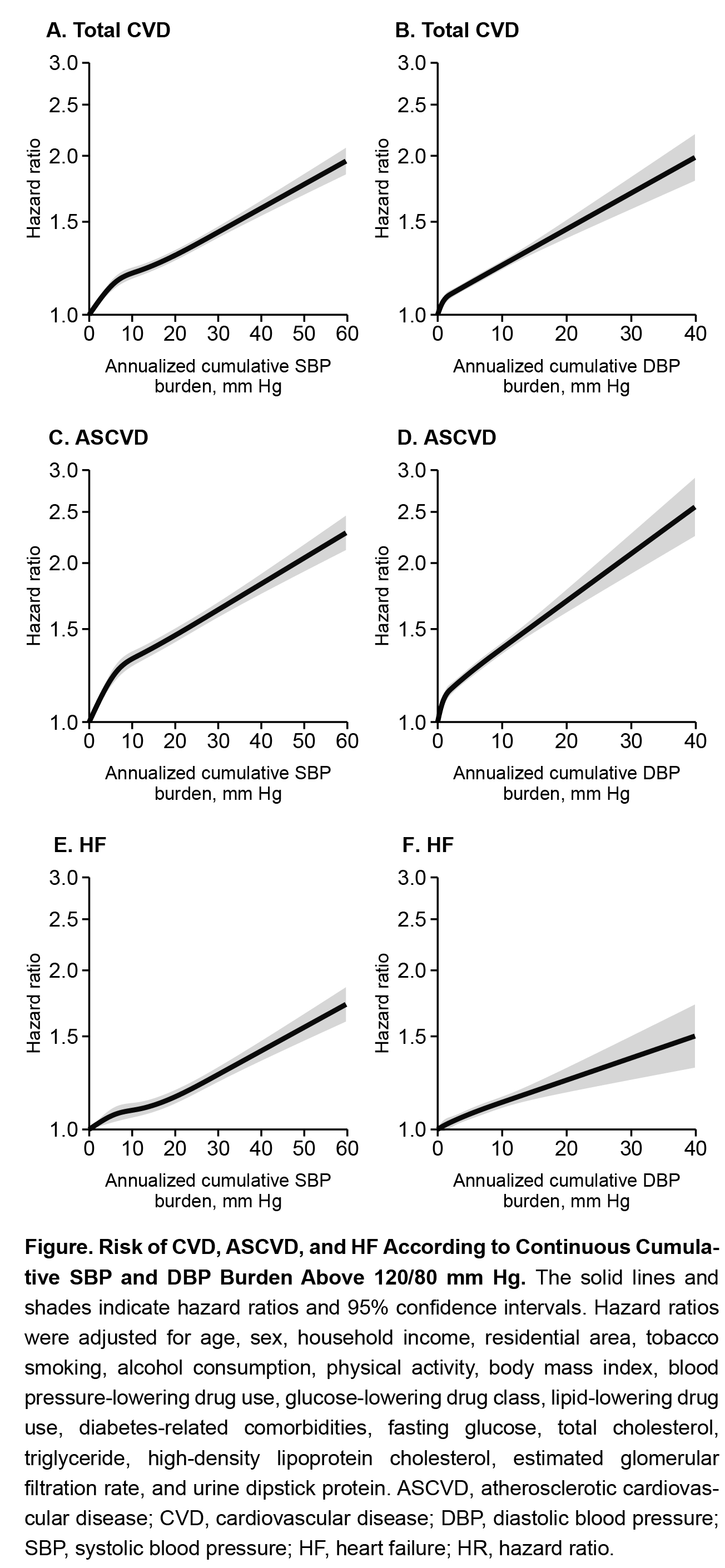
Results: Among the 485,642 participants included, the mean±SD age was 60.3±9.7 years, and 40.0% were women. Over a median follow-up of 12.6 years, 90,350 CVD events, 51,252 ASCVD events, and 50,958 HF events occurred. Cumulative incidence and multivariable-adjusted HRs of all outcomes increased monotonically toward higher quintiles of cumulative SBP and DBP burden. Each 10 mm Hg higher SBP above 120 mm Hg and 5 mm Hg higher DBP above 80 mm Hg, respectively, when sustained over time, was associated with 11% (HR, 1.11; 95% CI, 1.10–1.12) and 10% (HR, 1.10; 95% CI, 1.09–1.11) higher hazard of total CVD; 18% (HR, 1.18; 95% CI, 1.16-1.19) and 15% (HR, 1.15; 95% CI, 1.14-1.16) higher hazard of ASCVD; and 11% (HR, 1.11; 95% CI, 1.10-1.12) and 6% (HR, 1.06; 95% CI, 1.05-1.07) higher hazard of HF in a dose-dependent manner (Figure). Similar findings were observed for cumulative SBP burden above 130 mm Hg and cumulative DBP burden above 70 mm Hg.
Conclusions: In patients with diabetes, a higher cumulative BP burden above optimal level was associated with an increased risk of CVD, ASCVD, and HF, highlighting the importance of sustained maintenance of optimal blood pressure below 120/80 mm Hg for the primary prevention of CVD in diabetes.
Son, Dasom
(
Yonsei Univ College of Medicine
, Seoul , Korea (the Republic of) )
Ha, Kyoung Hwa
(
Yonsei Univ College of Medicine
, Seoul , Korea (the Republic of) )
Lee, Hyeok-hee
(
BIDMC
, Boston , Massachusetts , United States )
Kim, Hyeon Chang
(
Yonsei Univ College of Medicine
, Seoul , Korea (the Republic of) )
Lee, Minyoung
(
Yonsei Univ College of Medicine
, Seoul , Korea (the Republic of) )
Lee, Hokyou
(
Yonsei Univ College of Medicine
, Seoul , Korea (the Republic of) )