Association of Daily Step Count with All-Cause Mortality Among Older Adults with Hypertension and Resistant Hypertension
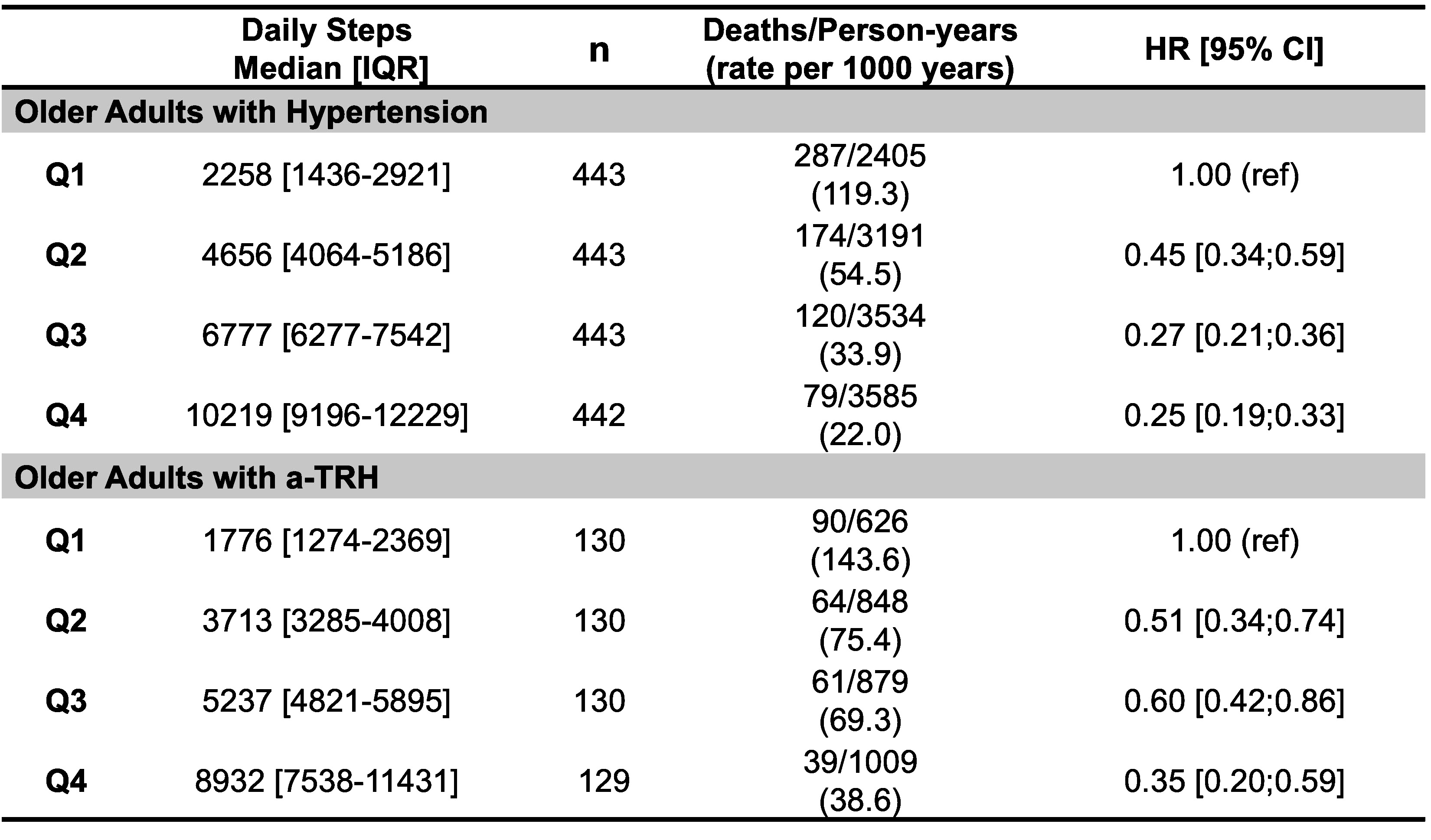
Abstract Body: Introduction: Physical activity, particularly daily step count, is associated with all-cause mortality in older adults. However, evidence is limited among those with hypertension and apparent treatment-resistant hypertension (a-TRH)–defined as uncontrolled blood pressure despite taking ≥3 antihypertensive medications–who are at high risk for cardiovascular and all-cause death. We hypothesized that higher daily step counts would be associated with lower all-cause mortality in both hypertensive and a-TRH populations. Methods: We analyzed data from NHANES 2005–2006 and 2011–2014, linked to mortality through 2019. The sample included 2,290 older adults aged ≥65 years with valid accelerometer data for daily step calculation (a-TRH = 519; hypertension = 1,771). Daily steps were categorized into quartiles within each group. Survey-weighted Cox proportional hazards models were used to determine associations between daily steps and all-cause mortality, adjusting for demographics, lifestyle factors, and comorbidities, and stratified by hypertension status. Results: Median daily steps were 5,749 [3,470–8,160] in the hypertension group and 4,432 [2,771–6,796] in the a-TRH group. Participants were followed for 7.2 ± 3.5 years and 6.5 ± 3.3 years in the hypertension and a-TRH groups, respectively. During follow-up, 914 deaths occurred (254 [28%] among a-TRH and 660 [72%] among hypertensive participants). Among older adults with hypertension, hazard ratios (HRs) for the second, third, and fourth quartiles were 0.45, 0.27, and 0.25, respectively, compared with the lowest quartile. Among those with a-TRH, HRs across quartiles were 0.51, 0.60, and 0.35 (Table), compared with the lowest quartile. Conclusions: Higher daily step counts were associated with lower all-cause mortality risk among older adults with hypertension and a-TRH. The greatest incremental benefit was observed between the first and second quartiles; compared with the lowest quartile taking about 2,000 daily steps, mortality risk was roughly 50% lower at about 4,000 daily steps. Lower risk continued with higher quartiles, although less pronounced; compared with the lowest quartile, mortality risk was 65–75% lower in the highest quartile taking about 9,000–10,000 daily steps. Among older adults with hypertension–even those with resistant hypertension–increasing daily steps may be a viable intervention for longevity in this high-risk population.
Parvizi, Pardis
(
University of Massachusetts Amherst
, Amherst , Massachusetts , United States )
Paluch, Amanda
(
University of Massachusetts Amherst
, Amherst , Massachusetts , United States )
Lee, Duck-chul
(
University of Pittsburgh
, Pittsburgh , Pennsylvania , United States )