Stress, Forgetfulness, and Hypertension: The Mind-Heart-Body Link in Refugee Health
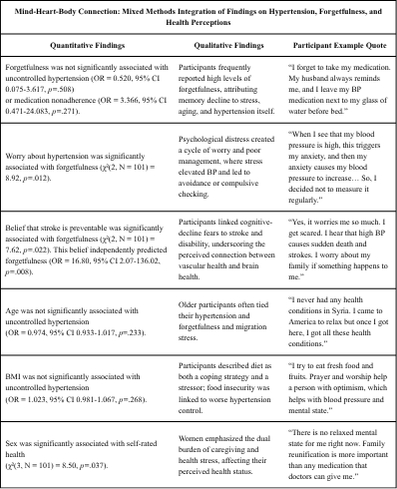
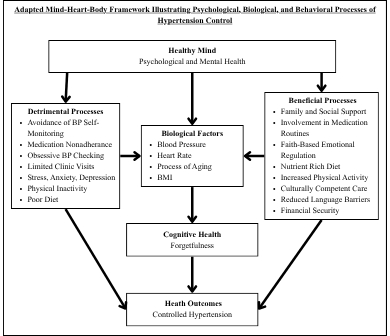
Abstract Body: Introduction: The world is witnessing the highest number of refugees ever recorded. Poor blood pressure (BP) control is prevalent among refugees, who also face elevated stress and poor mental health. Psychosocial stressors can exacerbate hypertension and cognitive decline (forgetfulness), yet these connections are not explored in refugees. We sought to determine whether subjective cognitive decline and psychosocial stressors were associated with poor BP control in refugees. Hypothesis: We hypothesized that subjective cognitive decline would be associated with uncontrolled BP and linked to psychological stressors. Methods: A convergent mixed-methods study among hypertensive Syrian and Iraqi refugees aged ≥21 years. Recruitment occurred from 4/2021 to 4/2022 through a federally qualified health center serving a refugee-majority neighborhood in San Diego, CA. Primary exposure was self-reported forgetfulness; secondary exposures were worry about BP, belief that stroke could be prevented, and medication adherence. Primary outcome was hypertension control (uncontrolled BP ≥130/80mmHg) from averaged home readings. Pearson chi-square and binary logistic regression were used to examine forgetfulness, hypertension control, and related health beliefs adjusting for age, sex, and BMI. Interviews were thematically analyzed using an adapted mind-heart-body framework. Results: Of 101 hypertensive Syrian and Iraqi refugees (mean age=64±9.7; 51.5% male; 79.2% Iraqi), 59.4% had uncontrolled BP and 81.2% were forgetful. Forgetfulness correlated with greater worry about BP (χ2=8.92, p=.012) and lower belief that stroke is preventable (χ2=7.62, p=.022). Belief that controlling BP can prevent stroke predicted forgetfulness (OR 16.80, CI 2.07-136.02, p=.008). Participants reporting being forgetful had higher odds of uncontrolled BP (OR 0.520, CI 0.075-3.617, p=.508), though not significant. Quantitative and qualitative findings, integrated through the mind-heart-body framework, showed that stress, worry, and cognitive perceptions were strong influences of BP control. Conclusions: Subjective cognitive decline among hypertensive refugees was prevalent and associated with worry about BP and stroke prevention, but not associated with uncontrolled BP. Psychosocial stress was perceived by refugees as related to BP control. Culturally tailored, mind-heart-body-integrated interventions for refugee care are needed to address these interconnected pathways to achieve BP control for all.
Khayamian, Ariana
(
University of California, San Diego
, La Jolla , California , United States )
Tamamian, Carine
(
University of California, San Diego
, La Jolla , California , United States )
Al-rousan, Tala
(
University of California, San Diego
, La Jolla , California , United States )