Predicting Glycemic Responses to Dietary Intake Among Non-diabetic Adults: an Evaluation of Modeling Approaches
Abstract Body: Objective: To determine the features and models that improve the prediction of postprandial glucose response (PPGR) using continuous glucose monitoring (CGM) data.
Method: We analyzed data from 860 Framingham Heart Study Third-Generation cohort participants without diabetes (with average age 60 years old, 59.8% women) who attended their fourth exam (2022-2025), wore a Dexcom G6 Pro CGM, and completed valid Automated Self-Administered 24 dietary recalls. A total of 3,402 valid meals, without eating occasions 2 hours before or after, were matched to CGM-derived PPGRs within a 2-hour postprandial window. We applied multiple predictive models, including Lasso, Linear Mixed Effect Model, Mixed Effect Random Forest (MERF), GPBoost, Generalized Additive Mixed Models (GAMM) and Supervised Autoencoder, to relate meal composition to two PPGR outcomes: incremental area under the curve (iAUC120, subtracting negative AUC from positive AUC) and relative glucose excursion. The baseline model included sex, age, BMI, HbA1c, and venous blood glucose, whereas fully adjusted models incorporated additional covariates including with CGM features, meal composition and context (for the specific meal and prior meals).
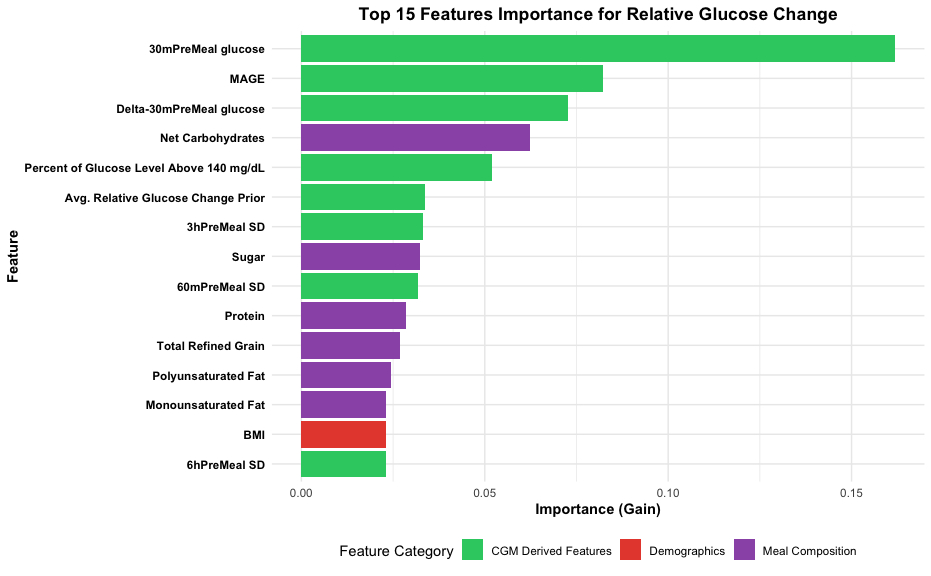
Results: In fully adjusted models, the addition of CGM-derived variables (e.g. mean amplitude of glycemic excursions [MAGE], mean glucose over the 30 minutes prior to the meal [30mPreMeal glucose], and the change between 30mPreMeal glucose and glucose at meal time) and detailed dietary information (e.g., net carbohydrates, sugar and protein) significantly improved prediction over models using only demographic and clinical factors by at least 30% increase in R2. Based on the comparison of models’ results using Wilcoxon signed-rank test, we observed the highest model R2 and strongest Pearson’s r (observed vs. predicted) with GPBoost models (iAUC120 R2=57.91%, r=0.76; relative peak glucose excursion R2=47.57%, r=0.69). The Figure shows the top dietary predictors identified through feature importance analyses, which may inform actionable strategies to modulate glycemic response.
Conclusion: Our integrative approach suggests that combining CGM-derived dynamics and dietary composition substantially enhances prediction of PPGR in real-world conditions. Optimizing such models could advance the use of CGM in the prevention and management of type 2 diabetes and related cardiometabolic disorders.
Yao, Suheng
(
Boston University
, Boston , Massachusetts , United States )
Srivastava, Vedika
(
Boston University
, Boston , Massachusetts , United States )
Bakhshi, Bahar
(
Boston University School of Medicine
, Dorchester , Massachusetts , United States )
Sultana, Naznin
(
Boston University
, Boston , Massachusetts , United States )
Lin, Honghuang
(
UMass Chan Medical School
, Worcester , Massachusetts , United States )
Cheney, Michael
(
Boston Medical Center
, Jamaica Plain , Massachusetts , United States )
Mckeown, Nicola
(
Boston University
, Boston , Massachusetts , United States )
Spartano, Nicole
(
Boston University School of Medicine
, Dorchester , Massachusetts , United States )
Walker, Maura
(
Boston University School of Medicine
, Dorchester , Massachusetts , United States )
Cheng, Huimin
(
Boston University
, Boston , Massachusetts , United States )