Binge Eating Symptoms are Prospectively Associated with Cardiovascular Disease Risk Factors in Early Adolescence: the Adolescent Brain Cognitive Development (ABCD) Study
Abstract Body: Introduction: Binge eating symptoms, defined as consuming an atypically large amount of food with associated loss of control, are common in adolescents and may represent an early psychosocial risk factor for adverse cardiovascular and metabolic outcomes. Binge eating has been associated with cardiovascular disease (CVD) risk factors such as diabetes, hypertension, obesity, and dyslipidemia, but the long-term cardiovascular effects among adolescents remain unclear. In the present study, we examined the prospective associations between binge eating symptoms and CVD risk factors in early adolescents.
Hypothesis: We hypothesized that binge eating symptoms would be prospectively associated with greater CVD risk factors among adolescents.
Methods: This prospective cohort study included data from 7,577 adolescents from the Adolescent Brain Cognitive Development (ABCD) Study collected at Year 2 (2018-2020, ages 11-12) and Year 4 (2020-2022, ages 13-14) across 21 diverse sites in the US. Adjusted multivariable linear regression models estimated the prospective associations between Year 2 binge eating symptoms and Year 4 cardiovascular health outcomes (body mass index [BMI] percentile, waist circumference percentile, systolic blood pressure percentile, diastolic blood pressure percentile, hemoglobin A1c [HbA1c], total cholesterol, high-density lipoprotein [HDL] cholesterol, and non-HDL cholesterol). Presence of binge eating symptoms was assessed via parent report using the Kiddie Schedule for Affective Disorders and Schizophrenia (KSADS-5).
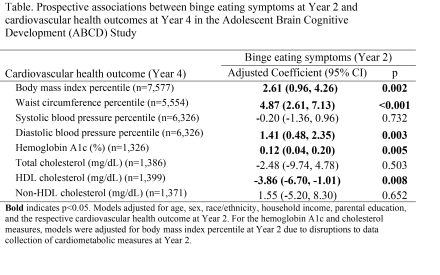
Results: In our sample, 6.03% of adolescents experienced binge eating symptoms. After covariate adjustment, binge eating symptoms were prospectively associated with higher BMI percentile (adjusted coefficient [B] 2.61; 95% confidence interval [CI] 0.96, 4.26; p=0.002), higher waist circumference percentile (B 4.87; 95% CI 2.61, 7.13; p<0.001), higher diastolic blood pressure percentile (B 1.41; 95% CI 0.48, 2.35; p=0.003), higher HbA1c (B 0.12; 95% CI 0.04, 0.20; p=0.005), and lower HDL cholesterol (B -3.86; 95% CI -6.70, -1.01; p=0.008) two years later.
Conclusion: Binge eating symptoms were associated with greater CVD risk factors, highlighting the importance of early identification and intervention. Clinicians caring for early adolescents should consider screening for binge eating symptoms and initiate conversations and interventions to promote cardiovascular health.
Nguyen, Nathan
(
UCSF School of Medicine
, San Francisco , California , United States )
Helmer, Christiane
(
UCSF
, San Francisco , California , United States )
Nagata, Jason
(
UCSF
, San Francisco , California , United States )